
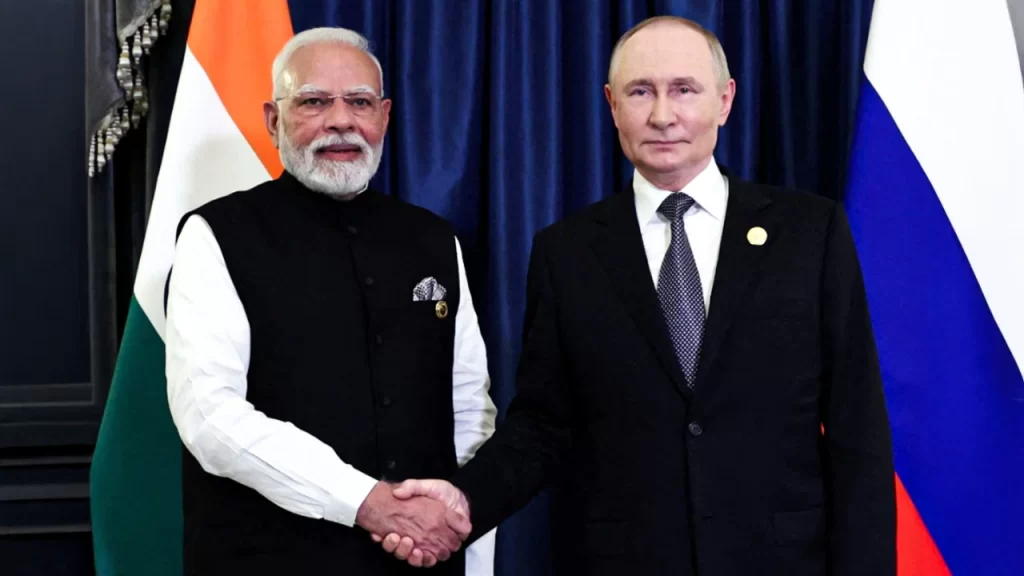
As Russian President Vladimir Putin arrives in New Delhi for his two-day official visit, the national capital has been placed under an intensive security shield. Authorities have rolled out a multi-layered protection system — consisting of commandos, snipers, drones, counter-drone units, and advanced AI surveillance — marking one of the most comprehensive security arrangements India has implemented for a visiting foreign leader.
Enhanced Multi-Layer Security Deployment
The elaborate five-layer framework integrates Russian security personnel with India’s elite agencies. The innermost layer is operated by the Russian Presidential Security Service, supported closely by India’s Special Protection Group (SPG) and National Security Guard (NSG) commandos. Surrounding layers comprise Delhi Police units, anti-terror squads, quick-reaction teams, and intelligence operatives stationed strategically across the capital.
Security officials report that Russian advance teams have been coordinating with Indian agencies for days, conducting route familiarization, technical inspections, and risk assessments. Multiple locations where the President is expected to visit have been sanitized and secured with round-the-clock monitoring.
Snipers, Drones, and Aerial Shielding
To enhance real-time situational awareness, drone surveillance has been deployed across high-sensitivity corridors and meeting venues. These aerial units continuously stream live visuals to a central command center, allowing authorities to track movement patterns and potential threats. Complementing this coverage are sniper teams positioned at elevated vantage points along identified routes and rooftops.
In anticipation of evolving drone-related risks, counter-drone systems and jamming devices have been installed to neutralize any unauthorized aerial activity. Officials emphasize that no unmanned aerial vehicle will be permitted in the vicinity during the President’s movement.
AI Surveillance and Tech-Driven Monitoring
Advanced facial-recognition cameras and AI-based behaviour-monitoring tools are being used extensively to identify unusual patterns or suspicious movement in crowded areas. Integrated communication systems allow quick transmission of alerts to multiple agencies, ensuring swift response during emergencies.
Roads along the delegation’s route are being closely monitored through an expanded CCTV network, with intelligence teams analyzing data feeds in real time. Vehicle checks, barricades, and layered access control have been increased across restricted zones.
Public Movement and Traffic Management
The heightened security measures are expected to cause disruptions in traffic flow across several parts of Delhi. Diversions have been planned around key routes to ensure smooth movement of the presidential motorcade. Authorities have urged commuters to plan travel accordingly and follow official advisories.
Security personnel have been instructed to maintain high alert throughout the visit, with additional patrolling across public spaces, hotels, and diplomatic zones.
Significance of the Visit
The extensive security coverage reflects the strategic importance of President Putin’s visit, which includes the India-Russia Annual Summit and discussions on defence cooperation, trade, energy, and geopolitical developments. At a time of global uncertainties, the visit is viewed as a critical opportunity for both nations to strengthen their long-standing partnership.
Conclusion
With commandos, snipers, drones, artificial intelligence, and sophisticated surveillance systems forming a tight defensive perimeter, Delhi has effectively transformed into a high-security zone. The five-layer security ring not only underscores the gravity of Putin’s visit but also highlights the evolving nature of VIP protection in an increasingly complex global environment.

