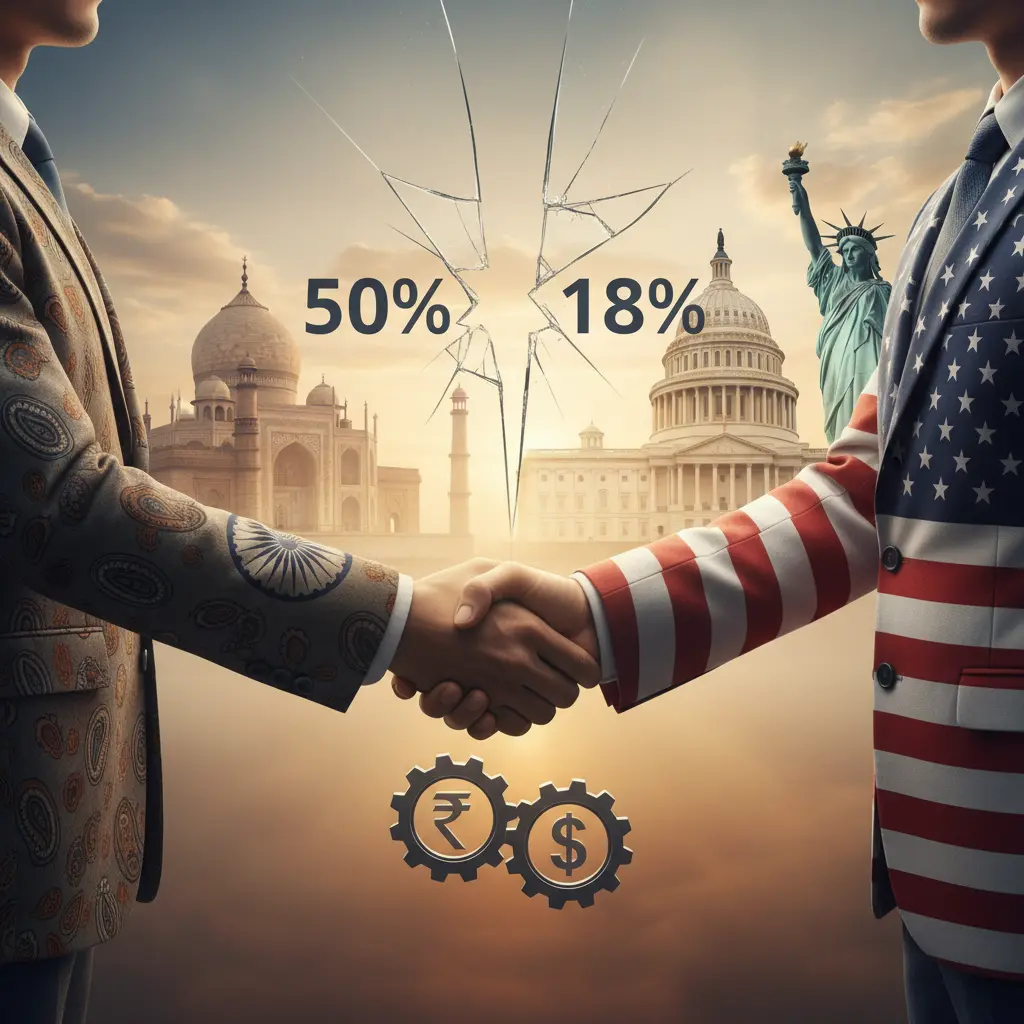
It took one phone call to undo months of tension. On a Monday that started like any other, Prime Minister Narendra Modi and President Donald Trump got on the line together, and by the end of the conversation, the United States had agreed to slash tariffs on Indian goods from a punishing 50 percent all the way down to 18 percent. For an Indian economy that had been bracing for the fallout of some of the steepest US tariffs anywhere in Asia, the announcement landed like a genuine reprieve.
How We Got Here
To understand why this matters, it helps to remember how steep the penalty had become. Washington had layered a 25 percent “reciprocal” tariff on Indian imports on top of another 25 percent punitive duty tied specifically to India’s continued purchases of discounted Russian crude oil. Together, those two measures pushed the effective tariff rate on Indian goods to 50 percent — among the harshest treatment the US has handed any major trading partner in recent memory.
That penalty tariff was Washington’s way of pressuring New Delhi to fall in line with broader Western efforts to isolate Moscow economically. India, however, had leaned hard into cheap Russian oil since the war in Ukraine began, arguing it was simply securing affordable energy for its economy. That stance put New Delhi on a collision course with Washington, and the resulting tariff wall strained what had otherwise been a warming relationship between the two governments.
What Changed
According to Trump, the breakthrough came down to personal rapport. In a social media post following the call, he said the reduced tariff was being applied “out of friendship and respect” for Modi, framing it as a favor extended to a close ally rather than a hard-fought negotiated concession. A White House official confirmed to Reuters that the punitive 25 percent duty tied to Russian oil purchases was being fully rescinded, effective immediately, on top of the reciprocal rate coming down to 18 percent.
In exchange, Modi is said to have committed India to sharply reducing trade barriers on American products, with some reports suggesting tariffs on select US goods could effectively drop to near zero. He also pledged that India would ramp up purchases of American energy, technology, and agricultural products, with figures floated north of $500 billion. Part of that shift reportedly includes India stepping back from Russian oil purchases and looking instead to US — and potentially Venezuelan — crude as alternatives.
Modi didn’t hold back his enthusiasm either. He said he was delighted that products made in India would now face a reduced tariff of 18 percent, and thanked Trump on behalf of India’s 1.4 billion people for the announcement. It was a sign that “when the world’s two largest democracies come together, it helps their people, and it creates opportunities for mutually beneficial cooperation,” he said.
Markets Cheered, Analysts Stayed Cautious
The reaction from investors was immediate. US-listed shares of major Indian companies jumped on the news, with IT firms and banks among the biggest gainers as traders bet on smoother trade flows ahead. For businesses on both sides that had been absorbing the cost of the trade standoff, the tariff rollback offered a clear signal that the worst of the friction may be behind them.
Still, economists and trade analysts have been careful not to overstate what’s actually been agreed. Several noted that it remains unclear whether Monday’s announcement represents a fully concluded, legally binding trade agreement or more of a tariff truce — a political understanding between two leaders that still needs to be formalized through official channels. Notably, there was no immediate statement from India’s Ministry of External Affairs confirming the details Trump laid out, leaving some ambiguity about the precise terms.
Trade watchers have also pointed out that even at 18 percent, India’s new tariff rate would bring it roughly in line with other major economies in Asia, most of which sit somewhere in the 15 to 19 percent range. In that sense, the deal doesn’t necessarily give India a special advantage — it simply removes an outlier penalty that had made Indian goods unusually expensive to import into the US.
A Relationship Back on Track
Beyond the numbers, the tone of the exchange said a lot. Trump has repeatedly described Modi as one of his closest international counterparts, and this latest call fit that pattern — heavy on warmth, light on the granular detail that usually accompanies formal trade agreements. Whether that personal chemistry translates into a durable, comprehensive bilateral trade agreement, or simply buys both sides some breathing room before the next round of negotiations, is still an open question.
For now, though, the headline numbers speak for themselves: tariffs cut from 50 percent to 18 percent, a punitive measure tied to Russian oil sanctions lifted, and two leaders publicly reaffirming a partnership that had looked shakier just weeks earlier. Whether this becomes a lasting reset in US-India trade relations or just a temporary truce will likely become clearer as both governments work out the finer print in the months ahead.