
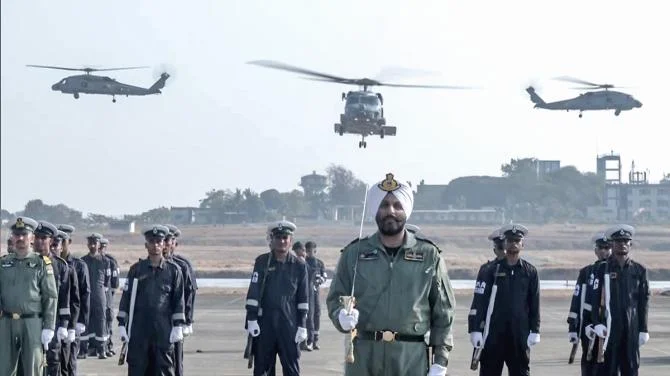
In a landmark enhancement of India’s naval combat and surveillance capabilities, the Indian Navy formally commissioned its second MH‑60R “Romeo” multirole helicopter squadron, INAS 335 “Ospreys”, at the INS Hansa naval air station in Goa on 17 December 2025. The induction marks a pivotal stride in bolstering India’s maritime security architecture, anti‑submarine warfare (ASW) readiness, and aerial reconnaissance reach along the strategically vital Western Seaboard.
The commissioning ceremony, presided over by Chief of Naval Staff Admiral Dinesh K. Tripathi, featured a traditional water cannon salute, underlining the historic significance of the event and the Squadron’s operational potential. High‑ranking naval officials and distinguished defence personnel were in attendance as the Ospreys joined the Navy’s expanding aerial fleet.
Expanding India’s Aerial Maritime Power
The newly constituted INAS 335 ‘Ospreys’ represents the second operational unit outfitted with Sikorsky MH‑60R Seahawk helicopters — advanced, multi‑mission aircraft designed for complex maritime operations. These helicopters are equipped with cutting‑edge sensors, avionics, and weapons suites suitable for:
- Anti‑Submarine Warfare (ASW)
- Anti‑Surface Warfare (ASuW)
- Maritime Surveillance and Domain Awareness
- Search and Rescue (SAR)
- Medical Evacuation (MEDEVAC) and Logistic Support
The induction of the Ospreys into INAS 335 significantly enhances the Navy’s rapid response capability across the Indian Ocean Region, a theater of increasing geopolitical competition and security challenges.
Key Operational Enhancements at a Glance
| Capability | Strategic Impact |
|---|---|
| Advanced ASW sensors | Detects and neutralizes submarine threats at greater ranges |
| Multi‑role armament (torpedoes, missiles) | Extends surface and sub‑surface combat reach |
| Maritime surveillance systems | Strengthens domain awareness and reconnaissance |
| Integrated ship‑borne deployment | Bolsters fleet versatility during joint operations |
Strategic Context: Western Naval Seaboard and Beyond
The commissioning of the INAS 335 squadron comes amid an era of dynamic maritime developments. The MH‑60R Romeo helicopters will operate from both shore bases and frontline platforms, forming a force multiplier for vessels such as aircraft carriers and destroyers. Their role in enhancing the Navy’s anti‑submarine warfare and maritime surveillance is particularly crucial given the increasing focus on securing sea lines of communication and deterring undersea threats.
Speaking at the ceremony, Admiral Tripathi emphasized that the evolving maritime environment requires heightened vigilance and advanced capabilities. Strengthening maritime security and deterrent posture, he noted, is critical to safeguarding national economic and strategic interests amid shifting security dynamics.
The new squadron follows the earlier commissioning of the first MH‑60R unit, which was inducted in March 2024 at Kochi. Together, these squadrons signify a robust expansion of the Indian Navy’s air‑sea integrated warfare capacity, aligning with long‑term modernisation goals.
Broader Defence Implications
The induction of INAS 335 ‘Ospreys’ underscores India’s strategic priorities:
- Force Modernisation: Continued integration of advanced aerial platforms into naval operations strengthens India’s status as a key maritime power.
- Maritime Domain Awareness: Enhanced detection and tracking capabilities improve situational awareness across critical sea zones.
- Operational Synergy: Multi‑mission helicopters augment conventional maritime assets, enabling coordinated responses to hybrid and asymmetric threats.
Looking Ahead
As INAS 335 readies for full operational deployment, the Indian Navy is positioned to maintain a dominant and responsive maritime posture across the Indian Ocean. With ongoing technology acquisitions and enhanced inter‑service cooperation, India’s naval aviation is poised to play an increasingly decisive role in regional security, deterrence, and humanitarian missions.
The commissioning of the Ospreys thus represents not only an expansion of equipment but a reaffirmation of India’s commitment to securing its maritime interests with cutting‑edge capability and strategic foresight.

