
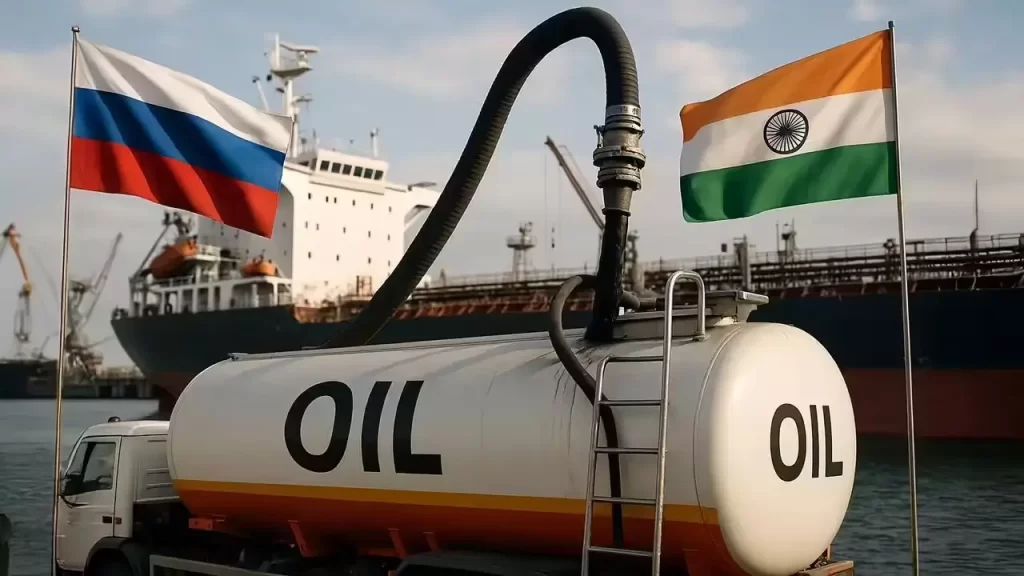
India’s major oil refiners have paused new procurement deals for crude oil from Russia following fresh U.S. sanctions imposed on the Russian energy giants Rosneft and Lukoil, triggering a dramatic shift in India’s oil-supply strategy. With New Delhi now caught between energy-security imperatives and compliance with Western sanctions, the disruption has forced Indian refiners to explore alternative supplies while Moscow vows to continue offering lower-priced high-quality crude.
The United States’ latest sanctions target Rosneft and Lukoil—the two heavyweight Russian crude-oil exporters—raising concerns about indirect restrictions on their customers and logistics partners. While the sanctions do not explicitly ban all Russian oil exports, the measures impose significant pressure on entities, shipping lines, and financial flows linked to the sanctioned companies.
In reaction, many Indian refiners have stopped placing new orders for Russian crude until there is clearer guidance on compliance. Sources report that state-run refiners such as Indian Oil Corporation (IOC) and Bharat Petroleum Corporation Ltd (BPCL) are reviewing contracts and seeking assurance that cargoes are not tied to sanctioned entities, while private players like Reliance Industries are ramping up spot-market purchases elsewhere.
India has been the world’s largest buyer of seaborne Russian crude since Moscow’s full-scale invasion of Ukraine. According to the International Energy Agency (IEA), India imported nearly 1.9 million barrels per day of Russian crude in the first nine months of 2025—roughly 40 percent of Russia’s total seaborne exports.
The pause in Russian crude procurement presents a logistical and financial challenge for Indian refiners. Alternatives such as Iraqi Basrah Heavy and U.S. West Texas Intermediate (WTI) light crude have been cited, albeit at higher delivered cost. A refinery source stated that replacement by other grades could raise the import bill by under two percent annually, though complexity remains.
Meanwhile, Russia continues to assert its ability to supply quality crude at discounted rates to willing buyers. Moscow’s stance reflects an effort to maintain market share in Asia even as Western sanctions mount. The dynamic places India in a delicate balance between energy security, cost management, and evolving global geopolitics.
Indian refiners report that the pause in orders is temporary and conditional. IOC’s finance director, Anuj Jain, clarified that Russian crude itself is not sanctioned, but the entities and shipping lines involved in transportation are. He emphasized that if a non-sanctioned supplier offers compliant cargo, purchases could continue.
India’s decision by its refiners to halt new deals with Russian oil suppliers amid U.S. sanctions on Rosneft and Lukoil marks a pivotal moment in its energy procurement strategy. While the nation seeks to uphold its commitment to securing reliable and affordable crude supplies, the sanctions climate underscores the increasing interlinkage of energy flows and geopolitics. As alternatives are pursued and contractual reviews progress, the immediate impact may be a modest rise in import costs—but the broader signal is clearly one of shifting supply-chain alignment in a volatile global energy market.

