
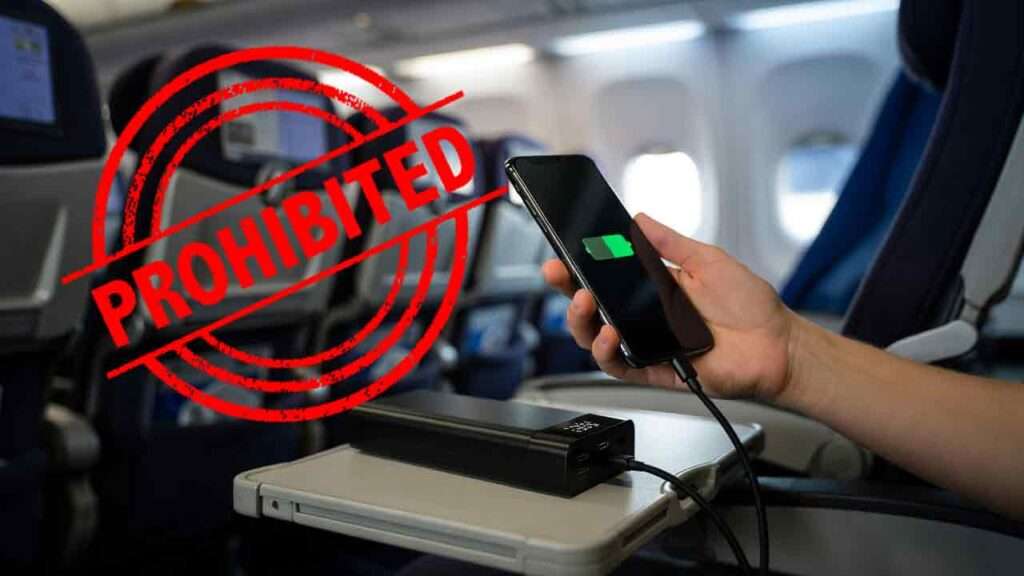
India’s aviation regulator, the Directorate General of Civil Aviation (DGCA), has introduced a stringent safety directive that prohibits the use of power banks to charge any electronic device during flights, including through aircraft seat USB ports and in‑flight power outlets. The rule, effective from early January 2026, is part of a broader move to mitigate the growing threat posed by lithium‑ion battery fires onboard aircraft.
The DGCA’s Dangerous Goods Advisory Circular clarifies that while passengers may still carry power banks in cabin baggage, in‑flight usage and charging of the power bank itself are strictly banned. This development signals one of the strictest regulatory stances taken worldwide on portable battery chargers in commercial aviation.
🔋 Safety Risks Drive Regulatory Action
Lithium‑ion batteries — the core of modern power banks — are energy‑dense and widely used in portable electronics. However, they are also susceptible to thermal runaway: a rapid, uncontrolled increase in temperature that can lead to fire or even explosions. Incidents of overheating and combustion, while relatively rare, pose high risks in the confined environment of aircraft cabins, prompting international scrutiny of battery-related safety protocols.
The DGCA’s advisory emerges against this backdrop of safety concerns, aligning Indian aviation standards with emerging global practices. Airlines such as Singapore Airlines and Emirates have already adopted similar bans on in‑flight use and charging of power banks, citing safety imperatives under the International Air Transport Association’s (IATA) Dangerous Goods Regulations.
✈️ New Rules at a Glance
The key points of the DGCA’s updated guidelines include:
- Complete ban on using power banks to charge electronic devices during the flight. Charging the power bank itself via seat USB or AC outlets is also not permitted.
- Power banks must be carried in cabin baggage only; storage in overhead bins is not advised as fires there are harder to detect.
- Passengers must keep devices within reach so cabin crew can respond quickly if a battery overheats.
- Airlines are required to update safety announcements and educate staff and flyers on the new restrictions and fire‑prevention measures.
These measures aim to enhance onboard safety awareness and reduce the likelihood of hazardous events tied to portable lithium batteries.
📊 Global Trend Toward Stricter Battery Policies
India’s regulatory shift mirrors a broader industry trend. Carriers across Asia and the Middle East have tightened power bank policies in recent months:
- Singapore Airlines and Scoot banned in‑flight power bank charging from April 2025.
- Emirates introduced a complete ban on in‑flight use of power banks from October 2025, requiring them to be kept unused in the cabin.
- Other major airlines, including Thai Airways and EVA Air, also restrict in‑flight power bank usage or storage due to fire risks.
These measures reflect a growing global emphasis on lithium battery safety, as regulators and carriers weigh the convenience of portable power against the potentially catastrophic consequences of an onboard fire.
🧭 Passenger Guidance and Preparations
For travellers, the new DGCA directive underscores the importance of pre‑flight preparation:
- Charge devices fully before departure.
- Rely on aircraft-provided power outlets (if available) rather than personal power banks.
- Carry power banks in carry‑on luggage and avoid stowing them out of sight.
- Be aware that failure to comply with safety announcements could result in crew intervention.

