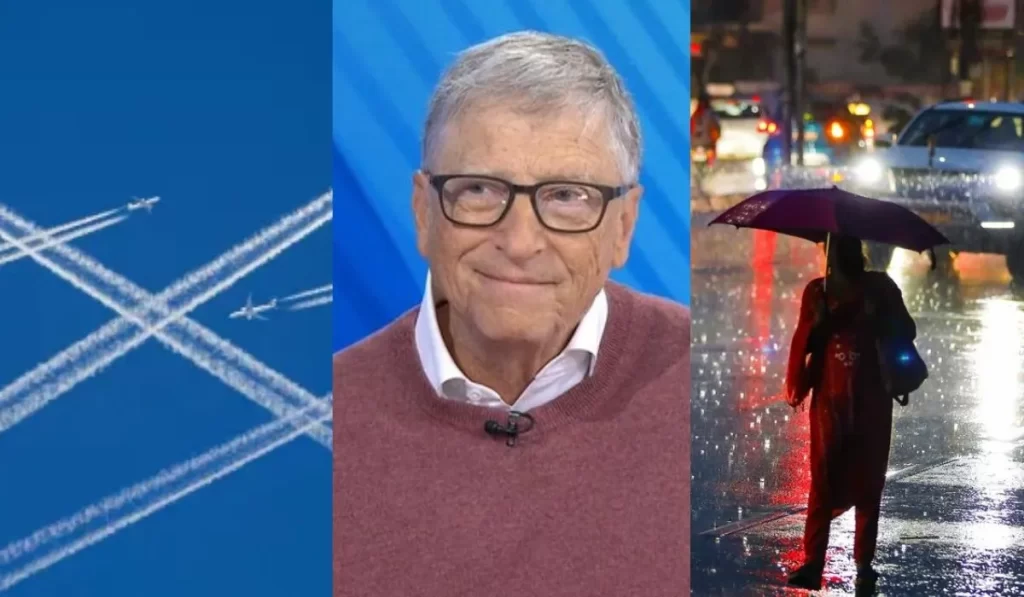
In the past few weeks, social media feeds in India and a few other countries have been flooded with sensational videos that say recent rains are “not natural” but are instead the result of secret “artificial rain” experiments done by billionaires, multinational corporations, or foreign governments. Viral videos, now ubiquitous, have propelled these claims, dubbing recent rainfall “death rain” or “Bill Gates rain.” They also suggest that “cloud seeding,” “chemtrails,” and “climate engineering” are being used to control crop production, water resources, and public well-being.
Given the escalating temperatures and increasing public anxiety, it is crucial to distinguish between scientifically validated information and the fabrications circulating online, and to ascertain the capabilities and limitations of artificial rain and climate engineering technologies.
This article talks about the viral beliefs, the real science underpinning geoengineering and cloud seeding, and why meteorologists and climate-policy experts warn that many of these claims are at best wrong and at worst harmful misleading information.
What exactly are “artificial rain” and “cloud seeding”? The term “artificial rain” isn’t a misnomer; it’s a weather modification technique, cloud seeding, that’s been in use for years. The aim is to increase or decrease rainfall, depending on the desired outcome. The basic idea is simple: if clouds are loaded with moisture, scientists can encourage precipitation by injecting tiny particles, like silver iodide or sodium chloride.
These particles facilitate the aggregation of water droplets or ice crystals, resulting in the formation of larger droplets. Consequently, these larger droplets are more prone to descending as either snow or rain.
This technology has been used in the US, China, the UAE, and India since the 1940s to deal with droughts, get more water, or aid agricultural. India’s testing program dates back to the 1970s.
Recently, states like Maharashtra, Rajasthan, and Delhi have tried cloud seeding to make it rain more or to get rid of dangerous winter smog by commencing wash-out events.
Cloud seeding can’t make it rain while the sky is clear. It only works when there are existing clouds in the sky and they contain enough moisture to be modified. When the weather is dry or the atmosphere is too steady, even the best seeding attempts don’t work. For instance, Delhi spent more than ₹3 crore on testing in 2025, but there was no measurable rain because the humidity was low and the clouds weren’t high enough.
“Death Rain,” “Chemtrails,” and “Bill Gates” are all viral accusations.
The most current wave of fear-based information includes short posts and reels that forcefully say things like “Bill Gates is making it rain in North India” or “artificial rain” is being used to control the monsoon or hurt people. The speaker in some of these movies warns that the rain right now is “not normal” but “death rain.” They tell people not to go outside or get wet, and they even tell parents to keep their kids inside.
These claims usually mix up a few different ideas:
It’s possible to influence the weather in a certain area by seeding clouds.
“Chemtrails” is a conspiracy theory that alleges the trails that planes leave behind are secret chemical sprays that are meant to modify the weather or affect humans.
Climate engineering or geoengineering are big, mostly experimental technologies that strive to change the way the weather works.
Fact-checking sites and weather experts have emphasized over and over that the recent rain in cities like Delhi is totally natural and driven by well-known weather patterns. It is neither the result of a secret Gates-linked project or a large-scale artificial rain blitz. Several fact-checks have uncovered the same shocking video that has been seen by tens of millions of people. This shows how quickly an unverified video can become a story that spreads across geographies.
What Science Knows About Cloud Seeding
Cloud seeding is best understood as a tiny instrument than a magical cure from a scientific point of view. International and Indian research, notably the Cloud Aerosol Interaction and Precipitation Enhancement Experiment (CAIPEEX), indicates that, under ideal circumstances, cloud seeding could increase rainfall by about 10–25%, and in certain favorable situations, by as much as 40–50% in particular areas.
But there are a few aspects that make it less useful and dependable:
Cloud seeding operations can’t make it rain if there aren’t any clouds.
Weather sensitivity: The success of seeding depends on the temperature, humidity, wind shear, and cloud microphysics.
Because rain varies so much, it’s hard to say how much of a storm’s severity is due to seeding and how much is due to natural processes.
In real life, this means that cloud seeding is only useful when it’s part of a bigger plan to improve the quality of air or water. It doesn’t let you manipulate the weather at random or on purpose to generate big floods or droughts.
From the Lab to the Web: Geoengineering and Climate Engineering
People desire to make substantial changes to the Earth’s climate system, which is sometimes called climate engineering. Most of the time, these modifications are aimed to either keep part of the sunlight from reaching the surface or take carbon dioxide out of the air. These ideas can be put into two primary groups:
Carbon dioxide removal (CDR) is a group of methods that strive to pull greenhouse gases out of the air. These methods include direct-air capture, large-scale afforestation, and more weathering.
Solar radiation modification (SRM): Some people link the cooling effect of huge volcanic eruptions to theoretical methods like pumping reflective particles into the stratosphere to lower the temperature of the earth.
Experts believe that most geoengineering ideas are still being researched or tested and that there are no large-scale, long-term uses of them yet. Climate policy and scientific groups agree that geoengineering is not a substitute for cutting emissions. They also say that geoengineering has major risks, including as influencing various areas in different ways and perhaps messing up monsoon systems.
Conversely, conspiracy theories frequently manipulate these experimental principles, presenting them as evidence of existing “control” over weather patterns, the instigation of droughts, or the deliberate creation of famines. Such assertions are routinely deemed false or lacking empirical support by established climate scientists and fact-checking organizations, who emphasize that the observed weather anomalies are more accurately attributed to escalating greenhouse gas concentrations and inherent climatic fluctuations, rather than clandestine geoengineering endeavors.
Regarding safety, environmental impact, and the dissemination of misinformation, the public often expresses apprehension concerning “artificial rain,” primarily due to the chemical agents employed in cloud seeding, with silver iodide being a notable example. Research on silver iodide has demonstrated that the quantities used in seeding operations are typically minimal, and the compound exhibits limited solubility. Consequently, it remains in a solid state and does not readily transform into highly toxic forms upon exposure to air or water.
Groups that keep an eye on the environment, including the Weather Modification Association, have found that silver iodide doesn’t seem to hurt the environment at the levels it is being used presently.
Scientists, on the other hand, say that any large-scale use of seeding chemicals should be closely observed, especially in places that are sensitive to the environment or close to water. This is because using it a lot over a long period of time might, in theory, damage the ecosystems in the area. If cloud seeding is going to become more common, it needs to be done with studies of its effects on the environment and an open government.
There is no scientific evidence that the viral reports calling the recent rain “Bill Gates rain” or “death rain” are accurate. Meteorologists and fact-checkers have confirmed that these occurrences align with past patterns, especially the early-season thunderstorms and short-lived surges of moisture often seen in areas such as North India. The proliferation of misinformation presents a significant challenge. It heightens public anxiety and undermines confidence in scientific bodies and the efficacy of climate change mitigation strategies.
Several key factors contribute to the quick spread of misinformation about artificial rain and climate engineering.
Emotional manipulation is a significant factor. The strategic use of emotionally charged language, such as “death rain” and “Bill Gates controlling the weather,” is intended to provoke feelings of anger and fear. These emotions are very effective at capturing attention on social media.
Time-lapse videos of rain, airplanes, or changing clouds can easily be misinterpreted as proof of “chemtrails” or “seeding planes.” This is true even when the videos show normal weather or typical air travel.
Conspiracy theories offer simple, blame-focused explanations for events, like the idea that a single billionaire controls the weather. In contrast, the complexities of real climate science make it difficult to explain in a short video.
In India, where concerns about water scarcity, air pollution, and the reliability of the monsoon season are acute, these reports find a receptive audience. Observing governments or organizations experimenting with technical solutions like cloud seeding can lead some to believe that every unusual weather occurrence is part of a larger, concealed scheme.
A Reality Check: The Limits of Artificial Rain
Let’s examine the actual capabilities of current artificial rain and climate engineering technologies.
In some cases, cloud seeding could potentially encourage clouds to release more precipitation.
It doesn’t, however, allow for the creation of storms from nothing or the manipulation of entire monsoon systems.
Localized experiments have produced mixed outcomes. Delhi’s 2025 attempt, for instance, resulted in less rainfall than anticipated, despite extensive seeding efforts.
There is no reliable evidence to support claims that global billionaires or foreign governments are using cloud seeding or chemtrails to “poison” rain or manipulate countries.
Most ideas about geoengineering are still in the testing stage, and there isn’t much evidence that they are being used on a large enough scale to change regional weather patterns, as conspiracy theories say.
Is it real or fake? Viral Theories About Artificial Rain and Climate Engineering Explained