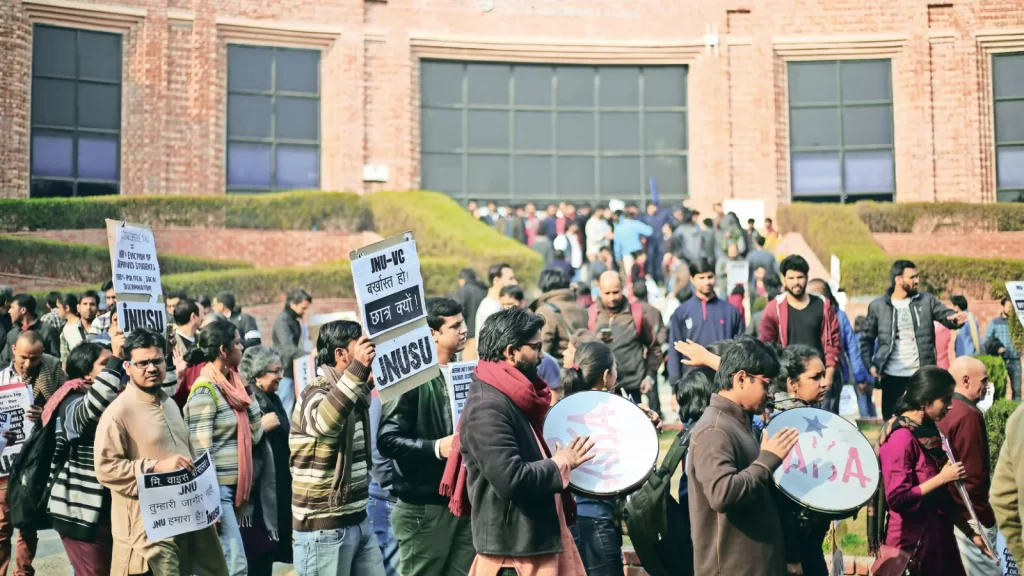
June 30, 2025 — Tensions continue to escalate at Jawaharlal Nehru University (JNU) as the Jawaharlal Nehru University Students’ Union (JNUSU) intensifies its indefinite hunger strike in protest against the university administration’s decision to scrap the in-house entrance examination for PhD admissions. The protest, led by union office-bearers, is centered on the recent move to mandate the University Grants Commission’s National Eligibility Test (UGC-NET) as the sole criterion for PhD admissions.
Vice-Chancellor Santishree Dhulipudi Pandit recently confirmed that the university’s deans are not in favor of conducting a separate entrance examination, citing alignment with national academic standards. “The deans have expressed that the UGC-NET system ensures uniformity and merit-based selection,” she said.
However, student leaders have called the move undemocratic and exclusionary. According to JNUSU President Dhananjay, the NET-based admission model disproportionately affects students from marginalized and economically weaker backgrounds. “JNU’s in-house entrance was a gateway for diverse voices in academia. Replacing it with UGC-NET risks shutting that door,” he stated.
The students argue that the UGC-NET, being a highly competitive and standardized test, overlooks the inclusive approach JNU has traditionally followed, which considers the varied academic and socio-economic backgrounds of applicants. They have also raised concerns over the sudden implementation of the change, alleging a lack of consultation with student bodies and faculty.
Several departments within JNU have also voiced unease over the new policy, stating that it undermines the university’s academic autonomy. Many have highlighted that their research programs require evaluation criteria that go beyond the scope of standardized tests like UGC-NET.
In a statement issued by JNUSU, the student union accused the administration of “bypassing democratic procedures” and “surrendering to centralization pressures,” calling the change a part of a broader trend to dilute public education institutions.
The hunger strike, now in its sixth day, has garnered support from student unions across other central universities, with solidarity statements pouring in from institutions such as Jamia Millia Islamia, Delhi University, and Hyderabad Central University.
Despite growing unrest, the administration has yet to initiate a formal dialogue with the protesting students. JNUSU leaders have vowed to continue the strike until the university revokes its decision and reinstates the traditional entrance process for PhD programs.
The ongoing standoff raises significant questions about academic accessibility, institutional autonomy, and the future of research education in India. As the impasse continues, all eyes remain on the JNU administration’s next move amid mounting pressure from students and academic communities nationwide.