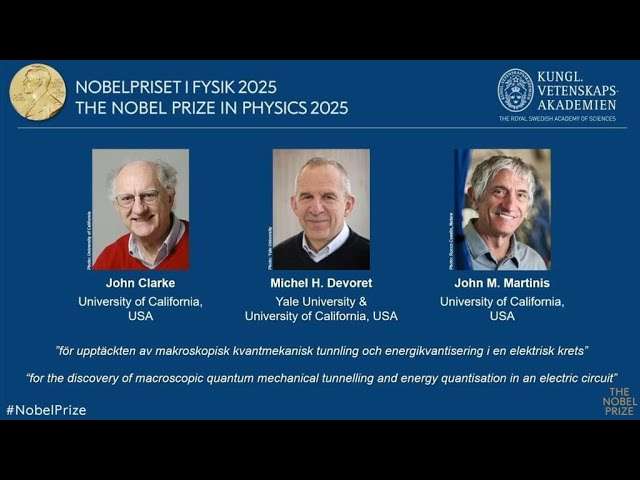
The 2025 Nobel Prize in Physics has been awarded to John Clarke, Michel H. Devoret, and John M. Martinis for their groundbreaking discovery of macroscopic quantum mechanical tunneling and energy quantization in an electrical circuit. The Royal Swedish Academy of Sciences announced the award in Stockholm, recognizing the trio’s pioneering experiments that bridged the gap between theoretical quantum physics and practical engineering applications.
According to the Nobel Committee, their experiments demonstrated that entire electrical circuits—systems composed of billions of electrons—can behave according to the principles of quantum mechanics. The laureates’ work revealed that even large-scale superconducting circuits could exhibit quantum phenomena such as tunneling and quantized energy levels, effects previously observed only in atomic-scale systems.
Their research, conducted during the 1980s and 1990s, laid the foundation for modern quantum technologies, including quantum computers, superconducting qubits, and high-precision quantum sensors. By showing that macroscopic systems could maintain quantum coherence, Clarke, Devoret, and Martinis opened a new frontier in experimental physics that continues to shape the future of computing and information science.
Pioneering Quantum Circuits
The team’s use of Josephson junctions—tiny devices made of two superconductors separated by an insulating layer—proved crucial in demonstrating that electric current could tunnel through barriers via quantum effects. These findings established that superconducting circuits could act as controllable quantum systems, paving the way for quantum bits, or qubits, that now form the core of many leading quantum computers.
John Clarke, a physicist at the University of California, Berkeley, is also known for developing SQUIDs (Superconducting Quantum Interference Devices), which are used for ultra-sensitive magnetic field detection. His innovations have influenced both scientific research and medical imaging technologies.
Michel H. Devoret, currently associated with Google Quantum AI, has played a major role in advancing superconducting qubit design, including the development of transmon and fluxonium qubits used in quantum processors.
John M. Martinis, who previously led Google’s quantum hardware team, is credited with overseeing the first demonstration of “quantum supremacy” in 2019, where a quantum computer outperformed a classical supercomputer on a specific task.
Global Recognition and Reactions
At the press conference following the announcement, Clarke expressed humility and gratitude, stating that “it had never occurred to us that our work would one day be recognized with a Nobel Prize.” Devoret admitted he initially thought the news was a prank call, underscoring the element of surprise even among seasoned researchers.
Global scientific leaders hailed the decision, noting the laureates’ central role in transforming quantum physics into an engineering reality. Google, in an official statement, congratulated Devoret and Martinis for their long-term contributions to the company’s quantum hardware advancements.
A Milestone for Quantum Technology
The 2025 Nobel Prize in Physics marks a defining moment for the quantum research community. By proving that quantum effects can govern macroscopic electrical systems, the laureates have provided the theoretical and experimental framework that underpins much of today’s quantum innovation.
As the world races toward more powerful quantum computers and advanced sensors, the work of Clarke, Devoret, and Martinis stands as a testament to how fundamental physics can evolve into transformative technology — connecting the mysteries of quantum mechanics with real-world applications.