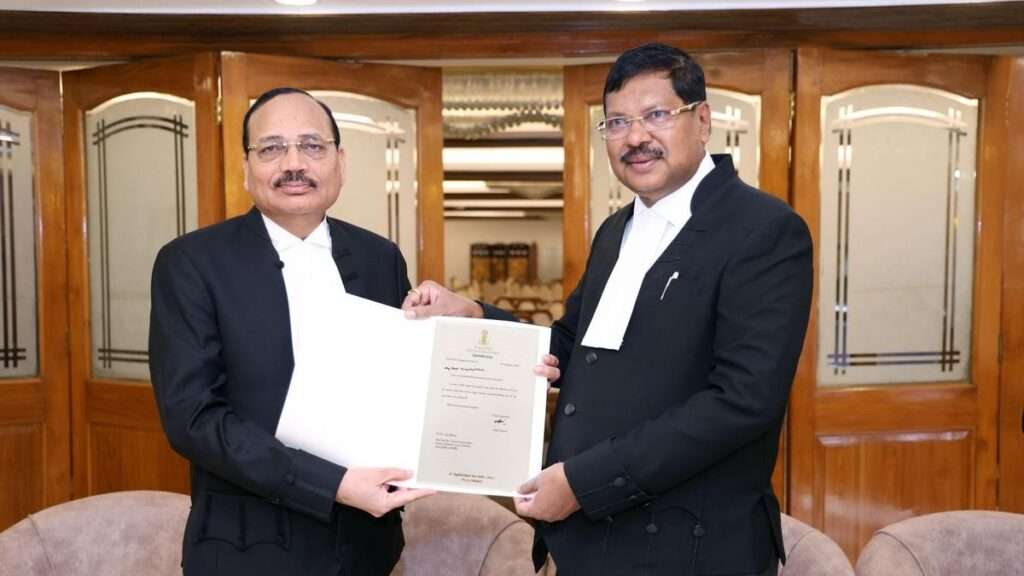
In a move that draws on long-standing convention within the Indian judiciary, Chief Justice of India B. R. Gavai has formally recommended his Supreme Court colleague, Justice Surya Kant, to succeed him as the next Chief Justice of India (CJI). The recommendation, made on 27 October 2025, sets in motion the process for Justice Kant to become the 53rd CJI.
Under the established tradition followed by the apex court and the Centre, the senior-most judge of the Supreme Court of India is recommended by the incumbent CJI for appointment as the next Chief Justice. This principle is clearly at work here, as Justice Surya Kant is currently next in line in seniority after CJI Gavai. Once the government issues formal notification, Justice Kant’s appointment is expected to become official.
Born on 10 February 1962 in Hisar, Haryana, Justice Surya Kant holds a bachelor’s degree in law from Maharishi Dayanand University, Rohtak. He began his legal career in the district court of Hisar in 1984 and later moved to practice in the Punjab & Haryana High Court in 1985. Over the years, he has held several significant positions, including Advocate General of Haryana in 2000, Judge of the Punjab & Haryana High Court from 2004, and Chief Justice of the Himachal Pradesh High Court from 2018 to 2019. He was elevated to the Supreme Court on 24 May 2019. In 2025, he was appointed Executive Chairman of the National Legal Services Authority (NALSA), underscoring his commitment to legal-aid and access to justice.
The recommendation of Justice Surya Kant carries weight for several reasons. Firstly, it confirms adherence to the seniority convention, reinforcing institutional continuity in the judiciary. Secondly, it places an experienced jurist with over six years of Supreme Court experience and a strong record in criminal, constitutional, and service matters at the helm. His projected tenure until February 2027 offers a rare opportunity for a relatively long stint as Chief Justice, allowing ample time for leadership and reform.
At a time when India faces complex legal, constitutional, and social challenges—ranging from case backlogs to the delicate balance between individual rights and national interests—having a stable CJI with a meaningful tenure is viewed as beneficial for institutional consistency. Justice Kant has, in several recent public remarks, emphasised the judiciary’s role as the “moral spine” of democracy and the importance of ensuring access to justice for all citizens. His appointment is expected to mark a proactive phase in judicial administration, particularly in areas of legal aid, transparency, and procedural reforms.
With Chief Justice B. R. Gavai’s recommendation of Justice Surya Kant as the next Chief Justice of India, the stage is set for an important leadership transition in the country’s highest judicial institution. The seniority-based appointment reflects stability and continuity, while Justice Kant’s extensive judicial experience and reform-oriented outlook suggest readiness to steer the Supreme Court through a crucial phase. As the government’s formal notification follows, India prepares to welcome its 53rd Chief Justice—a jurist known for integrity, vision, and commitment to justice.