
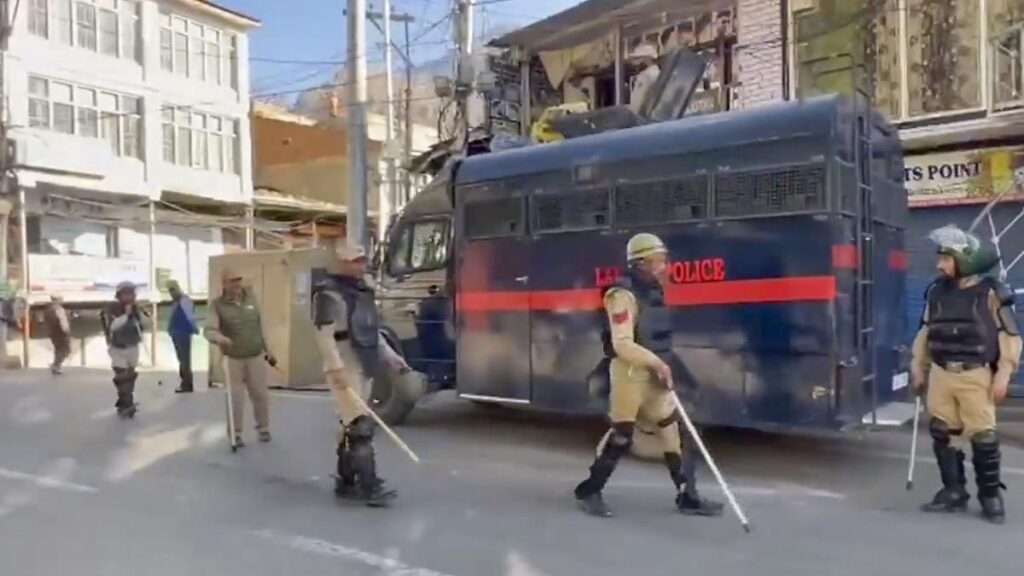
Tensions remain high in Leh as a curfew continues to be enforced following violent protests earlier this week that led to the death of four individuals. The central government has dispatched a special envoy to the Union Territory, while the Lieutenant Governor chaired a high-level security review to assess the situation and prevent further escalation.
The unrest began after a series of demonstrations over local governance issues and long-standing demands for constitutional safeguards for Ladakh’s people. Protestors have been voicing concerns over land rights, job reservations, and the protection of the fragile Himalayan ecosystem. The situation spiraled earlier this week when clashes between demonstrators and security forces turned violent, resulting in casualties and widespread tension.
According to officials, internet services remain restricted across several parts of Leh to prevent the spread of misinformation and maintain public order. Security forces, including additional paramilitary units, have been deployed to sensitive areas. Despite these measures, sporadic demonstrations continue to be reported, with local groups demanding immediate dialogue and intervention from New Delhi.
The Centre’s decision to send a special envoy underscores the seriousness of the crisis. The envoy is expected to meet with local leaders, civil society representatives, and religious heads to restore trust and open channels of communication. Government sources have indicated that the envoy’s mandate includes addressing grievances related to political representation, employment opportunities, and ecological concerns tied to rapid development in the region.
Lieutenant Governor B.D. Mishra, who chaired the emergency security meeting, urged officials to ensure the safety of civilians while maintaining law and order. He also emphasized the need for restraint on all sides, stressing that peace and stability are essential for addressing Ladakh’s developmental challenges.
Political observers suggest that the unrest in Ladakh highlights the growing discontent among residents who feel marginalized since the region was carved out as a separate Union Territory in August 2019. While some welcomed the move for improved administrative efficiency, others argue that Ladakh has lost crucial constitutional safeguards once guaranteed under Jammu and Kashmir’s special status.
Civil society groups have reiterated calls for statehood and Sixth Schedule protections, which would safeguard land and cultural identity for indigenous communities. Environmental activists have also raised alarms about unchecked infrastructural expansion in the ecologically fragile Himalayas, warning that ignoring these issues could lead to long-term consequences.
As the curfew in Leh enters its next phase, uncertainty looms large over how long restrictions will continue. While the administration has appealed for calm, local leaders insist that meaningful dialogue and concrete assurances from the Centre are the only sustainable solutions.
For now, the people of Ladakh remain caught between heightened security and unresolved demands, as the region awaits the outcome of the envoy’s visit and the Centre’s response to growing unrest.

