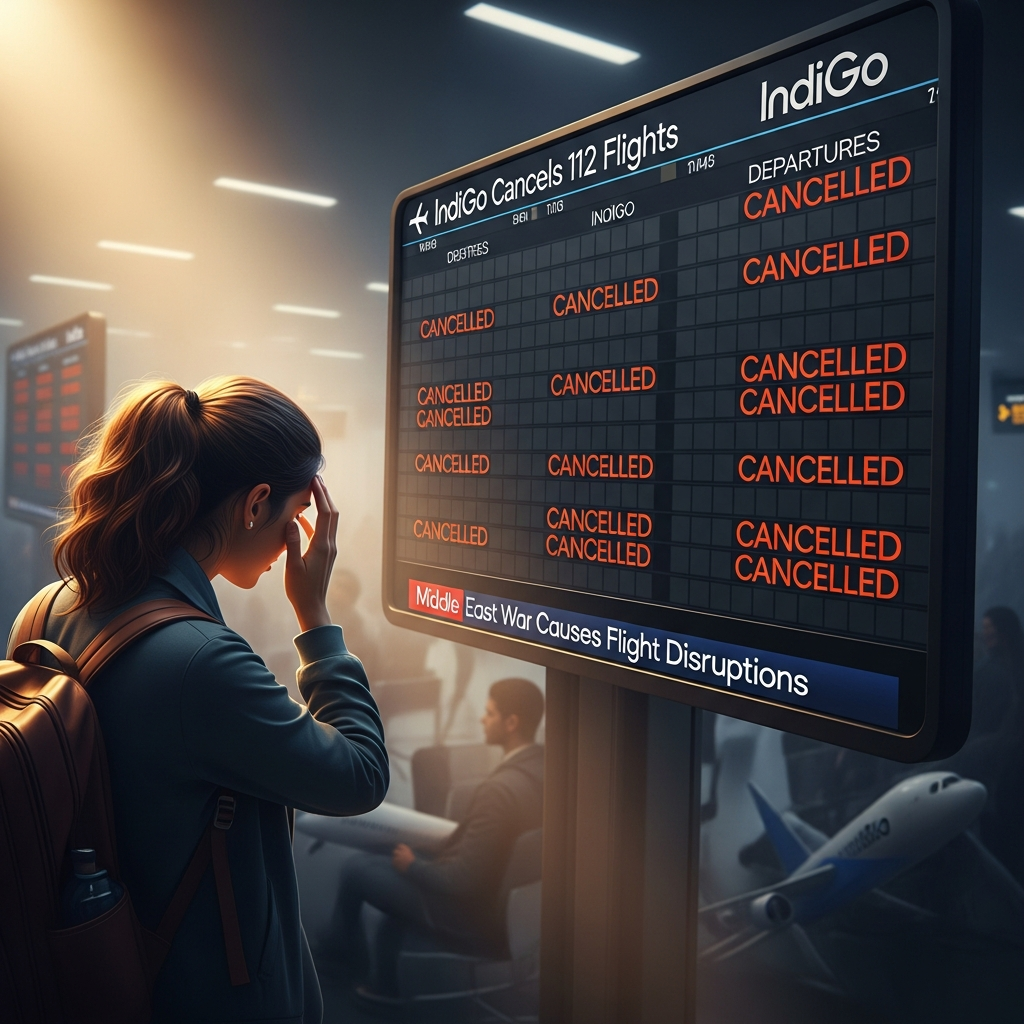
For millions of passengers glancing at their flight trackers, the map has started to look different. The once‑straight lines streaming from Europe to India, Southeast Asia, and the Gulf have been bent into long arcs, looping around the Middle East. As conflict zones in the region force airlines to avoid certain airspace, international flights are being rerouted, adding hours to journeys and quietly pushing up the cost of air travel worldwide — including for Indian travelers whose itineraries often pivot through the Gulf.
Why flights are being rerouted
Commercial aviation has long relied on specific “corridors” across the Middle East as the most efficient route between Europe, South Asia, and Southeast Asia. These corridors cut travel time and fuel burn, which is why airlines typically fly directly over Iran, Iraq, parts of the Gulf, and adjoining regions.
But as geopolitical tensions escalate, several countries have restricted or closed their airspace to civilian aircraft. Iranian, Iraqi, and some Gulf airspace have been progressively shut or severely limited, according to aviation authorities and flight‑tracking data. The result is that what used to be a near‑straight path is now a detour, with aircraft being pushed either north through Central Asia and the Caucasus or south via the Arabian Sea, Indian Ocean, and Egypt.
For an airline, rerouting is not just a matter of redrawing a line on a map. Regulators must approve each new route, airline operations teams must recalculate fuel loads, and pilots must steer around zones marked as “no‑fly” or high‑risk. It is a safety‑first move, but one with real‑world knock‑on effects for passengers and balance sheets.
Concrete impact on travel time
Recent schedule changes and routing analyses show that many Europe–Asia and Gulf routes now routinely add a substantial chunk of flight time.
On some Delhi–Europe routes that previously crossed the Middle East in roughly eight hours, flight durations have stretched to 12 hours or more after rerouting through the Arabian Sea, Oman, or Egypt.
Flights between India and key European hubs that once routed directly over Iran or Iraq now bend north or south, adding anywhere from 30 minutes to several hours of flying time depending on the exact path.
For travelers, that means longer time in the cabin, more disruption to sleep cycles, and tighter connections at busy hubs. For business travelers and tourists on tight schedules, the extra hours can tip a return trip from “manageable” to “exhausting.”
Indian carriers and foreign airlines serving Mumbai, Delhi, Bengaluru, and other major Indian cities report noticeable schedule adjustments, especially on services that used to rely on Gulf or Iranian airspace. Some flights now avoid the region entirely, while others circle around conflict‑adjacent zones, leading to a patchy but nonetheless visible slowdown in long‑haul connectivity.
Fuel burn, costs, and rising fares
The most direct consequence of rerouting is fuel. Longer tracks mean more time in the air, more fuel burned, and higher operational costs. Airlines that once flew efficiently over the Middle East are now zigzagging around closed airspace, often adding hundreds of miles per journey.
Even a modest detour of a few hundred miles can translate into tens of thousands of dollars more in fuel costs across a single long‑haul flight, especially when times are multiplied by hundreds of weekly services. Analysts have warned that if the conflict‑driven closures persist, airlines may pass some of those costs on in the form of higher fares or reduced discounts.
For Indian passengers, this risk is particularly visible on:
India–Europe “direct‑ish” routes that once cut through the Middle East glass corridor.
Gulf‑hub routes (via Dubai, Doha, Abu Dhabi), which are now being rerouted or, in some cases, suspended altogether.
Industry insiders note that carriers are already seeing “fare volatility” on selected India–Europe and India–West Asia tickets, as airlines adjust capacity and load factors in response to altered routings and uncertainty.
Who really pays that extra cost? In the short term, it is often absorbed by airlines already trying to recover from earlier shocks such as the pandemic and fuel price swings. But the longer airspace closures last, the more likely passengers will see marked‑up ticket prices, especially on peak‑season or last‑minute bookings.
Operational knock‑on effects: crews, connections, and schedules
Rerouting does not just add distance to a flight; it ripples through the entire airline network. Aircraft that once completed a round trip in a set number of hours now need more time in the air, which can delay aircraft rotations and crew schedules.
For example, if a Delhi–London flight that used to take eight hours suddenly takes 12, the same aircraft may no longer be able to operate an immediate return or another leg in the same day. This situation can result in:
Reduced flight availability on specific routes.
Shorter layover periods at major airports.
An increased likelihood of delays or cancellations, especially if a single diverted flight disrupts several connecting flights.
Dubai, Doha, and Bahrain, among other major hubs, have experienced intermittent disruptions or reductions in their flight schedules, both incoming and outgoing.
This is due to airlines grappling with closed airspace and the logistical challenges of finding alternative routes.
Some carriers have completely stopped certain routes, deciding that the costs and difficulties of changing them outweigh any potential profits in the current situation.
From a passenger’s perspective, that can mean missed connections, involuntary re‑routing, and longer layovers as airlines try to squeeze flights into constrained corridors.
India’s place in this global rerouting web
India sits at the heart of some of the busiest Europe–Asia traffic flows, and many of its long‑haul services either pass through or rely on Middle East airspace and hubs.
Recent updates show that:
Delhi–London and similar routes have seen flight‑time increases when aircraft are pushed south via the Arabian Sea or Oman instead of cutting directly across Iran.
Airlines operating India–West Asia services (including to Israel, Lebanon, and Gulf states) have either rerouted, suspended, or cancelled large portions of their schedules amid airspace restrictions.
For Indian travelers, this means:
Longer journeys between Europe and India, especially on certain carriers or routes.
Greater uncertainty about Gulf connections, which have long been popular for cost, connectivity, and onward travel options.
More frequent changes to schedules, requiring extra vigilance before travel.
Some Indian‑origin itineraries now require an extra stop or longer layovers as airlines avoid the most volatile corridors. This may not always be obvious to passengers at first glance, but it can make the difference between a smooth trip and one marked by long waits and last‑minute changes.
Passenger experience: uncertainty, anxiety, and adaptation
For the average traveler, the change in the sky is often first felt in the small print: longer flight durations listed on the booking page, more frequent “schedule change” emails, or last‑minute calls to confirm a flight before heading to the airport.
In India, authorities and travel‑industry bodies have already urged passengers to avoid going to the airport without a confirmed ticket, given that airlines are only allowed to operate certain services after security and airspace clearances. That kind of environment adds another layer of stress for families, business travelers, and students trying to navigate final‑minute exam or work schedules.
There is also a psychological dimension: flying through or near conflict zones, even via rerouted paths, can heighten anxiety for some passengers. The knowledge that an aircraft is being pushed around a war‑torn region, or that a flight may be turned back mid‑air, stays with many who follow the news.
At the same time, airlines are trying to reassure passengers with clearer communication, more flexible rebooking policies, and, in some cases, alternative routing options. Yet the question remains: how long can travelers reasonably expect “normal” timings and pricing when a major global air corridor is effectively blocked?
What does the future look like?
The longer the Middle East conflict drags on, the more likely it is that rerouting will become the new norm rather than a temporary exception. Aviation analysts suggest that if airspace closures persist for months, airlines may even begin to redesign their long‑haul networks around the rerouted corridors, rather than waiting for a return to the old routes.
This could mean:
More reliance on Central Asia and the Caucasus for certain Europe–Asia traffic.
Greater use of southern routes over the Arabian Sea and Indian Ocean for India–Europe and India–West Asia services.
New or expanded hub functions for airports that sit along these alternative corridors.
For passengers, that reality may translate into:
Permanently longer average flight times on some key routes.
A more complex pricing structure, where “cheapest” tickets may often come with longer in‑flight durations or less convenient connections.
An expectation that geopolitical risk is now baked into every long‑haul itinerary, not just a side note.
The situation raises a broader question the industry is still grappling with: how do airlines balance the imperative of safety against the economic and social costs of making the world’s most‑used air corridors longer, slower, and more expensive to fly?
What travelers can do now
In practical terms, there are several steps passengers can take to navigate the new environment:
Check flight‑time estimates carefully: Assume that some India–Europe or Gulf‑hub routes may be significantly longer than they were a year ago.
Allow extra buffer time at connections: With rerouting and schedule uncertainty, tight connections are riskier than before.
Stay in close contact with the airline: Monitor emails, SMS alerts, and app notifications, since routes and departure times can change with little notice.
Think about insurance and flexible fares. If your plans are uncertain, or if you might need to change your itinerary, it could be smart to splurge on tickets that offer more flexibility, or to get travel insurance.
For Indian travelers especially, the message is simple: the skies over the Middle East may look calmer from the ground, but in the air, the world has already changed. The question is not whether rerouting will continue, but how passengers, airlines, and regulators will adapt to a new era of longer, more expensive, and more uncertain journeys across one of the planet’s busiest air corridors.
“Longer in the sky, heavier on the wallet” — Airlines reroute around Middle East conflict zones, reshaping global air travel