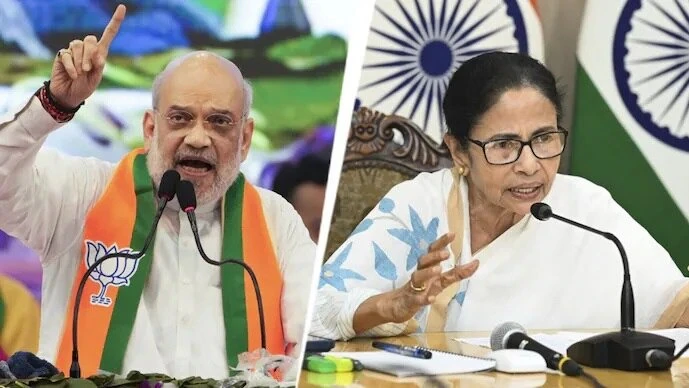
Kolkata, December 3, 2025 — West Bengal Chief Minister Mamata Banerjee has launched a sharp political attack at Union Home Minister Amit Shah, alleging that the ongoing Special Intensive Revision (SIR) of electoral rolls is part of a larger “strategy to capture Bengal.” She asserted that the plan “will collapse,” declaring that voters in the state are fully aware of the political intent behind the exercise.
Banerjee, addressing a public gathering in Malda, argued that the hurried and “unnecessary” revision of voter lists just months before the 2026 assembly elections was not an administrative requirement but a politically motivated move. She claimed that the SIR could lead to the removal of thousands of genuine voters, especially those from marginalized communities, thereby disturbing electoral fairness.
The Chief Minister warned that any attempt to delete legitimate names from voter lists would be met with strong resistance. She reiterated her commitment to protecting the democratic rights of citizens, stating that her government would challenge “every undemocratic process” that threatens electoral integrity. Banerjee further stated that she would not hesitate to mobilize nationwide protests if political targeting intensifies in the coming weeks.
BJP’s Counter-Narrative: Security, Infiltration, and Voter Accuracy
Meanwhile, Amit Shah and the Bharatiya Janata Party (BJP) maintain that the SIR is essential for ensuring a clean voter list, especially in a border state like West Bengal. Shah has repeatedly asserted that infiltration from across the Bangladesh border remains a critical issue and that only a BJP-led government can effectively curb the trend.
Shah has also criticized the West Bengal government for allegedly obstructing central security efforts by delaying approvals for land acquisition required by border security agencies. According to Shah, the inability to enforce strict surveillance and security measures compromises both national security and the accuracy of the electoral process.
A Deepening Political Battle
The dispute over the SIR points to a broader political struggle — one rooted in trust, identity, and the role of central institutions in state-level electoral processes. For the Trinamool Congress (TMC), the revision exercise symbolizes a possible attempt to manipulate voter demographics. For the BJP, it is a necessary measure to safeguard the electoral framework and address long-standing concerns regarding illegal immigration.
Political analysts note that the clash between Banerjee and Shah is not merely administrative but ideological. While Banerjee focuses on voter rights and federal autonomy, Shah frames the conversation around national security and demographic integrity.
High Stakes Ahead of the 2026 Elections
With the 2026 assembly elections approaching, both parties are intensifying their narratives. Banerjee’s strong criticism reflects her strategy to position herself as the defender of democracy and Bengal’s autonomy. On the other hand, the BJP is building its campaign around themes of national security, border control, and governance reforms.
The outcome of this conflict may shape the political climate in Bengal for years to come. As both leaders escalate their rhetoric, the state’s electorate is expected to play a decisive role in determining which narrative gains momentum.
Conclusion
Mamata Banerjee’s declaration that Amit Shah’s “ploy to capture Bengal” will fail underscores the heightened political tensions as the state prepares for a pivotal election. While the TMC highlights threats to voter rights, the BJP emphasizes security and electoral reform. With both sides doubling down on their positions, West Bengal is set for an intensely contested political season, one that may redefine the power dynamics between state and central leadership.