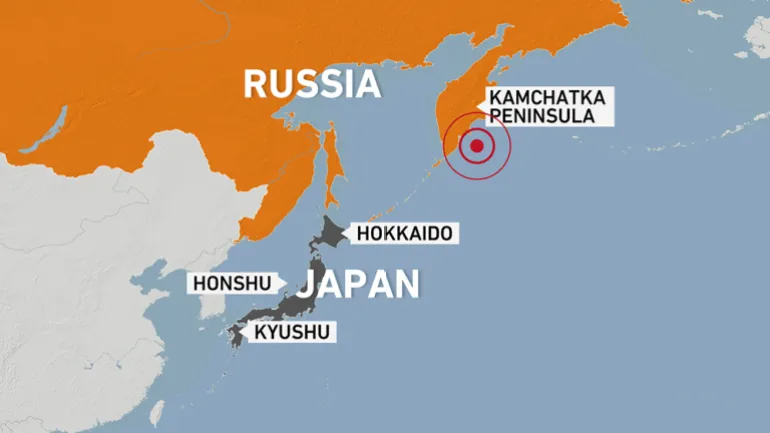
A powerful earthquake with a magnitude of 8.8 struck off the eastern coast of Russia near the Kamchatka Peninsula early Wednesday, prompting widespread tsunami alerts across the Pacific region. This seismic event is considered one of the strongest to hit the area in decades.
Russia: Coastal Towns Hit by High Waves
The epicenter was located offshore, near the Kuril Islands, leading to waves exceeding 3 meters in some areas. In Severo-Kurilsk and nearby towns, buildings, including schools and residential complexes, suffered structural damage. Emergency services reported several injuries, though no fatalities were confirmed.
Local authorities swiftly moved residents to higher ground as part of precautionary evacuations. Roads in several parts of the Far East region were temporarily closed due to water inundation and debris.
Japan: Widespread Evacuations Despite Minor Wave Impact
Although Japan experienced significantly smaller waves—ranging between 20 and 40 centimeters—officials did not take any risks. Over 900,000 residents across more than 100 coastal municipalities, including regions in Hokkaido, Aomori, and Ibaraki, were ordered to evacuate.
Train and ferry services in northern Japan were temporarily halted. At Fukushima Daiichi Nuclear Plant, workers were moved to safety zones, though officials reported no signs of abnormal radiation levels.
Pacific-Wide Warnings: From Hawaii to South America
The earthquake triggered tsunami alerts as far away as Hawaii, Alaska, Taiwan, Indonesia, and several Pacific islands. Some U.S. coastal states, including California, Oregon, and Washington, issued marine warnings, urging residents to stay away from beaches and harbors.
In Hawaii, authorities activated emergency sirens, and schools in low-lying areas remained closed as a safety measure. Though the waves were not destructive, the threat of strong currents and surges remained.
Expert Insights and Aftershock Concerns
Geophysicists believe this earthquake resulted from tectonic plate movement along the Pacific Ring of Fire, a region known for frequent seismic activity. The Russian Seismic Monitoring Agency warned of possible aftershocks, some of which may be strong enough to warrant further alerts.
Summary
| Key Details | Information |
|---|---|
| Magnitude | 8.8 |
| Location | Offshore, near Kamchatka, Russia |
| Tsunami Waves | 3–4 meters in Russia; 20–40 cm in Japan |
| Evacuations | Russia, Japan, and Pacific nations |
| Damage | Structural damage in Kuril Islands |
| Casualties | Minor injuries, no fatalities reported |
| Tsunami Alerts | Issued in Russia, Japan, Hawaii, and U.S. West Coast |
Authorities continue to monitor the situation and urge coastal residents across the Pacific to remain vigilant. Scientists stress that tsunami activity can persist for hours, with multiple wave sets possible.