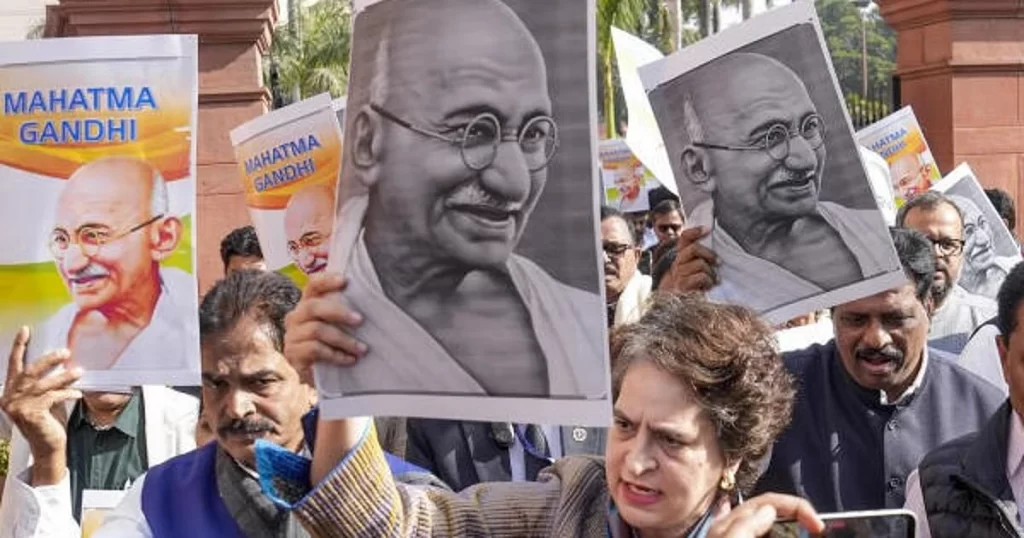
A fresh political controversy has erupted following the government’s move to rename the Mahatma Gandhi National Rural Employment Guarantee Act (MGNREGA), one of India’s most extensive social welfare programmes. The proposed legislation seeks to rechristen the flagship rural employment scheme as VB-G RAM G, triggering sharp reactions from opposition parties who allege that the change is aimed at removing Mahatma Gandhi’s name from a law that has symbolised inclusive development for nearly two decades.
A Scheme at the Centre of Rural India
Launched to provide guaranteed wage employment to rural households, MGNREGA has long been regarded as a critical safety net during periods of agrarian distress, economic slowdown, and public health crises. The scheme legally guarantees at least 100 days of wage employment per financial year to rural families, while also creating durable assets such as roads, ponds, and irrigation facilities.
Over the years, MGNREGA rural employment scheme, job guarantee programme, and rural livelihoods have become closely associated with the law’s identity—anchored strongly to Mahatma Gandhi’s philosophy of dignity of labour and grassroots empowerment.
The Government’s Rationale
Government representatives have defended the renaming proposal, arguing that the new title reflects a forward-looking vision aligned with national development goals. According to officials, the proposed name under the VB-G RAM G bill is intended to emphasise growth, self-reliance, and outcomes-driven governance in rural India.
Supporters of the move claim that renaming does not dilute the legal entitlements under the scheme. They insist that wage guarantees, funding mechanisms, and implementation frameworks will remain intact, while the rebranding signals a renewed focus on efficiency and accountability.
Opposition Pushback Intensifies
The opposition, however, has rejected this explanation outright. Several leaders have accused the government of engaging in symbolic politics, arguing that removing Gandhi’s name undermines the historical and moral foundations of the programme. The issue has quickly escalated into a broader political row over MGNREGA, with protests, parliamentary disruptions, and heated public statements.
Opposition parties contend that the name “MGNREGA” carries global recognition and constitutional significance, and that altering it risks weakening public trust. They also warn that the renaming could distract from pressing concerns such as delayed wage payments, budgetary constraints, and declining workdays under the scheme.
Key Arguments in the Debate
| Supporters of Renaming | Critics of Renaming |
|---|---|
| Emphasises future-oriented development | Erases Mahatma Gandhi’s legacy |
| Aligns with new governance vision | Undermines scheme’s identity |
| No change to legal guarantees | Distracts from implementation issues |
Wider Implications
Policy experts note that while renaming welfare schemes is not unprecedented, altering a programme as emblematic as MGNREGA carries significant political and social implications. The controversy raises larger questions about continuity in public policy, the symbolism of national icons, and the balance between reform and legacy.