
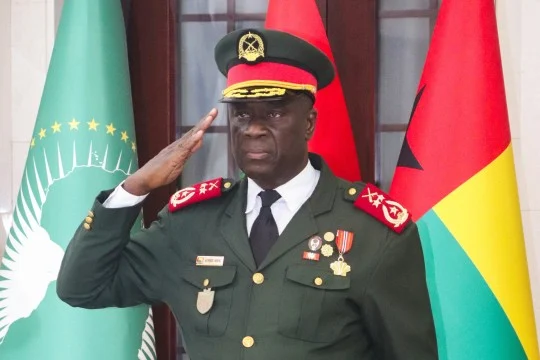
Guinea-Bissau plunged into political turmoil as the military seized control of the country, deposing President Umaro Sissoco Embaló, who subsequently fled to neighboring Senegal. The coup, which occurred amid the presidential election process, highlights the persistent fragility of democratic institutions in the West African nation.
Sudden Seizure of Power
The military, declaring itself the “High Military Command for the Restoration of Order,” announced the removal of President Embaló and the suspension of the electoral process. A nationwide curfew was imposed, borders were closed, and the release of election results was halted. Reports indicated gunfire near the presidential palace, electoral commission offices, and the Interior Ministry in Bissau, signaling a rapid escalation of the crisis.
Within 24 hours, the junta appointed Horta Inta-A, former army chief of staff, as the head of a transitional government set to rule for one year. He was sworn in at a military ceremony, pledging to restore “order and stability” in the country.
Embaló’s Flight and Regional Reactions
Following his removal, Embaló was flown to Dakar, Senegal, where officials confirmed his safe arrival. Regional organizations, including the Economic Community of West African States (ECOWAS) and the African Union (AU), condemned the coup and demanded the release of detained officials and a return to constitutional order. ECOWAS also suspended Guinea-Bissau from its decision-making bodies until democratic governance is restored.
Historical Context and Causes
Guinea-Bissau has experienced repeated coups since gaining independence from Portugal in 1974. Analysts cite institutional weakness, widespread corruption, and the country’s role as a transit hub for narcotics as underlying causes of political instability. Embaló’s administration faced mounting scrutiny over alleged links between political leaders and drug trafficking — a key justification cited by the coup leaders.
Among those detained alongside Embaló were major political figures, including his main challenger Fernando Dias and former Prime Minister Domingos Simões Pereira, underscoring the breadth of disruption to the country’s leadership.
Implications and Outlook
- Democratic Backsliding: Suspension of elections and military rule risk prolonged authoritarian governance.
- Regional Stability: The coup raises concerns about political turbulence across West Africa.
- Governance and Narcotics: Without reform, Guinea-Bissau may continue to serve as a transit hub for illicit trade.
- International Pressure: ECOWAS and the AU may push the junta toward new elections, depending on coordination and diplomatic leverage.
The deposition of President Embaló represents another chapter in Guinea-Bissau’s tumultuous political history. With constitutional order suspended, key leaders detained, and a military government in power, the coming months will be critical for determining whether the country can return to democratic governance or face further instability.

