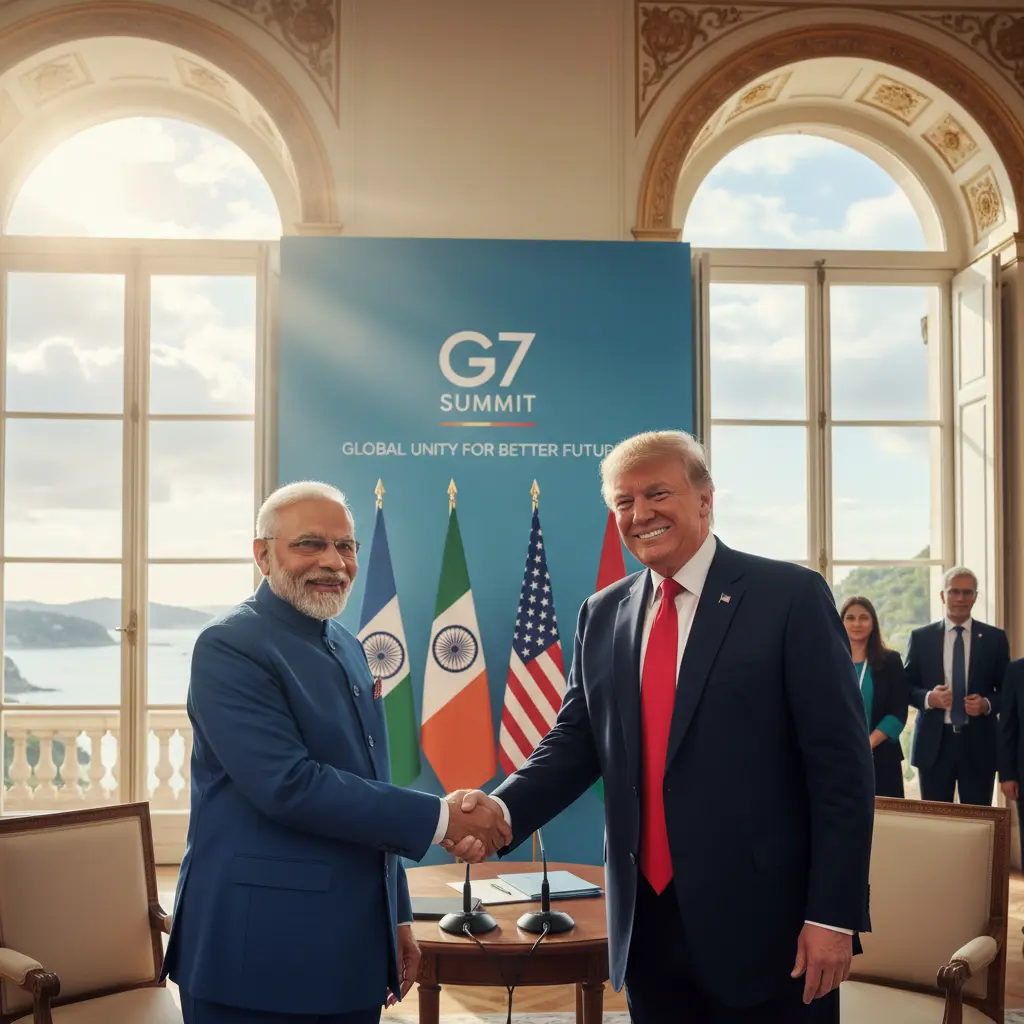
There’s something quietly significant about the way Prime Minister Narendra Modi walks into a room full of the world’s most powerful leaders. He doesn’t hurry. He doesn’t hedge. And at this year’s G7 Summit, expected to be held in France, that same composure is likely to define what could be one of the most consequential diplomatic appearances of his tenure.
India was not always a regular face at G7 gatherings. For decades, these summits were the exclusive preserve of Western industrialized nations — a club shaped by Cold War economics and Atlantic alliances. But the world has shifted. And so has India’s place in it. Modi’s anticipated participation at this year’s summit isn’t ceremonial. It signals something far more meaningful: that India now occupies a seat at the table where global decisions are made.
The Trump Factor
Perhaps the most closely watched moment of Modi’s summit schedule will be his expected bilateral meeting with US President Donald Trump. The two leaders have a well-documented chemistry — one built on mutual transactional respect and an understanding that both nations need each other more than either may openly admit.
But this meeting carries fresh urgency. India-US relations have been navigating a complex stretch, with trade tariffs, technology transfer restrictions, and the question of India’s strategic autonomy all sitting on the table. Based on news reports, the discussions will probably cover three broad topics: trade and market access, technology cooperation — especially in semiconductors and defense tech — and the changing geopolitical landscape due to the ongoing conflicts in Eastern Europe and the volatile situation across the Indo-Pacific.
For Modi, getting the trade conversation right is critical. India has been pushing for a structured bilateral trade agreement, and any positive signal from Trump could carry enormous domestic economic weight. For Washington, India represents both a massive consumer market and a vital counterbalance in the Asia-Pacific — a partner that is neither purely aligned with the West nor with Beijing.
More Than Just Two Leaders
While the Modi-Trump bilateral will inevitably grab the most headlines, India’s engagement at the G7 won’t stop there. Modi is expected to hold discussions with several other world leaders on the sidelines, including those from the European Union, Canada, and Japan — all key partners in India’s expanding global ambitions.
The agenda goes well beyond the traditional talking points of diplomacy. Climate finance, energy security, digital governance, and food supply chains — each of these is an issue where India both has a stake and increasingly, a voice. As one of the world’s largest economies and its most populous democracy, India’s positions on these matters can no longer be treated as peripheral.
This is the new reality that Modi has, over the past decade, worked steadily to build. India chairs multilateral dialogues, hosts international summits, and now participates in conversations that once happened without it.
Reading the Diplomatic Signals
Diplomacy is, at its core, a language of signals. And what Modi’s presence at the G7 signals to the rest of the world is layered with meaning. To the Global South — a grouping India has frequently championed — it sends the message that their concerns have a voice in the rooms where decisions are made. To China, it underlines that India is not retreating from international engagement despite the tensions along their shared border. And for domestic audiences, it reinforces the story of an India that is confident, assertive and consequential on the world stage.
The optics matter too. Images of Modi alongside heads of state from the United States, Japan, Germany, France, the UK, Italy, and Canada carry a symbolic weight that official communiqués never quite capture. International diplomacy is partly theatre, and Modi — whatever one thinks of his domestic politics — is a skilled performer on the global stage.
What India Wants from This Summit
Strip away the pageantry and a few clear priorities emerge for New Delhi. First, India wants progress on trade — not just with the US but with Europe, where negotiations have dragged on for years. Second, India is looking for commitments on technology access, particularly in areas related to clean energy, artificial intelligence, and advanced manufacturing. Third, there is the ongoing matter of global security — from Ukraine to Gaza to the South China Sea — where India’s position of strategic autonomy makes it a uniquely placed interlocutor.
And then there’s investment. Every bilateral Modi holds at the G7 is an opportunity to attract capital into India’s infrastructure, its startups, and its manufacturing base. Global diplomacy, for this prime minister, has always had an economic dimension.
A Different Kind of India
Perhaps the most honest way to understand what Modi’s G7 presence means is to see it through the lens of history. Twenty years ago, India attended events like this at the invitation of others, as a guest. Today, it arrives as a participant with its own agenda, its own demands, and its own leverage.
That shift didn’t happen overnight. It was built through years of economic reform, demographic dividend, military modernisation, and — critically — a foreign policy that refused to be boxed into any single alliance. India’s insistence on engaging with both Washington and Moscow, with both Riyadh and Tel Aviv, has sometimes frustrated its partners. But it has also made India indispensable.
As the world splinters into competing blocs and multilateralism frays at the edges, nations that can bridge divides become extraordinarily valuable. Modi knows this. And at the G7 in France, he will use it.
Modi at the G7: India Steps onto the Global Stage with Purpose.