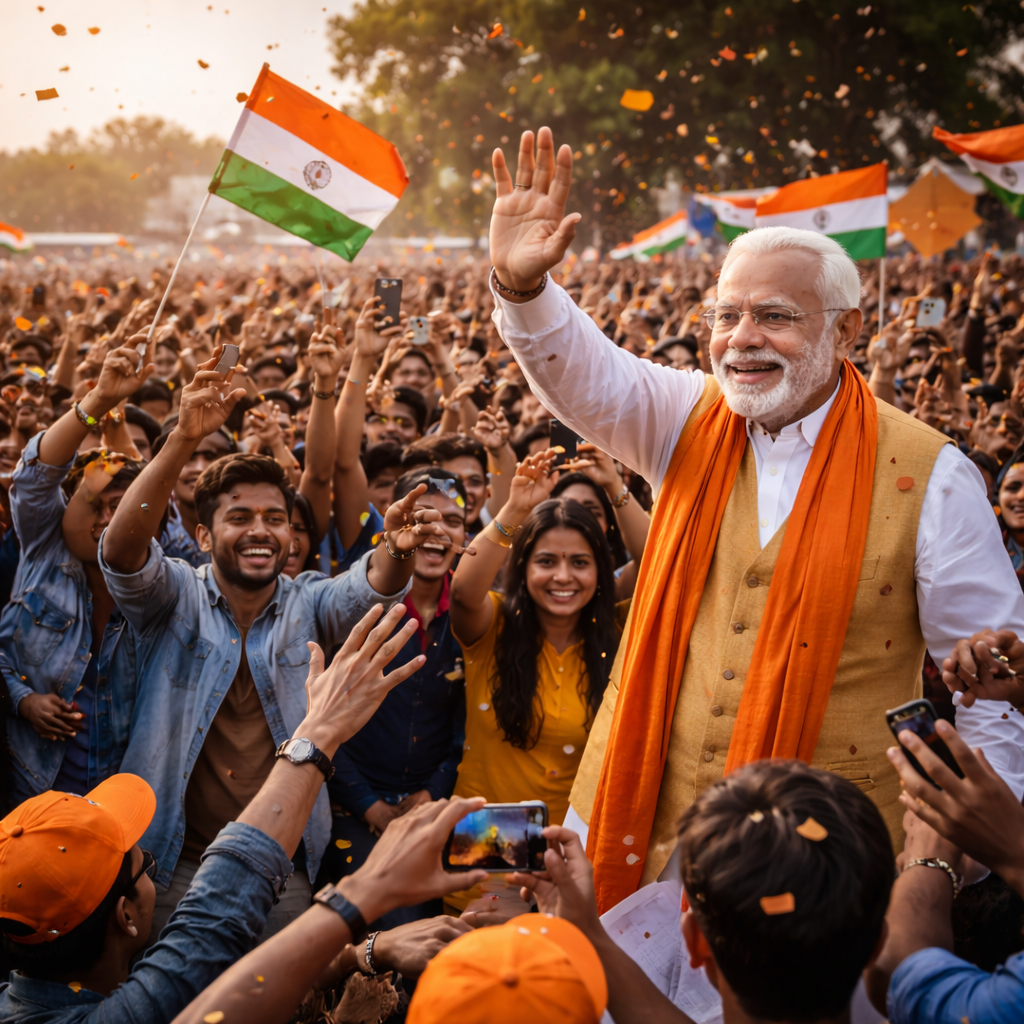
There’s a particular kind of electricity in a room when a young person realizes that the person at the top is actually listening.
Not performing. Not reading from a teleprompter. Actually listening — to their ideas, their frustrations, their vision of what this country could look like. That’s the energy at the heart of Prime Minister Narendra Modi’s ongoing youth engagement push in Bihar, and it deserves to be understood for what it really is: not just politics, but a genuine shift in how India’s leadership thinks about its youngest citizens.
Bihar Is Not Just a Political Destination — It’s a Demographic Statement
Before we talk about what Modi’s outreach means, let’s talk about where it’s happening and why.
Bihar is one of India’s most youthful states. A large portion of its population is under 30. And for decades, that demographic reality translated into one consistent storyline: young people leaving. Getting on trains to Varanasi, Delhi, and Mumbai, carrying ambitions that Bihar’s infrastructure couldn’t hold.
Modi himself acknowledged this migration problem directly when addressing Bihar’s youth. He stated that migration from Bihar to other states began due to a lack of educational opportunities, which forced parents to send their children elsewhere — and that this was the real beginning of Bihar’s migration crisis.
That framing matters. Because when a Prime Minister engages with young people in Bihar today, he’s not just addressing students in a hall. He’s engaging with the sons and daughters of a generation that left — and the generation that’s being asked to stay.
The Dialogue That Changed the Format
India’s relationship between government and youth has traditionally been one-directional. Speeches from the top. Reception at the bottom. The Viksit Bharat Young Leaders Dialogue 2026 — the centerpiece of the current youth engagement strategy — broke that mold in a meaningful way.
The programme featured a Grand Plenary Session led by the Prime Minister, including a Town Hall-style interaction with young leaders, where youth delivered ten high-impact presentations, each representing one of the national priority themes, directly before the Prime Minister and Union Ministers.
These weren’t symbolic presentations. A participant in the Dialogue, Anagh Saxena, stated that suggestions from young leaders were incorporated into the Union Budget 2026-27, with the Finance Minister referring to the dialogue directly in Parliament and describing the budget as youth-driven.
Think about that for a moment. A 20-something presenting to the Prime Minister — and seeing their idea show up in the national budget months later. That’s not tokenism. That’s governance with intention.
The Numbers Behind the Movement
The scale of youth participation in this initiative has been remarkable, and the Bihar component is no small piece of it.
The Viksit Bharat Young Leaders Dialogue 2026 recorded unprecedented participation, with over 50.42 lakh youth joining Phase 1 of the nationwide quiz — a significant rise from the previous edition’s 30 lakh participants, with youth from all 28 states and 8 Union Territories taking part.
Gender representation was nearly balanced, with 51% male and 49% female participants DD News — a detail that shouldn’t be glossed over in a country still working to close gender gaps in civic participation.
The Prime Minister himself expressed satisfaction, noting that more than 5 million registrations, over 3 million youths participating in the Viksit Bharat Challenge, and the sharing of ideas for the nation’s development represented unprecedented large-scale engagement of youth power. Prime Minister of India
Bihar’s Youth-Specific Investment — Real Money, Real Intent
Beyond dialogue and interaction, the government has backed its engagement with Bihar’s youth with substantial financial commitment.
Modi unveiled youth-focused initiatives worth more than ₹62,000 crore, with a special emphasis on Bihar, launching the PM-SETU scheme — Pradhan Mantri Skilling and Employability Transformation through Upgraded ITIs — with an investment of ₹60,000 crore, envisaging the upgradation of 1,000 government ITIs across the country. Business Standard
Closer to home for Bihar’s students, the redesigned Bihar Student Credit Card Scheme will provide completely interest-free education loans of up to ₹4 lakh, significantly easing the financial burden of higher education, with more than 3.92 lakh students having already availed loans worth more than ₹7,880 crore under the scheme. Prime Minister of India
There’s also the monthly allowance component — practical, immediate, and deeply human. Nearly five lakh graduates will receive a monthly allowance of ₹1,000 each for two years, along with free skill training, under the revamped Mukhyamantri Nishchay Svyam Sahayata Bhatta Yojana. Business Standard
For a young person in Patna or Darbhanga waiting for their first job, ₹1,000 a month plus free skill training isn’t just financial support. It’s a signal: we haven’t forgotten you while you figure out your next move.
The most important aspect of this Bihar program, and the larger VBYLD movement, is the core philosophy that guides it.
Ayushi Arya, a MyBharat Volunteer hailing from Patna, Bihar, and a presenter at the Dialogue, found the experience profoundly inspiring. She felt a swell of pride at being able to voice the hopes of India’s young people on such a prominent stage. She recalled Prime Minister Modi’s characterization of the youth as a “think tank” – a generation distinguished by its independent thought and the capacity to generate fresh, innovative ideas.
Prokerala
That description — youth as a think tank, not just a demographic — is what separates this initiative from routine political outreach. There’s a philosophical commitment at work here: the idea that governance shouldn’t happen at young people, but with them.
Modi emphasized that the period leading up to 2047, when India marks 100 years of independence, is a decisive phase for both the nation and its youth — and that the strength and capabilities of young Indians will shape India’s strength. Prime Minister of India
What This Means Beyond the Headline
Youth engagement programs can easily become photo opportunities. And critics are right to ask the hard questions — as one observer noted, the real test is whether a student from a small town in Bihar or a tribal area has an equal chance to be heard as those from elite colleges. New Kerala
That’s a fair and important question. Inclusion must extend beyond the auditorium. It must reach the student in Supaul who doesn’t have reliable internet. The girl in Muzaffarpur who never thought leadership was meant for her. The young man in Gaya who’s brilliant but broke.
The framework is now in place — the platforms, the funding, the dialogue infrastructure. What Bihar’s youth deserve next is not just access to these programs, but confidence that their participation will genuinely shape what comes next.
India is young. Bihar is younger still. And when a Prime Minister chooses to spend real time, real money, and real political capital on listening to that youth — the least we can do is pay attention to what they’re saying.
More Than a Speech — Why Modi’s Youth Outreach in Bihar Actually Matters.