
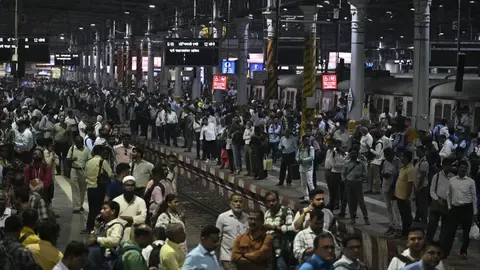
Mumbai’s suburban rail network was thrown into turmoil on Thursday evening when a tragic accident near Sandhurst Road Station resulted in two fatalities and three injuries, highlighting once again the grave dangers posed by overcrowding and disruptions on the city’s local train system. The incident occurred during the evening rush after a sudden service halt triggered by a protest.
The accident unfolded around 7 p.m. on the busy line of Central Railway when trains were stalled due to a flash protest by railway employees at the nearby Chhatrapati Shivaji Maharaj Terminus (CSMT). Services were reportedly suspended for nearly an hour, causing extreme overcrowding on platforms and in trains.
In the chaos, two commuters – one identified as a 19-year-old woman – were struck by a running train while walking on the tracks, and three more sustained injuries. The victims had alighted from overcrowded coaches and attempted to walk along the tracks to reach their destinations after becoming stranded.
Family members of the victims have pointed to the flash protest and resultant stand-still of services as the root cause of the tragedy. They allege that the crowding forced desperate commuters to take unsafe steps, such as walking along live tracks. “People were frustrated as the train was stationary for long … All of this happened because of the protest,” said one relative.
The flash protest was reportedly in response to an FIR registered after an earlier accident near Mumbra on June 9, where five commuters died in a case the engineers argue was caused by overcrowding rather than technical lapses. In their bail plea, the accused engineers stated that “many trains had passed through the tracks before and after the accident… if it was an issue with the tracks, at least the next few trains too would have been impacted.”
The incident once again draws attention to one of Mumbai’s long-standing systemic issues: overcrowding in suburban local trains during peak hours. Platforms designed for safe boarding and alighting are overwhelmed, and when services are disrupted, the risk to commuter safety escalates dramatically.
The suburban rail system in Mumbai carries millions of commuters each day and has little margin for error during disruptions. The combination of an unplanned stoppage, packed platforms, and frustrated passengers creates a dangerous scenario. This latest accident underscores how service disruptions can trigger cascading risks.
The protest-halt at CSMT reveals deeper issues of labour-management conflict within the railways—where employee grievances, operational disruptions, commuter safety and infrastructure vulnerabilities intersect. In this instance, the protest was triggered by a broader legal inquiry into the Mumbra accident, thereby linking two seemingly distinct events by the thread of commuter safety in congested conditions.
Efforts to mitigate overcrowding—such as adding more rakes, improving platform management, providing timely information to commuters, and managing labour disputes proactively—take on renewed urgency in the light of fatal incidents like this. Without prompt action, the risk of further loss of life remains elevated.
The deaths of two commuters and the injuries of three others at Sandhurst Road station must serve as a stark reminder of the vulnerabilities of Mumbai’s suburban rail system in the face of overcrowding and service disruption. As Central Railway investigates the crash and the preceding events, the broader imperative is clear: ensure commuter safety is not compromised by operational protests or infrastructural strain. The tragedy reaffirms the urgent need for structural reforms, better crowd-management protocols and contingency planning to safeguard the lives of thousands who rely on local trains every day.

