
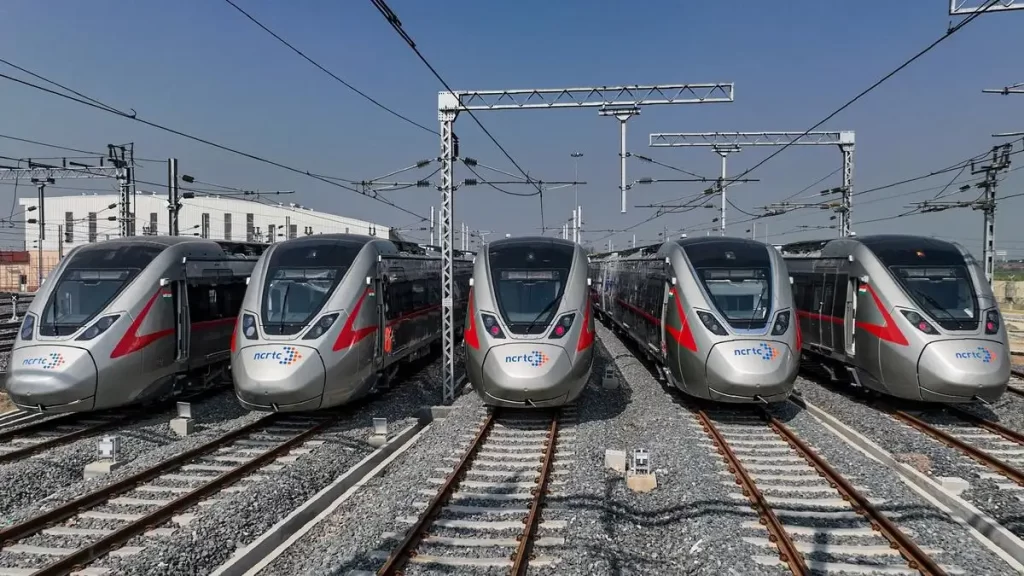
September 13,2025: India’s transport sector has reached a new milestone as the Namo Bharat train on the Delhi–Meerut Regional Rapid Transit System (RRTS) officially became the fastest train in the country, achieving a top speed of 160 kilometres per hour. This development places it ahead of the semi-high-speed Vande Bharat Express and Gatimaan Express, which currently operate at lower average speeds on most routes.
The Namo Bharat service has reduced the journey time between Delhi and Meerut to under an hour, offering commuters a faster and more reliable alternative to road travel. Officials confirmed that the 160 km/h speed was achieved on the 55-kilometre operational section between Sahibabad and Modi Nagar South. Once completed, the Delhi–Meerut corridor will cover 82.15 kilometres and include 16 modern stations.
Manufactured by Alstom at its Savli plant in Gujarat, the Namo Bharat trains incorporate advanced safety systems such as Automatic Train Protection, Automatic Train Control, and Automatic Train Operation. These features ensure precision, minimise human error, and improve overall safety. The aerodynamic design further allows the train to accelerate smoothly while reducing drag, making sustained high-speed travel possible even with frequent halts.
The comparison with existing services highlights the achievement. While Vande Bharat Express was designed for speeds up to 180 km/h, operational restrictions have limited it to around 130–140 km/h across most routes. Gatimaan Express, which runs between Delhi and Jhansi, does operate at 160 km/h but only on limited stretches. Namo Bharat, in contrast, maintains its top speed over significant portions of the route, coupled with a frequency of 15 minutes between trains. This makes it not only the fastest but also one of the most efficient services in the country.
The Delhi–Meerut corridor is expected to play a major role in boosting regional connectivity and reducing travel times for thousands of daily commuters. The National Capital Region Transport Corporation (NCRTC), which is implementing the project, has designed the RRTS network to integrate seamlessly with the Delhi Metro and other modes of transport, making it easier for passengers to switch between systems. In addition to speed and safety, the trains also provide modern amenities such as Wi-Fi, air conditioning, and comfortable seating.
Experts believe the high-speed corridor will encourage more people to opt for rail travel instead of road transport, reducing traffic congestion and vehicular emissions. The economic benefits are expected to be significant, with improved connectivity spurring growth in both residential and commercial sectors across the region.
The Delhi–Meerut RRTS is only the beginning of India’s ambitious rapid transit expansion. Similar projects are already planned for the Delhi–Panipat and Delhi–Alwar corridors, which will further strengthen intercity rail travel in the National Capital Region. Once completed, these projects are expected to set new benchmarks for speed, safety, and passenger convenience.
With the Namo Bharat train achieving 160 km/h, India has taken a decisive step towards modernising its railway network. The Delhi–Meerut RRTS is set to redefine the future of public transport in the country, making high-speed travel a reality for millions of commuters and firmly establishing Namo Bharat as India’s fastest train.

