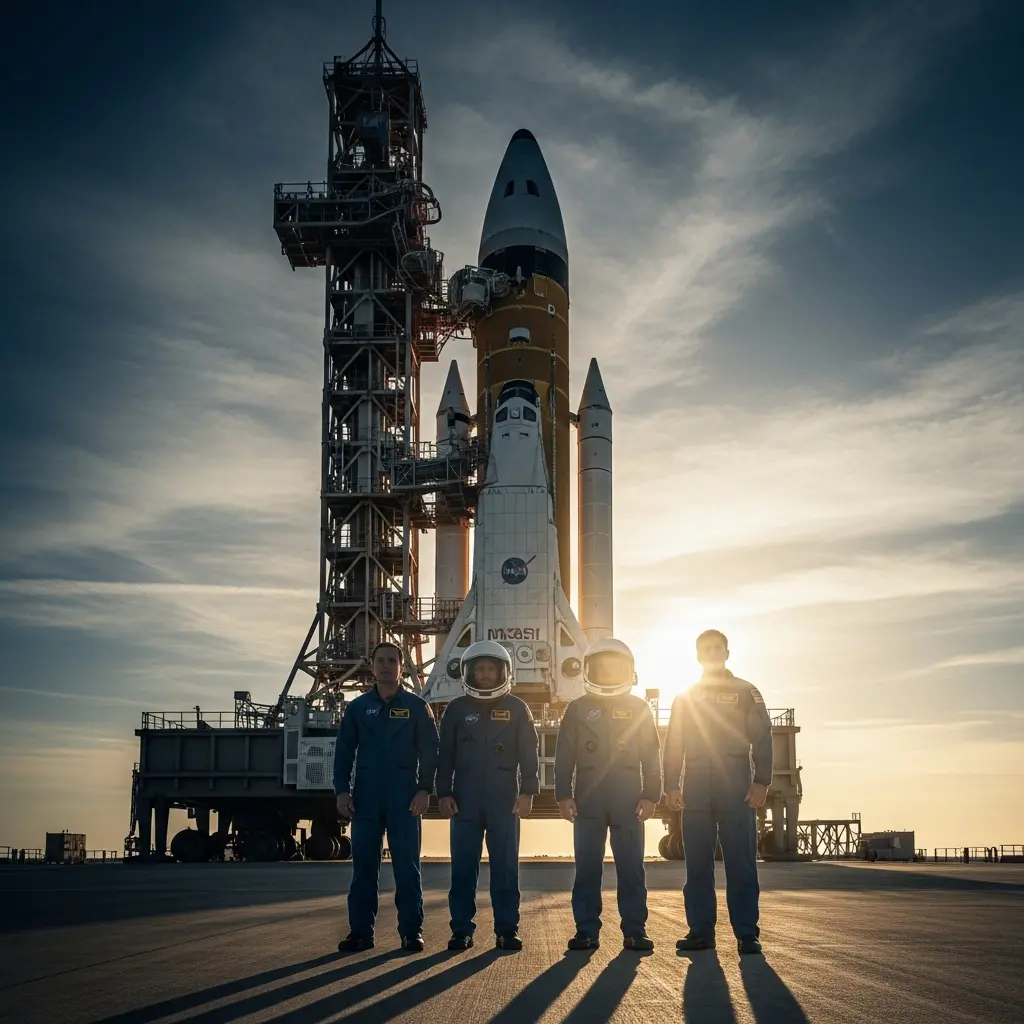
There is something about putting names and faces to a Moon mission that makes it real in a way that no technical briefing ever quite can. When NASA revealed the astronaut team selected for Artemis III, it wasn’t just an agency announcement — it was a reminder that at the center of all the engineering marvels, the rocket equations, and the policy decisions, are real human beings preparing to do something that only a handful of people in all of history have ever done.
The Moon mission is coming. And now we know who is going.
More Than a Crew List
Crew announcements in the space program carry a weight that is hard to articulate. For the astronauts selected, it is the culmination of years — often decades — of training, sacrifice, and patient waiting. For the engineers and scientists who have spent careers building the systems that will carry them, it is the moment the work becomes personal. And for the rest of us here on Earth, it is an invitation to look up and remember that the story of human exploration is still being written.
The selection of the Artemis III crew is a testament to NASA’s commitment to not only return to the Moon, but to do so with purpose and intention. Unlike Apollo — which was, in many ways, a race driven by Cold War urgency — the lunar program of today is being designed for longevity. The goal isn’t a flag and a few hours on the surface. It is the construction of a permanent human presence beyond the Earth, starting on the Moon and then outward in the solar system.
The crew chosen for this mission has been selected with that long vision in mind.
What Artemis III Is Actually Trying to Accomplish
To appreciate why this mission matters, it helps to understand where it sits in the larger arc of the NASA Artemis program. Artemis I was uncrewed — a test of the Space Launch System and the Orion capsule, sending them around the Moon and back to prove the hardware could survive the journey. Artemis II, the crewed flyby, put humans aboard and took them to lunar distance for the first time since Apollo 17 in 1972.
Artemis III is the one that lands.
But beyond the landing itself, the mission carries a technical agenda that will shape everything that comes after it. Docking operations with the Lunar Gateway — the orbital outpost being built in partnership with international space agencies — will be tested in real conditions for the first time.
Critical life support, surface mobility, and communication systems will be put through their paces not in a simulation chamber in Houston, but on the actual lunar surface, under actual lunar conditions.
The data gathered will be irreplaceable. All the systems that work well, all the unforeseen challenges that expose a design gap, all the procedures that need tweaking — it all goes into the blueprint for what’s next.” In this sense, Artemis III isn’t just a Moon mission. It is the foundation course for permanent human habitation beyond Earth.
The Human Element of Space Exploration
It is easy, in the flood of technical details that accompany any major space exploration announcement, to lose sight of the human story. These are men and women who have trained for environments that are unforgiving in ways that are almost incomprehensible. The Moon has no atmosphere to shield against radiation. Temperatures swing from brutal heat in sunlight to lethal cold in shadow.
Communication delays, equipment malfunctions, and the sheer physical demands of operating in a spacesuit are constant companions.
And yet, people volunteer for this. They compete fiercely for the privilege of taking on that risk. That says something profound about the human impulse to explore — an impulse that apparently cannot be argued, calculated, or risk-assessed out of existence.
The Artemis III astronauts arrive bearing not only their own dreams, but the dreams of everyone who has looked up at the Moon and wondered what it would be like to stand on it. That is a remarkable thing to carry.
An International Moment
While NASA leads the Artemis program, it would be a mistake to frame it purely as an American endeavor. The lunar program is also a story of international partnerships with space agencies from Europe, Japan, Canada and beyond. It is a conscious choice to make this chapter of exploration a collective human project, not a national trophy.
The technologies being tested, the protocols being established and the knowledge being accumulated will belong to the wider community of nations that explore space. In a world that often struggles to find common ground, the shared aspiration of space exploration has a quiet way of creating it.
Countdown to the Surface
There will be more announcements before launch day. More milestones, more technical reviews, more moments of anticipation and anxiety. Space programs move on timelines that test human patience, and the NASA Artemis III mission is no exception.
But the crew is named. The mission is real. And somewhere in Houston and Huntsville and Cape Canaveral, the people who will make it happen are already deep in the work of getting it right.
The Moon waited more than fifty years for us to return. The wait, it seems, is nearly over.
NASA Announces Artemis III Crew: The Humans Behind Humanity’s Next Giant Leap.