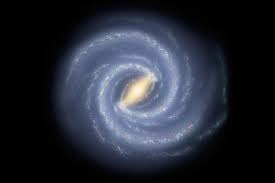
NASA simulations predict that our Milky Way galaxy will merge with the nearby Andromeda galaxy in around 4.5 billion years. This event will change how astronomers think about how galaxies change over time. Advanced modeling has long forecast this celestial catastrophe, which will change the night sky and the future of our cosmic neighborhood.
The Galactic Showdown is here!
Astronomers have been watching Andromeda, also known as Messier 31, for a long time. It is the nearest spiral galaxy to the Milky Way. It comes at us at a speed of about 250,000 miles per hour, which has been confirmed by decades of telescopic observations. NASA’s Hubble Space Telescope and data from the Gaia mission have made projections more accurate, putting the collision timeline at roughly 4.5 billion years with amazing accuracy.
This prediction is more accurate than earlier ones that changed because we didn’t fully grasp how dark matter and orbital pathways work. The event is important for more than just its grandeur; it shows how galaxies evolve in the universe as a whole. Today, we can see distant galaxies colliding, which causes bursts of star creation and wakes up central black holes.
NASA’s Breakthrough Simulations
Scientists at NASA’s Goddard Space Flight Center have used supercomputers and more than ten years of data to create a model of the encounter. The Milky Way and Andromeda, which are each around 100,000 light-years wide, will dance together because of gravity. At first, their spiral arms stay the same, but over time, they merge into an elliptical monster that people often call Milkomeda.
The Triangulum galaxy, or M33, is one of the models that might be involved, which makes things more complicated. Dark matter halos, which are much bigger than stars and can’t be seen directly, govern the courses of galaxies. Star-to-star collisions are still uncommon since there is so much space between them, just like two swarms of fireflies passing by each other without hurting each other. This investigation has led to changes in ideas about how cosmic structures develop.
A timeline of the inevitable clash
The merger happens in different steps. First, Andromeda’s disk will grow in our skies for the next three billion years. It might cover a much of the sky, but no one will be able to see it. The galaxies graze each other for about 3.5 billion years, pulling on each other’s arms and lighting up star clusters.
Around 4.5 billion years, the cores completely fuse, and supermassive black holes may spiral together, sending out gravitational waves. Five to six billion years after the event, the new ellipse settles down, with its stars moving in a calmer way around scattered globular clusters. These N-body simulations show how mergers create star nurseries from recycled gas, which keeps old spirals from fading away.
What this means for Earth and the Solar System
The clash happened a long time ago, yet it has a big effect on our solar system. Models say that the Sun gets thrown into a new orbit, maybe one that is farther from the center, in a star field that has been reorganized. The patterns of the stars would change, but the Sun’s life cycle, which ends in a red giant phase, will have already burned Earth long before that.
There are no mass star crashes that pose a concern; the chances stay low since there are hundreds of billions of stars spaced out. Still, denser areas might bring supernovae closer together, changing cosmic rays. For astrobiology, mergers add metals that are important for planets and life, and they change systems to make them more habitable.
Expert Opinions on How Galaxies Change Over Time
Roeland van der Marel, an astronomer at Hubble who is important to Andromeda research, says that these kinds of occurrences explain why elliptical galaxies are common in clusters. This is more proof that hierarchical merging, which builds galaxies from pieces of the Big Bang, works. T.J. Cox, an expert in simulations, talks about Milkomeda’s role in the future of the Local Group, which connects more than 50 people in a huge web.
Nearby instances like the Antennae Galaxies reveal merger chaos, creating stars that look like the sun at a rate of 100 per hour. Ultraviolet views show how gas compression causes these flares, giving a sneak peek at Milkomeda’s drama.
Dynamics of Stars and Gases
During collisions, tidal forces change the interstellar medium in a big way. Gas pulled from arms moves within, causing starbursts that are 100 times more powerful than normal. Before running out of fuel, Milkomeda might create billions of new stars, turning into a quiet ellipse.
Sagittarius A* in the Milky Way, which has four million sun masses, dances with Andromeda’s giant, which has 100 million solar masses. Their merger releases energy that is equal to billions of suns, according to relativity, and shapes the remains. LISA and other future detectors may be able to find these old ripples.
A Wider Cosmic Context
These spirals are the most important parts of the Local Group. They show how mini-structures are forming as the universe expands. After the merger, Milkomeda takes the lead and pulls in dwarf galaxies over millions of years. This fits with Lambda-CDM models, which say that mergers turned early aggregates into contemporary galaxies.
ALMA sees patterns in merging couples, like brighter nuclei, bigger halos, and more clusters. These help people look for exoplanets because changes in the universe could move inhabited worlds.
Problems with Prediction Exactness
There are still gaps. Gaia’s 17 km/s tangential velocity for Andromeda is based on line-of-sight measurements. Dark matter curves change the timing, maybe by a billion years. Rubin Observatory surveys offer more accurate data.
GADGET-4 codes tackle the intricacy of core quantum effects and supernova feedback. Still, experts all agree that it is unavoidable.
Technological Horizons in Research
James Webb looks at old mergers and finds early starbursts. Roman Telescope maps all of the group’s movements; ground giants figure out where the Andromeda stars are. Lensing by foregrounds may increase the number of quasar views, showing dark substructure.
Philosophical and Cultural Echoes
The prediction makes us wonder and makes us feel little in the grand scheme of things. The stories of Andromeda as a shackled figure are rapidly being replaced by stories of scientific reunions. It stops people from thinking that the universe is always changing.
Planetariums and VR make it real, and NASA’s programs get kids interested in STEM.
Possible Directions for Future Research
Multi-wavelength efforts are on the way: Euclid maps dark matter, and SPHEREx maps the history of infrared light. AI-enhanced simulations and magnetohydrodynamics make realistic gas models that can uncover merger signatures in the cosmic background.
The collision of the Milky Way and Andromeda shows how big evolution may be by changing our star system. It doesn’t signify the end of the world; instead, it celebrates the life of the universe and stimulates more in-depth star investigation.
NASA data shows that the Milky Way and Andromeda galaxies will collide in 4.5 billion years.