In a stunning cosmic snapshot that feels like a quiet moment of reflection, NASA’s Psyche mission has captured a new crescent image of Mars as it journeys toward the enigmatic metal‑rich asteroid 16 Psyche. Snapped on May 3, 2026, from roughly 4.8 million kilometers (3 million miles) away, the frame shows Mars as a ghostly, thin crescent—reminiscent of the Moon as seen from Earth—highlighting both the spacecraft’s trajectory and the delicate beauty of our neighboring world. This fleeting view isn’t just a publicity‑worthy photo op; it’s a crucial milestone in a mission that could reshape how scientists understand the formation of rocky planets and their hidden cores.
As the spacecraft continues its deep‑space glide toward 16 Psyche, the crescent Mars image offers a vivid reminder of how far NASA has reached beyond Earth’s orbit—and how much closer we are to opening a literal window into the interior of a planet‑like body. For astronomers and space enthusiasts alike, the shot raises a question: when we finally “see” what a planetary core looks like, will it look more like the iron‑nickel heart of Earth or something entirely unexpected?
The Psyche Mission: A Journey to a Metal World
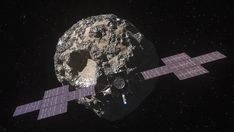
Launched in 2023, the Psyche mission is built around a singular, ambitious premise: visit an asteroid that may be the exposed core of a shattered early planet. Designated 16 Psyche, this object orbits the Sun between Mars and Jupiter, within the main asteroid belt, and is estimated to be about 220 kilometers across. Initial observations suggest that Psyche is unusually rich in metal, with scientists long suspecting it could be the remnant core of a planetesimal that never fully grew into a full‑size planet.
If that turns out to be true, the implications are profound. Planetary cores—like the one at the center of Earth—are buried under layers of rock and difficult to study directly. Psyche, by contrast, could offer a rare, almost up‑front view of a bare planetary core, giving scientists a chance to test long‑standing theories about how rocky planets like Earth, Mars, and Venus formed and evolved. As the mission’s lead investigators have put it, studying Psyche is like “going to the doctor to understand the whole body but getting to see the heart up close.”
How Mars Fits Into Psyche’s Trajectory
The crescent image of Mars emerged during a critical phase of the mission’s path: a gravity‑assist maneuver around the Red Planet. On May 15, 2026, the Psyche spacecraft is scheduled to swing past Mars, using the planet’s gravity to adjust its speed and trajectory so it can eventually reach 16 Psyche without needing an excessive amount of fuel. This kind of maneuver is a staple of deep‑space navigation, and NASA has used Mars flybys to boost missions such as the Curiosity and Perseverance rovers, as well as earlier orbiters.
As Psyche approached, it pointed its cameras back toward Mars, capturing the planet from a high‑phase angle—meaning the Sun was almost directly behind the spacecraft, illuminating the planet’s edge and leaving most of its disk in shadow. From that vantage point, Mars appears as a luminous crescent, backlit by the faint glow of sunlight skimming across its atmosphere. The image has been color‑enhanced slightly to bring out atmospheric and surface details, but the thin, curved shape is real—echoing the crescent Moon many of us see from Earth on certain nights.
Why This Image Matters Beyond the “Wow” Factor
At first glance, the crescent Mars photo might seem like a beautiful bonus, not central to the mission’s science. But it actually serves several practical and symbolic purposes. First, it helps engineers confirm that the spacecraft’s cameras and navigation systems are functioning coherently as Psyche continues its long journey toward the asteroid belt. Images taken from such distances also provide valuable data for refining the spacecraft’s trajectory, ensuring that the crucial Mars flyby on May 15 goes smoothly and places Psyche on the right path toward 16 Psyche.
Beyond the engineering side, the image offers a rare planetary‑scale perspective of Mars from a spacecraft that is not orbiting or landing on it. Most Mars images are captured by orbiters close to the planet or by rovers on its surface, which means they often focus on specific regions or surface features. A distant crescent view, however, emphasizes Mars as a whole world—its atmosphere, its curvature, and its relationship to the Sun—giving planetary scientists context that can help refine models of how light interacts with the Martian sky and how weather patterns play out across the planet.
The Search for Planetary Cores: What Psyche Could Reveal
The core scientific goal of the Psyche mission is to understand whether 16 Psyche really is the partially exposed core of an early planetesimal. If it is, the spacecraft will use a suite of instruments—including a multispectral imager, a gamma‑ray and neutron spectrometer, a magnetometer, and a radio science instrument—to map the asteroid’s surface, composition, magnetic field, and gravity. Taken together, these measurements could answer whether Psyche formed under similar or very different chemical conditions as Earth’s core, and whether it contains the same light elements that are expected to exist deep within our own planet.
For planetary scientists, the answers could help test theories about the early Solar System. One big question is whether rocky planets tend to form in stages—starting as small planetesimals that collide and grow—or whether some metal‑rich bodies like Psyche represent an alternate pathway, where heavy elements coalesced early and then never fully mixed into larger worlds. If Psyche turns out to be more oxidized or chemically different than Earth’s core, it could force a rethink of how and where the heavy metals needed for planets like ours actually accumulated.
From an Indian and global perspective, the mission also ties into broader efforts to understand the building blocks of habitable worlds. With India’s Mangalyaan orbiter and the upcoming Mars Lander Mission (MOM‑2), as well as joint missions with the United States and Europe, there is growing interest in how planetary interiors influence surface conditions, atmospheres, and the potential for water and life. Psyche’s insights into core formation could indirectly feed into models that help explain why Mars ended up so different from Earth, even though both worlds started out as rocky bodies in the inner Solar System.
From Distant Mars to the Psyche Flyby Timeline
The Mars crescent image is just one waypoint in a much longer journey. After the May 2026 gravity assist, Psyche will coast for several years before arriving at 16 Psyche in the late 2020s, where it will enter orbit and begin a detailed survey of the asteroid. Over the course of the orbital phase, the spacecraft will move through a series of gradually lowering orbits, allowing it to study Psyche’s surface at ever‑finer resolutions and collect data on its composition, magnetic properties, and topography.
The timeline is intended to be flexible so mission planners can adjust if the spacecraft encounters unexpected circumstances around the asteroid. For example, if Psyche’s surface turns out to be more fragmented or more reflective than expected, the flight team may modify the orbit or observation plan to prioritize the most promising science targets. This kind of adaptability is typical of modern deep‑space missions, from NASA’s OSIRIS‑REx and DART missions to ESA’s Hera and JUICE projects, all of which use real‑time data to refine their strategies.
What Comes Next for Psyche and Planetary Science
As NASA prepares for the Mars gravity assist on May 15, teams around the world are watching closely. For the Psyche mission, the next few days will be crucial for confirming navigation, updating the spacecraft’s trajectory, and ensuring that its instruments are ready for the long haul toward 16 Psyche. The mission’s success will depend not only on the health of the spacecraft but also on the ability of scientists to interpret the data once it arrives, especially if Psyche turns out to be more complex—or more surprising—than current models predict.
For the broader field of planetary science, the mission fits into a growing trend of probing the “innards” of Solar System bodies. From missions that crash into asteroids and comets to those that drill into the interiors of planets or study the composition of moons like Europa and Enceladus, researchers are increasingly focused on understanding what lies beneath the surface. Psyche is special because it offers a chance to study something that may literally be a planetary core, potentially giving us a clearer picture of how worlds like Earth, Mars and Venus came to be — and how common or rare such planets might be elsewhere in the universe.
As the crescent Mars image fades from the news cycle, it will linger as a quiet visual waypoint on a much grander journey. The Psyche mission is still in its early stages, but already it has given us a hauntingly beautiful reminder of how far we have come—and how much further we are trying to go. Will we one day look at metallic asteroids and say, “This is what a planetary core looks like”? Or will Psyche reveal that the interior of a planet is even stranger than we imagined? Whatever the answer, the crescent Mars image is a fitting prelude to a story that is only just beginning.
NASA’s Psyche Mission Snaps a Haunting Crescent Mars as It Races Toward a Metallic Asteroid