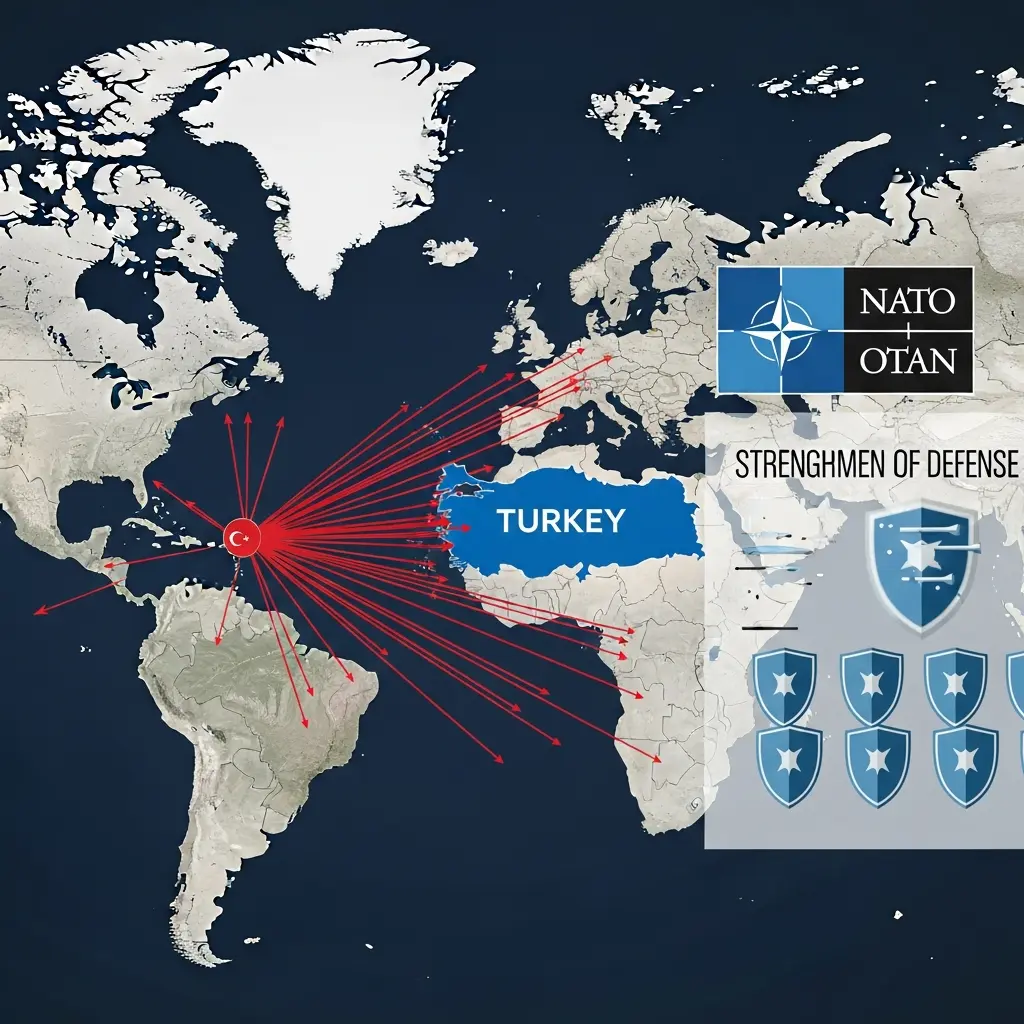
There is a moment in every crisis when the situation shifts from concerning to critical — when the events unfolding on a map stop feeling distant and start feeling dangerously close. For NATO, that moment arrived in early March 2026, and it has not eased since. What began as a regional conflict between the United States, Israel, and Iran has steadily, unmistakably, crept toward Europe’s doorstep. And for the Western military alliance, the response has been swift, decisive, and growing with every passing week.
On Monday, March 30, the world was reminded once again just how serious things have become.
The Fourth Interception in Less Than a Month
Turkey confirmed on Monday that a ballistic munition launched from Iran was neutralized by NATO forces after entering Turkish airspace — marking the fourth such interception since the U.S. and Israeli strikes on Iran began on February 28.
In a statement, the Turkish Defense Ministry said: “A ballistic munition, determined to have been launched from Iran and to have entered into Turkish airspace, has been neutralized by NATO air and missile defense assets deployed in the Eastern Mediterranean.” Outlook India No casualties were reported. No major damage. But the message embedded in that single interception was loud and impossible to ignore — this conflict is no longer contained.
The incident marks the fourth time since March that a missile launched from Iran has been intercepted on its way to or within Turkish airspace, according to Turkish authorities. VEDANTU Four intercepts in four weeks. That is not a coincidence. That is a pattern — and NATO is responding to it with everything it has.
How This Escalation Began
To understand what NATO is facing today, you need to rewind to the end of February 2026, when the regional conflict entered a new and far more dangerous phase. The incident represents the fourth time NATO has intercepted a projectile originating from Iran as it approached or entered Turkish airspace. Iranian officials have previously denied launching attacks targeting Turkey.
The first interception came on March 4, 2026, when NATO air and missile defense installations intercepted a ballistic missile bound for Turkey, with debris falling in Dörtyol, Hatay. Turkish officials confirmed the missile was launched from Iran and passed through Iraqi and Syrian airspace before being shot down. ISKCON The Iranian ambassador in Ankara was summoned immediately. Iran denied involvement.
The second interception followed on March 9, with debris from the downed Iranian missile falling on empty fields in Gaziantep province in southern Turkey. There was no damage or casualties. Wikipedia Turkey’s defense ministry stressed that while the country values peaceful relations, it would not hesitate to act against any threat to its territory or airspace.
By March 13, a third missile was intercepted — this time near the strategically vital Incirlik Air Base, which hosts U.S., Spanish, and Polish military personnel. NATO confirmed the development, with spokesperson Allison Hart stating that “NATO remains vigilant and stands firm in its defense of all allies.”
NATO’s Expanding Defense Posture
The alliance has not merely been watching and responding — it has been actively reinforcing Turkey’s defensive shield with each successive threat. Following the March 13 missile incident, the Turkish Ministry of National Defense announced the deployment of an additional Patriot air and missile defense system to Incirlik Air Base. The deployment was authorized by NATO Allied Air Command in Ramstein, Germany, and operates alongside the Spanish-operated Patriot system stationed at Incirlik since 2015.
The latest deployment brings the number of NATO Patriot batteries stationed in Turkey to three.
NATO is also sending another Patriot missile defense unit to Turkey’s Incirlik Air Base, which would complement “national-level measures to ensure the security of our airspace and our citizens,” according to the Turkish Defense Ministry. NewsBytes The PAC-3 system — an advanced Patriot unit designed specifically to intercept ballistic and cruise missiles — represents the cutting edge of alliance air defense capability.
Following the incidents, NATO also deployed a U.S. Patriot air defense system to the southeastern Turkish province of Malatya to increase defense at the Kurecik radar base — a key element of NATO’s missile shield that can detect Iranian missile launches.
It’s about securing the early warning system that the entire alliance relies on.
Turkey’s position in this unfolding crisis is especially intricate. As a NATO member since 1952, Turkey stands out as the only country in the Middle East within the alliance. This places it at the forefront, and also makes it the most vulnerable.
ISKCON It is also, simultaneously, a country attempting to serve as a diplomatic bridge between Washington and Tehran.
Turkey is acting as an intermediary between the United States and Iran in a bid to find a path to de-escalation in the war. VEDANTU Turkish Foreign Minister Hakan Fidan has been in active communication with his Iranian counterpart, attempting to address discrepancies between Iran’s denials and the technical evidence of missile launches. President Recep Tayyip Erdoğan sent a firm warning to Iran following the second interception to stop their “wrong and provocative steps.” ISKCON
Turkey is simultaneously defending itself, absorbing alliance reinforcements, and trying to stop the conflict from spiraling further. It is an extraordinarily difficult position — and one that underlines just how high the stakes have become for European security.
The recent event concerning Turkish airspace has consequences that extend far beyond Turkey’s borders, affecting both NATO and Europe as a whole. This interception underscores the widening geographical scope of the conflict and the increasing involvement of international military alliances in regional security.
Amitray
Furthermore, Iran’s actions, including its attempts to control maritime traffic in the Strait of Hormuz, have added to the instability in global energy markets.
Amitray The consequences — surging oil prices, supply chain disruptions, inflation fears — are already being felt in economies thousands of miles from the battlefield.
The alliance response has been measured but firm. Defense systems are being reinforced. Member nations are coordinating strategy. Diplomatic channels remain open. But the fundamental reality of 2026 is this — a conflict that began in the Middle East has now, four missile intercepts later, drawn NATO into its orbit in ways that cannot be walked back quietly.
Europe is watching. The alliance is ready. And the world is holding its breath.
NATO Strengthens Defense Measures: The Alliance Responds as Missile Threats Escalate Over Turkey.