
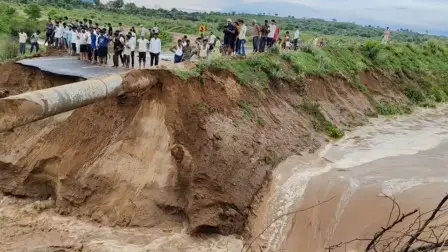
10 July, 2025-A newly-constructed highway in Rajasthan, expected to significantly boost regional connectivity, collapsed into a river before its official inauguration, raising serious concerns over construction quality, accountability, and public safety. The incident occurred following a spell of torrential rains that battered the region over the past several days.
The collapsed structure was part of a ₹40-crore infrastructure project aimed at improving road access between rural and urban districts in southern Rajasthan. Eyewitnesses reported that a substantial section of the road, which ran parallel to a river, caved in and submerged under strong water currents just days before its scheduled opening ceremony.
According to preliminary reports, the rains had led to a rapid rise in river levels, which exerted significant pressure on the embankment supporting the highway. However, engineering experts and critics have pointed to possible lapses in the design and construction standards as contributing factors to the failure. Videos of the collapsed highway quickly went viral on social media, prompting public outrage and demands for a thorough investigation.
Officials from the Public Works Department (PWD) acknowledged the collapse and stated that a technical team has been dispatched to assess the damage and determine the cause. A senior official remarked, “We have initiated a structural audit to understand whether this was due to excessive rainfall or substandard construction. Accountability will be established, and necessary action will follow.”
The incident has sparked political controversy, with opposition leaders accusing the government of compromising on infrastructure safety in the rush to complete projects before elections. Critics argue that such infrastructure disasters not only result in financial losses but also undermine public trust in state-led development initiatives.
Experts have stressed that climate resilience must be a key component of infrastructure planning, especially in flood-prone areas. “With increasing instances of extreme weather, construction practices must evolve to ensure durability against natural disasters,” said a civil engineering consultant.
In the aftermath of the collapse, construction companies involved in the project have come under scrutiny. Activists are calling for blacklisting firms found guilty of negligence and urging greater transparency in the tendering and monitoring processes of public infrastructure projects.
The highway collapse also raises concerns about the quality control mechanisms in place during construction. Government audits and third-party evaluations are now expected to become stricter, with central and state agencies already facing mounting pressure to reassess ongoing infrastructure works across the region.
This incident is not isolated. Similar occurrences in other states have highlighted the urgent need for reforms in infrastructure governance, particularly in the face of unpredictable climate conditions. While authorities have assured swift reconstruction, public confidence in the region’s infrastructure remains shaken.
The Rajasthan highway collapse serves as a grim reminder of the consequences of inadequate planning and oversight in public construction. As investigations continue, citizens and experts alike await concrete steps to prevent such failures in the future, ensuring that development is both sustainable and safe.

