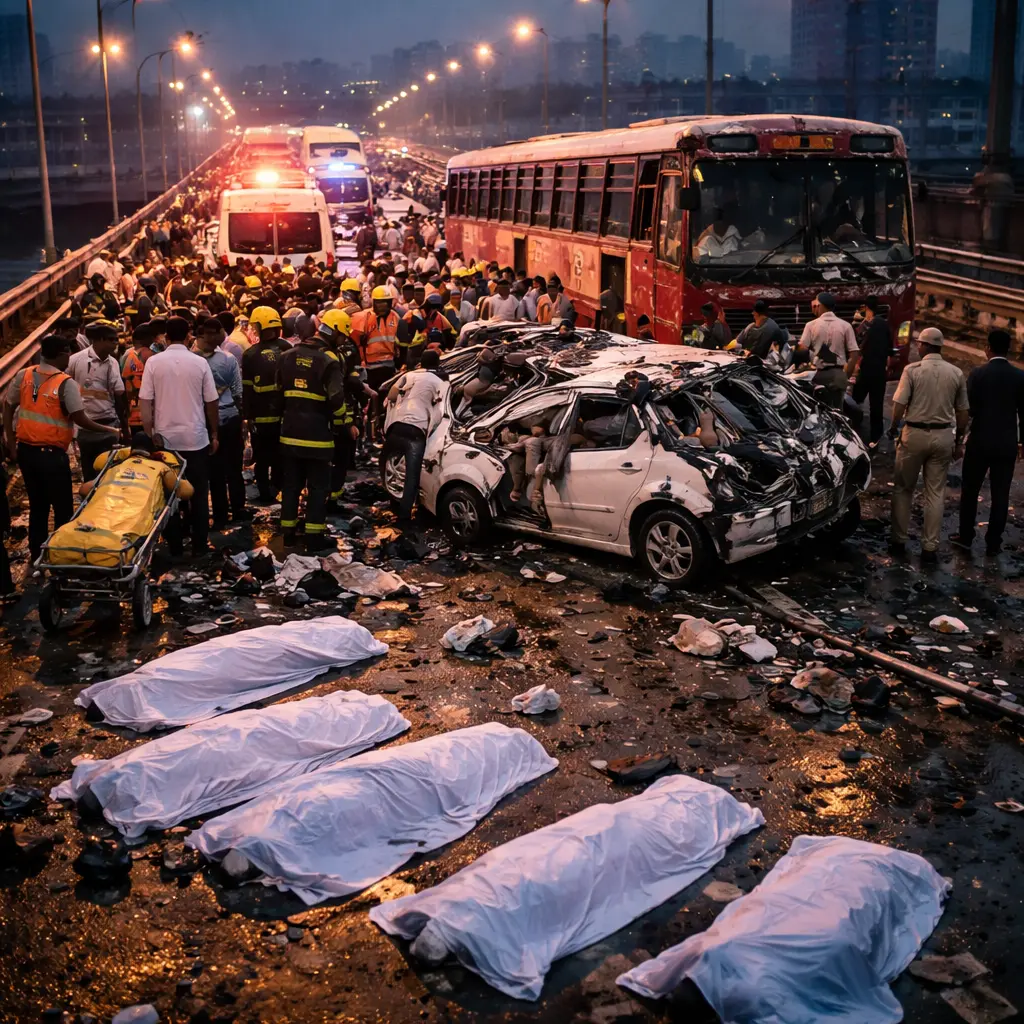
A speeding van and a cement mixer collided on a busy overpass in Maharashtra’s Thane district, killing nine people and leaving three others injured — reopening old wounds in India’s road safety crisis.
It was supposed to be an ordinary journey. But somewhere on a bridge in Thane district, Maharashtra, that ordinary journey turned catastrophic in an instant. A passenger van, allegedly speeding and hampered by poor visibility, slammed into a cement mixer. The impact was devastating. By the time rescue teams arrived and cleared the wreckage, nine people lay dead. Three others were pulled from the scene with injuries and rushed to nearby hospitals. In the silence that followed, a familiar grief settled over the district — one that India has felt far too many times before.
What happened
The Thane crash unfolded on a bridge in one of Maharashtra’s most densely connected urban corridors. Eyewitnesses and initial probes into the accident suggest two key contributors: the van driver’s excessive speed and the poor visibility that prevailed when the crash occurred. The collision’s force mangled both vehicles, pinning numerous passengers and complicating the already urgent rescue operations. Local police reached the spot quickly, cordoning off the area as emergency response teams began the grim task of extracting survivors and victims from the wreckage.
“Speeding and poor visibility — two problems we keep talking about, and two problems that keep killing people.”
Authorities have launched a formal investigation into the Maharashtra accident. Though the precise sequence of events is still being pieced together, the prevailing theory points to driver error, exacerbated by environmental factors that severely limited reaction time. The bridge, much like others in India’s swiftly growing urban areas, experiences heavy, mixed traffic throughout the day. Commercial vehicles, private cars, and passenger vans all share the road, often with little or no physical separation.
The bigger picture is troubling, too. The Thane road accident wasn’t a one-off. India regularly finds itself near the top of the list for road traffic deaths worldwide. Each year, tens of thousands of people die in crashes that, frankly, shouldn’t happen.
Maharashtra, with its sprawling highways and bustling urban expressways, is a constant presence in these statistics. For years, specialists have identified a blend of factors as the underlying problems: insufficient traffic enforcement, flawed road design, vehicles carrying too much weight, and a general lack of public understanding.
What makes accidents like this traffic collision particularly painful is the pattern they fit into. A bridge. A fast-moving vehicle. Low visibility. No time to react. These are not new variables — they are recurring features in a broken system that too often prioritizes construction speed over safety engineering. Road dividers, speed cameras, lane discipline enforcement, and mandatory vehicle fitness checks exist in policy documents but frequently fall short in practice, especially in peri-urban zones where Thane lies.
Response and accountability
The Maharashtra state government has acknowledged the accident and is expected to convene a review of traffic regulations in the wake of the crash. Whether that review translates into meaningful enforcement reform or fades quietly into bureaucratic procedure remains the real question. After each such incident, the cycle is familiar: expressions of condolence, calls for inquiry, promises of stricter enforcement — and then, in time, another accident that proves the promises were hollow.
Local authorities in Thane have been under pressure for some time to address rising traffic violations on elevated roads and bridges where monitoring is harder and crashes tend to be more fatal due to the nature of the terrain. Rescue crews did their jobs well that day, quickly clearing the debris and getting the injured the medical attention they needed. Still, quick rescues are always a stopgap measure. The only lasting answer is prevention, which requires political commitment, ongoing investment, and a serious look at the consequences of inaction.
Remembering the nine
Behind every statistic in a road safety report is a name, a family, a last conversation that no one knew would be the last. The nine people who lost their lives on that Thane bridge were not abstractions. They were mothers, fathers, sons, daughters — people who boarded a van on what should have been a routine day. Their deaths deserve more than a news cycle. They deserve the kind of systemic change that ensures the next family boarding a van on an Indian road does not face the same fate. Until then, every bridge, every highway, every poorly lit stretch of road in this country carries the weight of what we have not yet done.
Nine Dead on a Thane Bridge: When Seconds Decide Everything.