
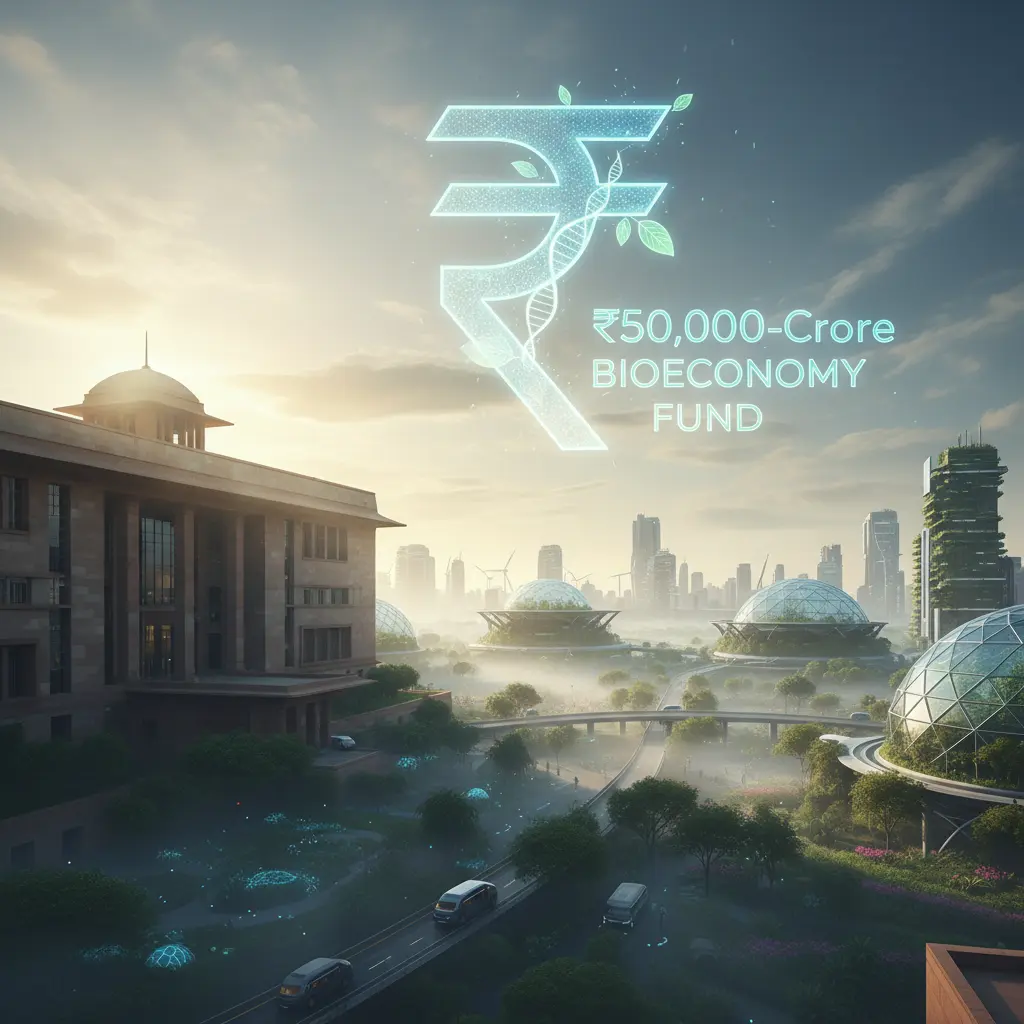
India’s biotechnology sector might be about to get its biggest policy push yet. NITI Aayog has released a new roadmap proposing a ₹50,000-crore BioEconomy Growth Fund, along with a set of national missions designed to turn India into one of the world’s leading biotech powerhouses over the next decade. The plan, titled “Building India as a Leading BioEconomy Powerhouse by 2035,” was released by NITI Aayog’s Frontier Tech Hub in partnership with the Department of Biotechnology, and it’s ambitious in a way that Indian policy documents rarely are.
The Numbers Behind the Ambition
Here’s the scale of what’s being talked about. India’s bioeconomy currently stands at around $195.3 billion, contributing about 4.8 percent to the country’s GDP. That figure alone represents nearly a 16-fold jump over the past decade, which is no small feat. But NITI Aayog isn’t stopping there. The roadmap projects the bioeconomy growing to $392 billion by 2030, then $691 billion by 2035, and, in a genuinely eye-catching long-term projection, reaching as high as $2.6 trillion by 2047, at which point it would account for somewhere between 8 and 10 percent of a projected $30 trillion Indian economy.
To get there, the plan expects the sector to generate more than 30 million high-value jobs and to help establish at least 15 globally competitive Indian biotechnology companies. NITI Aayog member Prof. Gobardhan Das, speaking at the roadmap’s launch, called this moment a turning point comparable to earlier industrial revolutions, and pointed to the fund as a way to back stronger talent pipelines alongside world-class biomanufacturing capacity.
Six Missions, One Direction
Rather than continuing with what the roadmap describes as fragmented biotechnology programmes, NITI Aayog is pushing for a shift toward six mission-driven national initiatives, each targeting a specific frontier within the broader bioeconomy. These include GeneIndia, aimed at expanding access to affordable gene and cell therapies and precision diagnostics; AgriBio 2.0, focused on climate-resilient crop varieties and quality-assured bio-inputs; BioX Foundry, meant to commercialise synthetic biology innovations; One Health Grid, built around AI-assisted disease surveillance; a Marine Biotechnology mission promoting seaweed cultivation and marine bioproducts; and BioPharmaNext, which aims to position India as a hub for next-generation biologics, biosimilars, vaccines, and AI-driven drug discovery.
Together, these missions are meant to build what the roadmap calls sovereign capabilities across advanced therapeutics, climate-resilient agriculture, synthetic biology platforms, pandemic preparedness, blue-economy innovation, and next-generation biologics. It’s a wide net, touching healthcare, agriculture, and clean energy applications all at once, which reflects just how broadly “bioeconomy” is being defined here.
Where the ₹50,000 Crore Actually Goes
The BioEconomy Growth Fund itself is designed to run from 2026 to 2035 and is meant to solve a problem that has quietly held back Indian biotech for years: the gap between promising laboratory research and actual commercial-scale manufacturing. Plenty of good science in India never makes it past the pilot stage because the capital and infrastructure needed to scale up simply aren’t there. This fund is meant to plug exactly that gap, offering capital support to start-ups, research institutions, and industry players working across the biotech spectrum.
Alongside the fund, the roadmap recommends PLI-style incentives, similar to what’s already worked for electronics and pharmaceuticals manufacturing, plus faster regulatory approvals and stronger intellectual property protections. There’s also a proposal for a dedicated fast-track IP pathway to help speed up commercialisation, along with new institutional structures: an Empowered Committee on National BioMissions, a National BioData Council, and a BioEconomy Investment and Policy Forum, all meant to improve coordination between ministries, departments, industry, and researchers.
Betting on Talent as Much as Capital
Money alone won’t get India to a $691 billion bioeconomy, and the roadmap seems to recognise that. Union Minister of State for Science & Technology Dr Jitendra Singh, speaking at the same launch event, announced India’s first Engineering Biology graduation course, describing it as a step toward building an independent, sovereign biotechnology ecosystem. He noted that India’s bioeconomy has already expanded from roughly $10 billion in 2014 to about $95 billion today, with IITs reportedly already submitting proposals for interdisciplinary programmes that combine engineering and medical training.
Prof. Das was even more provocative, comparing the promise of engineering biology in the next few decades to what computer science did for the digital revolution, a comparison that hints at how integral a discipline this is likely to be to India’s innovation economy in the future.
Next Steps
This is a roadmap, not a budget commitment set in stone for now. The proposal will need to go through inter-ministerial consultations before any final funding and implementation plan gets announced, so the actual rollout, timelines, and disbursement mechanisms are still to be worked out. That said, if the government does move from blueprint to budgeted reality, this could rank among India’s most significant industrial policy pushes since the PLI scheme reshaped electronics and pharmaceutical manufacturing.
With competitors like the United States, China, and several European nations also racing to scale up their own bio-manufacturing capabilities, the timing of this push isn’t accidental. Officials clearly see a narrow window for India to capture a meaningful share of the global bioeconomy market before the field gets even more crowded. Whether the ₹50,000-crore fund and its accompanying missions can actually close India’s long-standing lab-to-market gap will depend a great deal on how quickly the consultations wrap up and how faithfully the final plan sticks to what’s been proposed today.

