
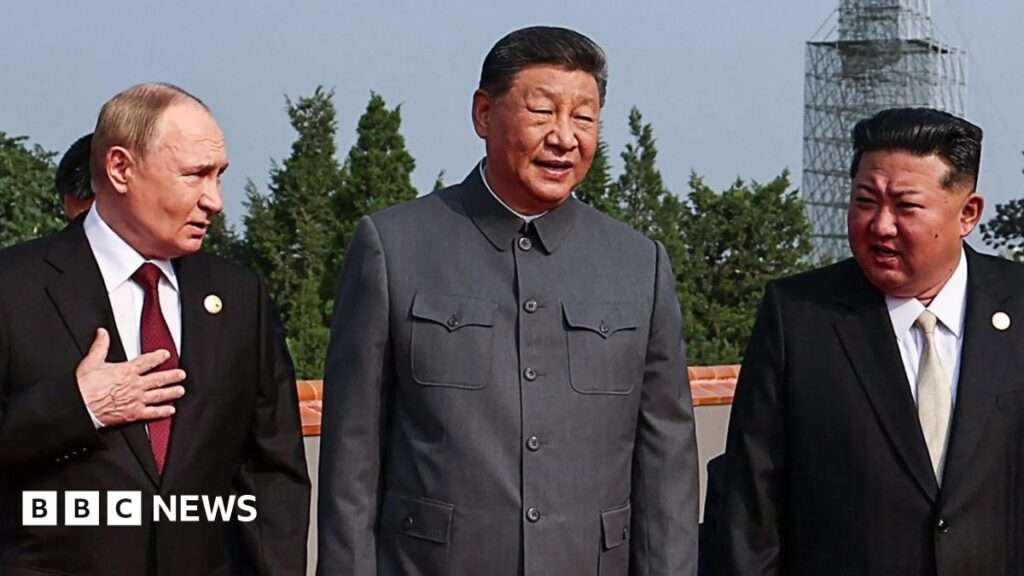
In a powerful display of military might and geopolitical alignment, North Korea hosted a massive military parade in Pyongyang to mark the 80th anniversary of the ruling Workers’ Party of Korea. The event, far more than a domestic celebration, served as a potent international message, highlighted by the unveiling of what state media described as the nation’s “most powerful” nuclear strategic weapon and the conspicuous attendance of top-level delegations from Russia and China. This extraordinary convergence of military spectacle and diplomatic support underscores a hardening of the “axis” against Western influence and has profound implications for global security.
The parade, featuring thousands of goose-stepping soldiers and an array of advanced weaponry, culminated in the showcasing of a new Intercontinental Ballistic Missile (ICBM), reportedly the Hwasong-20. North Korea’s presentation of this advanced missile, believed to be a solid-fuel system capable of carrying multiple warheads and striking the entire US mainland, is a calculated move to assert its status as an “irreversible” nuclear state and enhance its leverage on the world stage.
The ‘Most Powerful’ Weapon: Analyzing the Hwasong-20 ICBM
The star of the show, the newly unveiled ICBM, represents a significant leap in North Korea’s ballistic missile technology. While full details remain unconfirmed by independent observers, the official description as the “most powerful nuclear strategic weapon system” points to several critical advancements.
Key Facts on Missile Capabilities:
- Solid-Fuel Technology: Unlike previous liquid-fueled ICBMs, a solid-fuel missile like the alleged Hwasong-20 is far more practical for operational deployment. It can be stored, transported, and launched much faster, drastically reducing the crucial launch preparation time and making it significantly harder for US and South Korean forces to detect and preemptively strike. This shift enhances the survivability and readiness of North Korea’s missile force.
- Targeting the US Mainland: Experts suggest that the new ICBM’s range could exceed 15,000 kilometers, theoretically putting any location in the United States within striking distance.
- Multiple Warhead Potential: The missile’s large diameter suggests it may be designed for a Multiple Independently Targetable Reentry Vehicle (MIRV) payload. This capability would allow one missile to carry multiple nuclear warheads, each capable of striking a different target, a development that would severely complicate and potentially overwhelm existing US missile defense systems.
The unveiling of the Hwasong-20 is not merely a technical showcase; it is a declaration of confidence in the nation’s rapidly advancing missile program, directly challenging international sanctions and the security posture of the United States and its allies.
The Geopolitical Context: A New Axis of Solidarity
Perhaps as significant as the missiles themselves was the high-level attendance from North Korea’s key allies. The presence of Chinese Premier Li Qiang and Russia’s Dmitry Medvedev, the Deputy Chairman of Russia’s Security Council and a key ally of President Vladimir Putin, sent an unmistakable signal of geopolitical solidarity against the Western-led global order.
Facts on Foreign Attendance and Alignment:
- Elevated Status: The attendance of such senior officials—Premier Li being the highest-ranking Chinese official to attend a North Korean military parade in decades—lends significant diplomatic weight to Pyongyang’s celebrations. This counters the narrative that North Korea is a pariah state.
- Russia-DPRK Military Ties: Medvedev’s presence and reported talks with Kim Jong Un, where the leaders pledged to strengthen cooperation, further solidify the deepening Russia-DPRK military relationship. This relationship has flourished amid Russia’s war in Ukraine, with North Korea reportedly supplying military support in exchange for economic and potentially technical assistance. Kim Jong Un even honored North Korean soldiers dispatched to fight for Russia at the parade, publicly acknowledging Pyongyang’s contribution to Moscow’s war efforts.
- Trilateral Alignment: The event follows Kim’s attendance at a military parade in Beijing just weeks prior, where he stood alongside Chinese President Xi Jinping and President Putin. This sequence of high-profile meetings and shared military spectacles powerfully demonstrates a coordinated effort to showcase a united North Korea-China-Russia solidarity, essentially forming a strategic counter-bloc to the US and its allies in Asia.
Messaging to the World and the West
For Kim Jong Un, the elaborate parade served multiple purposes. Internally, it reinforces the legitimacy of his leadership and the “byungjin” policy of simultaneous economic and nuclear development. Externally, however, the message is stark and direct.
In his speech, Kim Jong Un vowed to build an “invincible” military force that “eliminates all threats.” By displaying the Hwasong-20 directly in front of Russian and Chinese delegations, Kim is conveying two core messages: first, that his nuclear deterrent is robust, operational, and capable of holding the US at risk; and second, that North Korea is not isolated but is a valued partner within a powerful strategic network.

