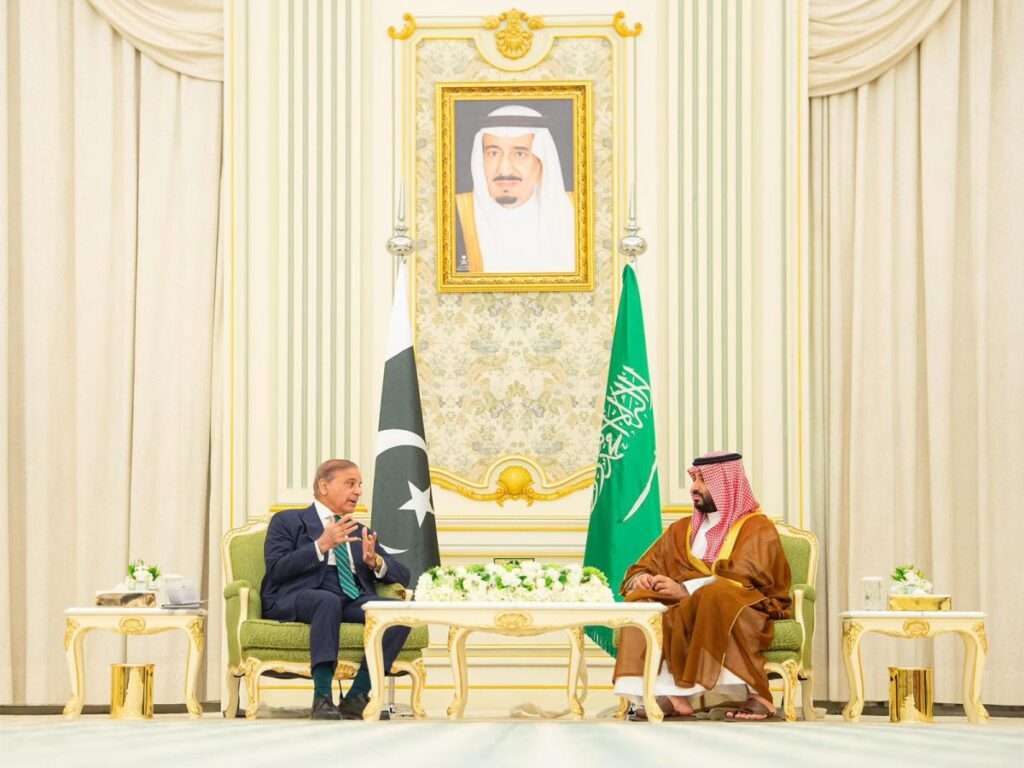
In a significant geopolitical development, Pakistan and Saudi Arabia signed a Strategic Mutual Defence Agreement on September 17, 2025, in Riyadh, solidifying their long-standing security cooperation. The pact, hailed as a milestone in bilateral relations, underscores a commitment that an attack on one nation will be considered an attack on both, aligning their defence policies more closely than ever before.
The agreement formalizes decades of military and strategic collaboration between the two countries. Both Islamabad and Riyadh have historically shared close defence ties, with Pakistan providing training support to Saudi forces and Riyadh extending financial assistance to Islamabad during times of economic distress. This new pact elevates their partnership to a binding security alliance, signaling a shift in the regional balance of power.
Saudi Defence Minister Khalid bin Salman and Pakistan’s Defence Minister Khawaja Muhammad Asif jointly announced the deal after a high-level meeting. The ministers emphasized that the agreement is aimed at ensuring “regional stability and mutual security” while strengthening the broader strategic partnership between the Gulf monarchy and South Asia’s nuclear-armed nation.
Regional observers note that the deal comes at a time of heightened tensions in the Middle East and South Asia. Saudi Arabia continues to navigate complex dynamics with Iran, while Pakistan faces ongoing challenges along its eastern and western borders. By embedding a collective defence clause, the two nations have effectively created a formal deterrence mechanism that could alter the security calculus in the region.
India, which shares a historically tense relationship with Pakistan, has responded cautiously to the development. The Ministry of External Affairs (MEA) stated that New Delhi is “closely studying the pact and its implications for national and regional security.” Analysts believe that India will monitor whether the agreement translates into enhanced military cooperation that could affect South Asia’s fragile security environment.
Experts also point out that the agreement reflects Riyadh’s evolving foreign policy, aimed at diversifying strategic partnerships beyond the United States. For Pakistan, the pact represents both an opportunity for enhanced security assurances and a potential counterbalance to its growing economic dependence on China.
While the agreement was welcomed domestically in both Pakistan and Saudi Arabia, some regional analysts warn that it could escalate rivalries. “The collective defence clause introduces new complexities in the Gulf-South Asia security architecture,” said Dr. Sameer Khan, a defence analyst based in Dubai. “It will likely trigger recalibrations among neighboring states, including India and Iran.”
The Strategic Mutual Defence Agreement is expected to cover intelligence sharing, joint military exercises, and enhanced defence technology cooperation. Though full details remain undisclosed, officials in Islamabad confirmed that discussions on missile defence systems and counterterrorism strategies are underway.
As the region absorbs the implications of this pact, the coming months will be crucial in determining how it reshapes existing alliances and rivalries. For now, the deal marks a decisive step in Pakistan-Saudi Arabia relations, potentially redefining the security architecture across the Middle East and South Asia.