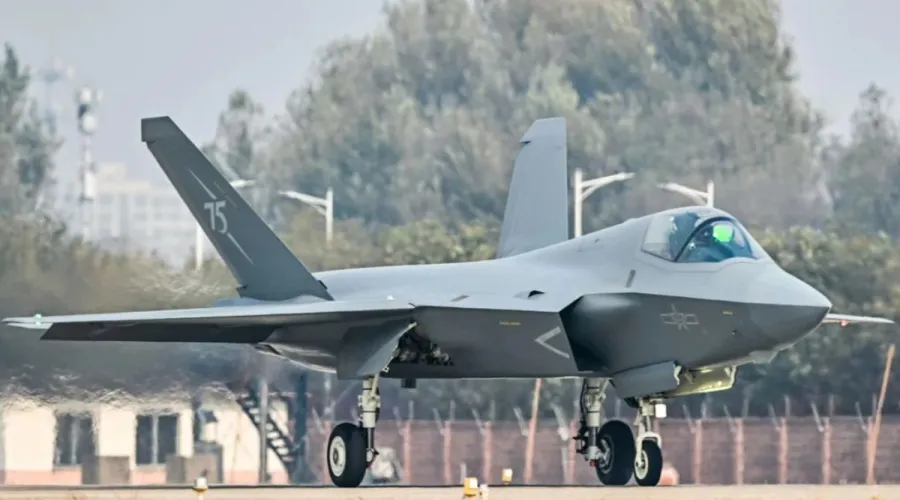
Pakistan is reportedly in advanced talks with China to procure 40 J-35 fifth-generation stealth fighter jets, a move that could significantly strengthen its air combat capabilities. At the same time, India’s homegrown fifth-generation fighter project—the Advanced Medium Combat Aircraft (AMCA)—remains several years from operational induction, raising concerns among Indian Air Force (IAF) veterans about the growing technological gap.
The J-35, developed by China’s Shenyang Aircraft Corporation, is a stealth-capable multirole combat aircraft featuring low radar visibility, advanced avionics, and long-range strike potential. Although still undergoing trials, the aircraft is being positioned as a major advancement in China’s defense export strategy.
If finalized, the acquisition would make Pakistan one of the first foreign operators of a fifth-generation stealth fighter in the region, marking a strategic leap in its aerial warfare capabilities. Defence analysts say this development could challenge India’s current air superiority in South Asia.
“Pakistan gaining access to stealth platforms like the J-35, especially with Chinese support, changes the regional airpower dynamics,” said Air Marshal Anil Chopra (Retd.), Director General at the Centre for Air Power Studies. “India must respond with urgency to avoid a capability imbalance.”
India’s AMCA project, led by the Defence Research and Development Organisation (DRDO) in collaboration with Hindustan Aeronautics Limited (HAL), is currently in the detailed design phase. The prototype is expected by 2028, with serial production projected post-2035.
Despite the planned deployment of Rafale jets and upgrades to Su-30MKI fighters, India currently lacks any operational stealth aircraft. This absence, coupled with delays in the AMCA program, has raised concerns about India’s preparedness in facing next-generation threats.
“Technology gaps cannot be ignored, especially when both China and Pakistan are moving ahead with stealth capabilities,” said Group Captain Sandeep Mehta (Retd.). “India needs to explore interim options—either through international collaboration or through rapid development of indigenous unmanned stealth systems.”
The J-35’s potential induction into the Pakistan Air Force (PAF) is being seen not just as an arms deal but as a strategic extension of China’s influence in South Asia. The deepening military ties between Beijing and Islamabad are raising fresh concerns in New Delhi.
Meanwhile, the Indian government has reaffirmed its commitment to self-reliance in defence. The AMCA program recently received initial funding and has seen involvement from private sector giants like Tata Advanced Systems and Larsen & Toubro to accelerate timelines.
However, IAF veterans argue that timelines must be reviewed in light of emerging threats. “We cannot afford to wait another ten years to field a fifth-gen fighter when the adversary might deploy one much sooner,” Chopra added.
As the race for stealth superiority in the region heats up, India’s response in the coming years will play a crucial role in maintaining strategic balance. Fast-tracking the AMCA and exploring temporary alternatives may be key to safeguarding national airspace and deterrence posture.