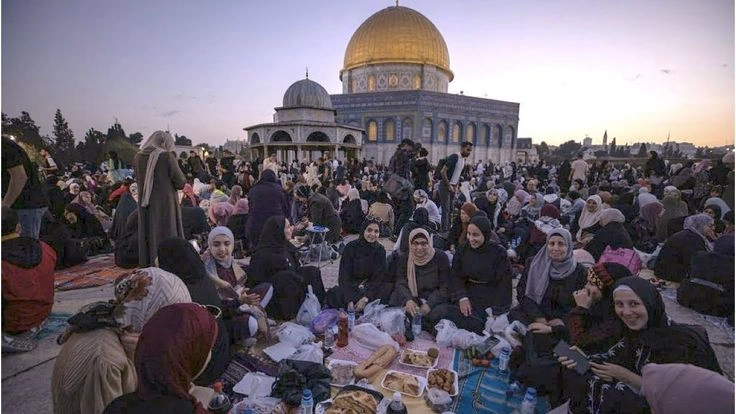
As Ramadan approaches, Israeli officials have made it very hard for Palestinians to get to the Al-Aqsa Mosque compound in Jerusalem, especially on Fridays. People are worried that this will make religious and political tensions in the area worse. Palestinian officials and worshippers have harshly condemned this action, alleging it is a deliberate attempt to make it harder for people to get to one of Islam’s holiest sites.
The Al-Aqsa Mosque Disputes Through Time
The Haram al-Sharif, or Temple Mount, in Jerusalem’s Old City is where the Al-Aqsa Mosque is. It means a lot to both Jews and Muslims. Muslims believe that the Prophet Muhammad made his Night Journey there, and it is the third holiest destination for Muslims after Mecca and Medina. Because Jews hold the same compound in high regard as the site of the First and Second Temples, there are different opinions about it.
Access problems have been a source of friction for decades, and the continuing Israeli-Palestinian conflict has made things worse. Ariel Sharon’s visit in 2000 and other events led to the Second Intifada. This shows that dominating this area might make a lot of people unhappy. There have been a number of battles in the previous few years, and when Israeli security forces are on high alert, they often don’t let Palestinians in because they think militant groups constitute a threat.
Age and residence limits are frequent in these kinds of rules. For instance, men under 50 can’t live in West Bank towns or need specific licenses to do so. Even if these acts are meant to be precautionary, they invariably lead to accusations of religious discrimination and efforts to change the way things are.
A detailed look at the most recent restrictions
Israeli police warned that the requirements for getting into Al-Aqsa for Friday prayers would be tighter before Ramadan, which is expected to start in late February or early March 2026, depending on when the moon is seen. Reports claim that only Palestinian men over 40 from Jerusalem, as well as women and children, will be able to enter without needing to plan beforehand. Younger males from the West Bank are not let in at all unless they are checked out one by one, which is a process that is known for taking a long time and turning people away.
These constraints are comparable to those from previous years, but they seem harsher this time. This is in line with intelligence indications that Hamas or Islamic Jihad groups may try to attack. The Jerusalem District Police said that the steps are meant to “keep the peace and keep the public safe.” This means that places like the Lions’ Gate can do electronic checks. Women and families can get in more readily, but the focus on young males is because they are worried about stone-throwing or knife attacks during peak prayer times.
Eyewitnesses report that on recent Fridays, there were long queues, ID checks, and skirmishes as outraged worshippers were turned away. One guy from Jerusalem said, “Because the mosque was closed, hundreds of people prayed in the streets.” It’s terribly sad during this holy month. Palestinian news sites have made these incidents seem worse than they are by calling them “systematic exclusion.”
Palestinians reacted and protested
Mahmoud Abbas, the president of the Palestinian Authority, said that the restrictions were “a dangerous escalation that desecrates our sacred places.” Hamas, the terrorist group that controls Gaza, called for big protests against the scheme, which they branded the “Judaization” of Al-Aqsa. People in Ramallah and Nablus protested by burning tires on fire and blocking roads while chanting “Al-Aqsa is Arab.”
Youth groups connected to Fatah organized sit-ins at checkpoints, and social media campaigns with hashtags like #SaveAlAqsa became viral in the area, gaining millions of views. Religious leaders, such as the Grand Mufti of Jerusalem, wrote fatwas asking people to stay strong and warning that limiting access damages the spiritual meaning of Ramadan.
These views were supported by a lot of Muslim groups around the world, from the Organisation of Islamic Cooperation to minor groups in Europe and the US. Thousands of people protested in Amman, Jordan, which has a large Palestinian diaspora. This put pressure on King Abdullah II, the mosque’s custodian, to step in diplomatically.
Reasons for the safety of Israel
Israeli officials indicated that this is the only way to deal with actual threats. Itamar Ben-Gvir, the Minister of Public Security, is known for being strict about who can go to the Temple Mount. He remarked, “Unrestricted entry invites violence,” and pointed to an increase in attacks since October 2023. Last year, the Israel Security Agency said there were more than 200 incidents at the site, such as attacks on officers and attempts to smuggle weapons.
The office of Prime Minister Benjamin Netanyahu highlighted the need to engage with Jordan to establish a balance between security and worship rights, pointing out that thousands still go to daily prayers. There is more monitoring now, such facial recognition technology, to make it easier to check people and keep troublemakers away. Supporters argue that what they did avoided more violence from erupting on holidays in the past.
Some members of the Meretz party and human rights groups in Israel, such B’Tselem, feel that the measures are unfair because they punish the peaceful majority for what a small group of people did. They refer to facts that show that most people who come in are religious, not fighters.
Effects on the world and the region
The restrictions affect more than just Jerusalem; they also make it tougher to get along with Arab neighbors. Jordan, which is in charge of Al-Aqsa as a Waqf, asked the Israeli envoy to come in for talks. It reminded me of a part of a peace agreement from 1994 that talked about holy sites. Both Egypt and Turkey spoke out against the move. President Erdogan called it “Ottoman-era injustices.”
The State Department advised everyone to “exercise restraint,” but they didn’t go so far as to condemn what the US did. President Donald Trump, who was re-elected in 2024, is strongly pro-Israel. Foreign ministers from the European Union asked for a de-escalation and pointed out the risks to the two-state solution.
Wider events in the Middle East make things worse. Hezbollah is battling on Lebanon’s border, and talks to end the conflict in Gaza have stopped. If things go worse at Al-Aqsa, it might lead to disasters on several fronts. Analysts fear that similar protests might erupt in the West Bank, where violence from settlers has already made residents leave their homes.
Trends and Important Numbers
To show how huge it is:
Visitor Numbers: Before the restrictions, Al-Aqsa hosted between 50,000 and 100,000 worshippers on Fridays during Ramadan. These constraints may cut this in half right now.
Attack Incidents: Israeli police say there were 150 or more fights in the compound in 2025, which is a 30% rise from 2024.
Permit Approvals: Only 20 to 30 percent of applications from the West Bank are accepted, which means that thousands of people are stuck every year.
The #AlAqsa hashtag goes up by 500% during these events, which makes content go viral on all platforms.
These data show that the method works by blending religion and security in a way that is not safe.
Professional Evaluation of Enduring Consequences
Dr. Khaled Elgindy, a Middle East expert, says, “Restrictions like these make people less trusting of Jordanian custodianship and make them more radical.” He thinks that more young people will become involved, maybe in the same way that Hamas used the “Al-Aqsa Flood” language in 2021.
“Targeted vetting works better than blanket bans because it keeps access open while lowering risks,” says Orna Mizrahi, a security analyst at the Institute for National Security Studies. But political motives, like Ben-Gvir’s base wanting him to be tough, often triumph out over good sense.
From a legal point of view, the Oslo Accords don’t properly define holy sites, which makes it possible for one-sided actions. International law experts point to UNESCO resolutions that back Muslim rule, but it is still hard to make them happen.
How social and economic issues affect the lives of people in Jerusalem
Al-Aqsa is more than just a site of prayer for Palestinians in East Jerusalem; it’s a community. Restrictions make it hard for people to earn a living. For instance, sellers in the Old City lose a lot of money during Ramadan, which is their busiest time of year. Families who are separated by checks have to deal with mental stress, and kids are missing vital prayers.
Women, who are only partially spared, act as guardians of tradition by holding informal meetings. This reform provides women more power, but it also reveals that access rules are different for men and women.
Palestinians can’t get to the Al-Aqsa Mosque, which makes things more tense before Ramadan.