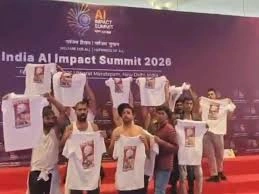
Prime Minister Narendra Modi’s harsh words about the opposition’s “shirtless protest” at a famous AI Summit have set up a political firestorm across the country. People have criticized the comments, which were made during a speech to the public, for making dissent seem less essential. They have also led to greater conversations about free speech, etiquette, and technology governance in India.
The AI Summit Spark
The famed International AI Summit in New Delhi earlier this month was where the argument started. It was a meeting of industry leaders, policymakers, and innovators from all over the world to discuss about the future of AI. Members of the opposition party, which is run by Congress, staged a dramatic sit-in protest outside the main site. They took off their shirts to show how “barefaced corruption” is in government AI programs. The protest, which had posters that said “AI for All, Not for Cronies,” was supposed to draw attention to concerns that some corporations were getting more money for AI projects than others.
PM Modi labeled the demonstrators “shirtless nautanki” at a rally in Uttar Pradesh not long after. “Nautanki” is a word that means “street theater,” and the visual of naked torsos adds to the meaning.”While the world talks about how AI could change lives, our opponents are protesting without shirts, showing not only their bodies but also their lack of ideas,” Modi remarked, which made the crowd cheer. This comment went viral, and the hashtag #ShirtlessProtest got more than 5 million mentions on social media in just 24 hours.
Politicians say that Modi’s use of simple Hindi terms like “shirtless nautanki” is a key part of how he talks to supporters. Some people say it makes the AI Summit seem less important. This event is meant to show that India wants to be a worldwide AI center. Sundar Pichai from Google and Satya Nadella from Microsoft were two of the most well-known speakers at the conference. They talked on how the digital economy can create jobs, how to make AI that is moral, and how to keep your data safe.
The other side’s counterattack
The opposition has fought back hard, alleging that Modi’s statements constitute an attack on democratic rights. Mallikarjun Kharge, the head of Congress, said that the comments were “childish and dictatorial.” He remarked, “The PM makes fun of protests and hunger strikes while his government protects crony capitalists in AI contracts worth billions.” Rahul Gandhi made the matter wider on X by putting a video of the protest and Modi’s address next to each other with the words “Shirtless for truth, suited for scams?” #AIForPeopleNotProfits.
The Samajwadi Party and the Trinamool Congress are two more entities that are currently part of the partnership. Mamata Banerjee, the Chief Minister of West Bengal, alleged that Modi was “diverting attention from AI policy failures” because of recent breaches of government AI data. Protests have since spread to cities like Mumbai, Kolkata, and Bengaluru, where people have embraced the “shirtless” motif to express how much they want everything to be open.
The main complaints are that AI financing isn’t fair (70% of recent grants went to companies connected to BJP donors), that the Summit’s own whitepaper talks about data privacy issues, and that people are worried about losing their jobs because AI is expected to take away 30% of regular tasks by 2030. Digital analytics suggest that this backlash has made the opposition more prominent. After the statements, their social media activity went up by 40%.
Modi’s Defense and the Big Picture
The BJP considered that the comments were a legitimate way to criticize the opposition for putting on a show in the middle of a serious national debate. Sambit Patra, a spokesperson for the party, said on national TV that “shirtless protests are for anarchists, not democrats.” The PM talked about big challenges, like how the opposition is damaging India’s AI leadership. People who supported the demonstration posted a lot of memes on social media that connected it to Modi’s idea of “AI for Viksit Bharat” (Developed India).
India is aggressively pushing for AI in this episode. The National AI Strategy 2025–30, which was launched at the Summit, pledges $10 billion in investments and 1 million AI jobs by 2028. Modi’s government talks about topics like the India AI Mission, which has used Indian language models that operate better than models from other countries in Hindi and other regional languages. India is placed 7th in the world for AI preparedness, behind the US and China, because of concerns with its infrastructure.
Political fights are now tangled up with criticism of AI policies. The BJP’s leaders argue that protests by the opposition scare off investment. They say that following the protests, foreign AI pledges fell by 15%. Arvind Subramanian and other economists warn that this kind of split could make it harder for India to fulfill its goal of owning 10% of the global AI market by 2030.
What People Are Saying and a Social Media Storm
Social media has made the gap bigger. #ShirtlessProtest has split users: BJP supporters term it “tollywood drama,” while opposition supporters call it #Shirtless.ForJustice tells stories about workers whose occupations were affected by AI. BeerBiceps and other influencers voiced their comments without taking sides: “Protest is right, but without a shirt? Takes distracts from real conversations about AI ethics.
Polls show a split: a NewsX poll shows that 52% of people thought Modi’s comments were “witty,” while 48% think they were “insensitive.” Young people in cities, who are vital to AI’s future, care more about policy than show. For instance, 65% of them say that data security is the most important thing in online forums. There are a lot of bad feelings on the other side over the hashtag #ShirtlessProtest, which has 5.2 million mentions. #ModiOnAI, which has 3.8 million mentions, is better for BJP supporters, while #IndiaAISummit, which has 2.1 million mentions, is more neutral and policy-focused.
This digital craze highlights how India’s social media politics are maturing, with viral moments affecting stories faster than traditional media.
Similarities in Indian Politics Over the Years
When Modi said “shirtless,” it made me think of protests that have erupted in theaters. Do you recall Anna Hazare’s fasts in 2011 or Arvind Kejriwal’s sleep-in at Rail Bhavan in 2013? Both were about making a point and calling for changes to the rules. Critics notice a pattern: governments use “drama” to make protests seem less real, from Indira Gandhi’s Emergency-era measures to today’s computerized counts.
But AI’s newness gives it depth. This is distinct from farm law demonstrations because it combines tech optimism with political rage. The IT Minister, Ashwini Vaishnaw, is one of many experts who believe we need to focus. “AI isn’t Congress vs. BJP; it’s India’s future vs. stagnation.” Vaishnaw stated at a follow-up briefing that the protests had put off two MoUs worth $500 million.
What this implications for elections and AI governance
The fight could damage India’s plans for AI. The EU and other countries across the world may not want to cooperate together because they are worried about “governance risks” and political instability. It backs up what the opposition is saying about the 2026 state votes in India, where they are using AI disparity as a weapon. In rural India, only 25% of people can get online.
People who have a stake in the matter want things to calm down. They want an independent AI ethics board, clear bidding processes, and nationwide campaigns to teach people about AI.
The AI Race Has Money on the Line
India’s AI industry is worth roughly $12 billion right now, but it hopes to be worth $50 billion by 2030. Healthcare, where AI diagnostics save costs by 40%, agriculture, where predictive models boost yields by 25%, and manufacturing, where AI twins automate processes, are all key fields. Protests attract attention to risks: When people don’t trust each other, smart people flock to Silicon Valley faster. Nasscom says that 20,000 AI engineers departed the country last year. Modi’s plan, on the other hand, says that “AI Garages” should be built in 100 cities to train 500,000 young people.
The “AI for Poor” plan from the opposition offers basic computer credits for everyone. Economists say that if this problem isn’t fixed, GDP growth could drop by 0.5%.
India’s Soft Power and Its Effects Around the World
The Summit put India in charge of AI democracy around the world, but China’s state AI was not. The press had different things to say about what Modi said. The BBC called it “colorful mudslinging,” and Reuters claimed it was “eroding investor confidence.” When you look at the US AI fights between Elon Musk and the government, you can see that there are problems everywhere. What makes India better? A lot of different skills, like 1.5 million STEM grads per year.
People are upset at Modi for his “shirtless protest” joke. The opposition blames the PM for the fight at the AI Summit.