Somewhere on the rocky ground of Mars, a six-wheeled robot just passed a milestone that no vehicle has ever reached on another world. NASA’s Perseverance rover now holds the record for the greatest total distance driven off Earth, and the way it got there says as much about the future of space exploration as the number itself.
The record, in numbers
On Sunday, October 11, Perseverance’s odometer hit 28.10 miles (45.22 kilometres). That edged past the 28.06 miles (45.16 kilometres) held by NASA’s Opportunity rover, which explored Mars from 2004 to 2018. So the margin is about 0.04 of a mile, roughly the length of a city block. It was a photo finish, but a finish nonetheless.
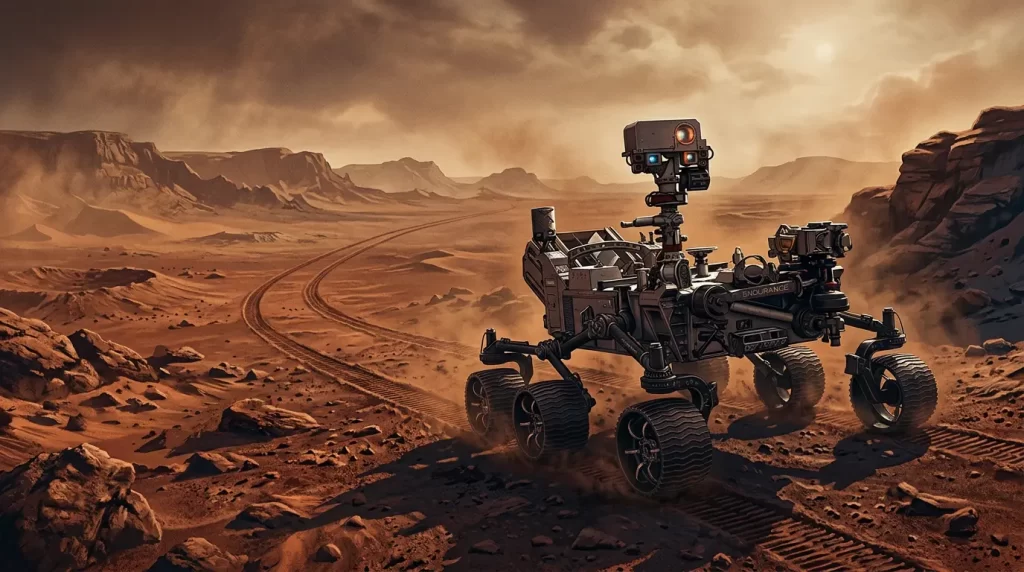
The date also carries a mission-specific marker. October 11 was the 2,006th Martian day, or sol, of the mission, since a day on Mars runs a little longer than ours. A navigation-camera image from that sol shows the rover’s tracks stretching across a rocky landscape, a simple picture of a very long road. NASA published the images this week, and reports say the mission team has received a Guinness World Records certificate recognising the achievement. I couldn’t find that certificate detail repeated in the coverage I checked, so treat it as the team’s own news for now.
Fifteen years versus five and a half
What makes this NASA Mars record remarkable is the speed of it. Opportunity needed nearly 15 years to rack up its distance. Perseverance covered the same ground in about five and a half.
That isn’t because Perseverance is fast. Its top speed is a gentle 0.16 kilometres per hour, slower than a leisurely walk. It is because of how it drives.
The self-driving rover
Perseverance uses an autonomous navigation system called AutoNav. Instead of waiting for engineers on Earth to approve every few metres, the rover looks at the terrain, spots hazards and picks its own safe path between waypoints chosen by the team. More than 90% of its total distance has been driven this way. For Opportunity and its twin Spirit, the equivalent figure was only about 5%.
Mission staff have been happy to give the rover credit. Mark Maimone, a deputy team chief for robotic operations, said it was a better driver now than when it landed, and that the team wasn’t done yet. Coming from the people who steer it, that is a lovely bit of understatement.
In practical terms, AutoNav lets the rover cover as much as 1,351 feet in a single sol. On a planet where radio signals take minutes to cross the gap, and where a single wrong turn could end a mission, that independence is a big deal.
Beating the Moon too
Mars isn’t the only place Perseverance has outpaced. On its way to the overall record, it also passed the distances driven by two famous lunar vehicles: the roughly 22.2 miles covered by Apollo 17 astronauts Gene Cernan and Harrison Schmitt in 1972, and the 24.2 miles driven by the Soviet Union’s Lunokhod 2 in 1973. That puts the rover in rare company, ahead of both the Apollo-era crews and the early robotic pioneers.
Where is it headed?
At the moment, Perseverance is travelling toward an area called Idubi, through a region beyond the western rim of Jezero Crater nicknamed Lac de Charmes. This isn’t a random stretch of dust. The team believes the terrain there may be among the oldest ever explored in the solar system.
That is the point of the whole mission. Jezero was once a lake fed by a river delta, which makes it a promising place to look for signs of ancient microbial life. Every mile driven is another step toward rocks that might hold clues about whether Mars was ever habitable. The distance record is a nice headline, but the science is what the rover came for.
A relay race across decades
It helps to see this as a team effort stretching across nearly three decades of NASA rovers on Mars. Each mission has driven farther and more capably than the one before, and each handed lessons to the next. Opportunity set the bar that stood for years, Spirit and Curiosity added their own chapters, and Perseverance has now taken the baton.
And the story isn’t over. NASA notes that both Perseverance and Curiosity are still operating and moving across the Red Planet today. Curiosity, which landed in 2012, has driven roughly 38 kilometres so far, so it is still rolling along too. Officials say Perseverance’s mobility systems are fully operational and that tests suggest it can keep going for years, which means this new record is likely to be broken again, probably by Perseverance itself.
Why it matters to the rest of us
It is easy to shrug at a record about driving distance, especially when the number is under 30 miles. But think about what it took. A machine built and launched from Earth landed on another planet, survived dust, cold and sharp rocks, and has now made thousands of small decisions on its own across 45 kilometres of alien ground.
That kind of autonomy is exactly what future Mars missions will need, whether the next rover is exploring a distant crater or scouting a landing site for human explorers. Every kilometre Perseverance drives without a human holding the joystick is practice for that future.