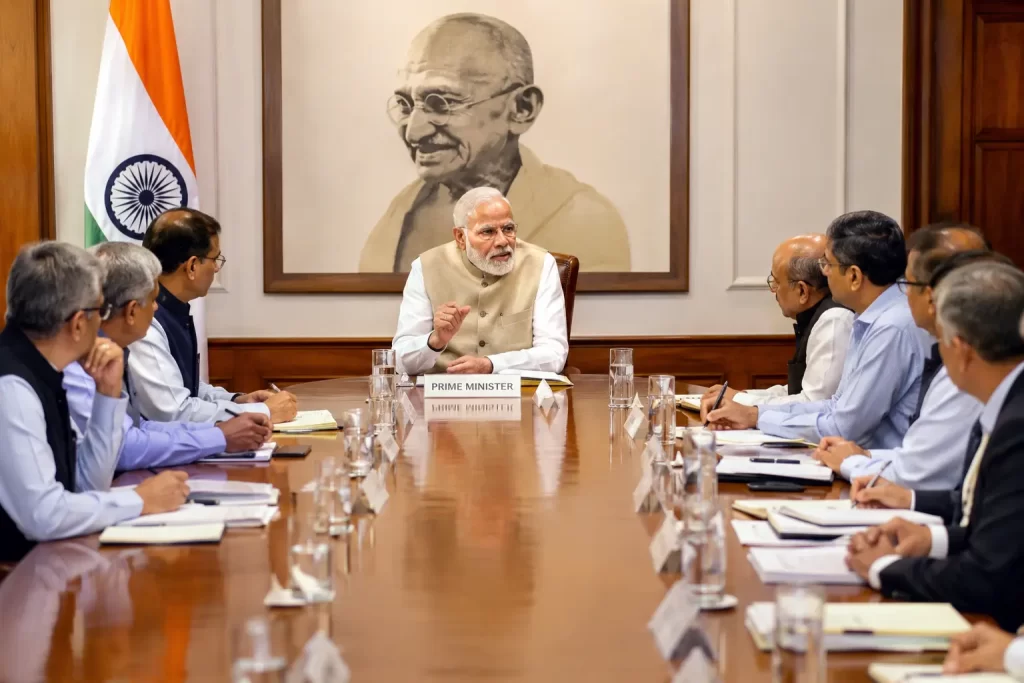
New Delhi: Prime Minister Narendra Modi has once again assembled India’s top bureaucrats for a free-wheeling closed-door conversation on how the country should be run — not just today, but decades from now. Aug 20, 2026: He held his third high level meeting with Secretaries to the Government of India at his residence, 7, Lok Kalyan Marg. This round of PM Modi governance talks zeroed in on ministries and departments handling infrastructure and connectivity, security and external affairs, and broader governance reforms.
It’s part of a pattern the government has been building through the year. Two earlier rounds of secretaries meetings had already covered ground like finance, commerce, industry and technology, so this third sitting effectively extended the review to the strategic side of the house — defence, foreign policy, and the machinery of governance itself. Together, these sessions form a running audit of how well India’s bureaucracy is translating policy into results, all under the wider umbrella of the Viksit Bharat by 2047 vision.
Breaking the Habit of Working in Silos
If there was one phrase that echoed through the meeting, it was “silos.” Modi told the gathered secretaries that departments working in isolation from one another was a serious drag on the system, and he pushed back on the idea that this is purely a structural problem. He argued it’s just as much a mindset issue as an organisational one, and pointed out that these silos can exist both horizontally, across parallel departments, and vertically, up and down the chain of command within a single ministry.
His prescription wasn’t a reshuffle or a new committee — it was simpler and, in some ways, harder to legislate: a genuine sense of ownership and belonging among officials. He encouraged senior officers to spend more time in informal conversation with their junior colleagues, to build networks that cut across cadres and departments, and to treat teamwork as something cultivated day to day rather than mandated from the top. This focus on Indian bureaucracy reform through culture rather than just structure has been a recurring thread in Modi’s recent addresses to civil servants.
Data as a National Asset
Another major theme was data — and how India uses it. Modi described data as a national asset and a resource that will only grow more valuable in the years ahead. He called for greater interoperability between the platforms different ministries already run, so that information collected in one corner of government doesn’t sit locked away from everyone else.
Tied closely to this was a call for smarter use of artificial intelligence, with a clear caveat: human oversight has to stay in the loop. Rather than letting AI operate as a black box, Modi urged officials to look for practical ways to combine machine efficiency with human judgment — a balance that’s likely to shape how AI tools get rolled out across government departments in the coming months.
Long-Term Thinking Over Day-to-Day Targets
Perhaps the most striking instruction from the meeting was Modi’s ask that secretaries stop measuring success purely in terms of immediate statistics and quarterly targets. He wants officials thinking in decades, not just fiscal years — considering how the systems being designed today will hold up, or fall apart, when India looks back from 2047. That’s the entire premise behind Viksit Bharat: a developed India built on foundations that are meant to last, not just look good in the next progress report.
To make the case for coordination, Modi pointed to recent real-world tests of the system — the COVID-19 pandemic and the West Asia crisis were both cited as moments when departments that don’t normally work together had to, and did, pull it off. His argument was that this kind of cooperation shouldn’t be an emergency reflex; it should be baked into how government functions on an ordinary Tuesday.
He also flagged the importance of bringing younger voices and academic institutions into the policymaking conversation, arguing that universities and young people can offer perspectives that a purely bureaucratic process tends to miss. And on the defence side, he pushed for India’s domestic defence industry to become more globally competitive, building on the country’s recent push toward self-reliant manufacturing.
What This Means for Citizen-Centric Governance
Attendees included the Cabinet Secretary, secretaries from key ministries, and senior officials from the Prime Minister’s Office. During the session, the secretaries themselves got space to speak — sharing what’s working in their sectors, where implementation is getting stuck, and what emerging challenges are shaping their day-to-day priorities.
Taken together, this third meeting reinforces a message Modi has repeated across all three sessions this year: that citizen-centric administration depends less on new schemes and more on how well existing ones are executed. Whether that translates into faster file movement, better inter-ministerial coordination, or a genuinely different working culture in India’s civil services will likely become clearer as the government moves closer to its 2047 milestone.
PM Modi chairs high-level review with top government secretaries, calls for long-term governance vision.