
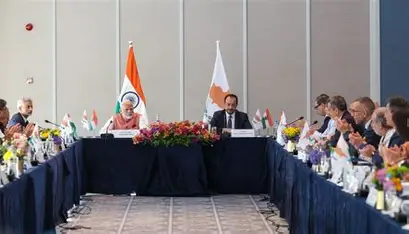
Prime Minister Narendra Modi departed for Canada late Tuesday to participate in the G7 Summit, following the conclusion of his official visit to Cyprus. His visit to Canada comes at a crucial time when global leaders are convening to discuss pressing international issues, including climate change, economic stability, and geopolitical conflicts.
During his two-day stay in Cyprus, Prime Minister Modi engaged in high-level discussions with President Nikos Christodoulides, focusing on enhancing bilateral cooperation in areas such as maritime security, fintech, and defense. The visit marked a significant step in deepening India’s strategic ties with Cyprus, a key member of the European Union.
PM Modi’s departure for the G7 Summit in Canada underscores India’s growing diplomatic engagement on the world stage. Although India is not a member of the G7, it has been consistently invited as a partner country due to its increasing global influence. The summit will bring together leaders from Canada, the United States, the United Kingdom, France, Germany, Italy, and Japan, along with representatives from the European Union and invited nations, including India.
At the summit, Prime Minister Modi is expected to hold bilateral meetings with several world leaders, including Canadian Prime Minister Justin Trudeau, US President Joe Biden, and UK Prime Minister Rishi Sunak. Key agenda items for the summit include global economic recovery post-pandemic, green energy transitions, digital governance, and coordinated responses to international security threats.
India’s participation is seen as crucial in shaping consensus on issues that affect the Global South. PM Modi is likely to emphasize India’s stand on sustainable development, fair trade practices, and inclusive growth. His presence also comes amid increasing global concerns over regional tensions in Asia and the Russia-Ukraine conflict, where India has positioned itself as a neutral yet influential voice.
The Indian delegation accompanying the Prime Minister includes Foreign Secretary Vinay Kwatra, National Security Advisor Ajit Doval, and senior officials from the Ministry of External Affairs. Sources indicate that India may also use the summit to push for broader cooperation on technology transfers, counterterrorism measures, and reforms in global institutions like the United Nations and the World Trade Organization.

