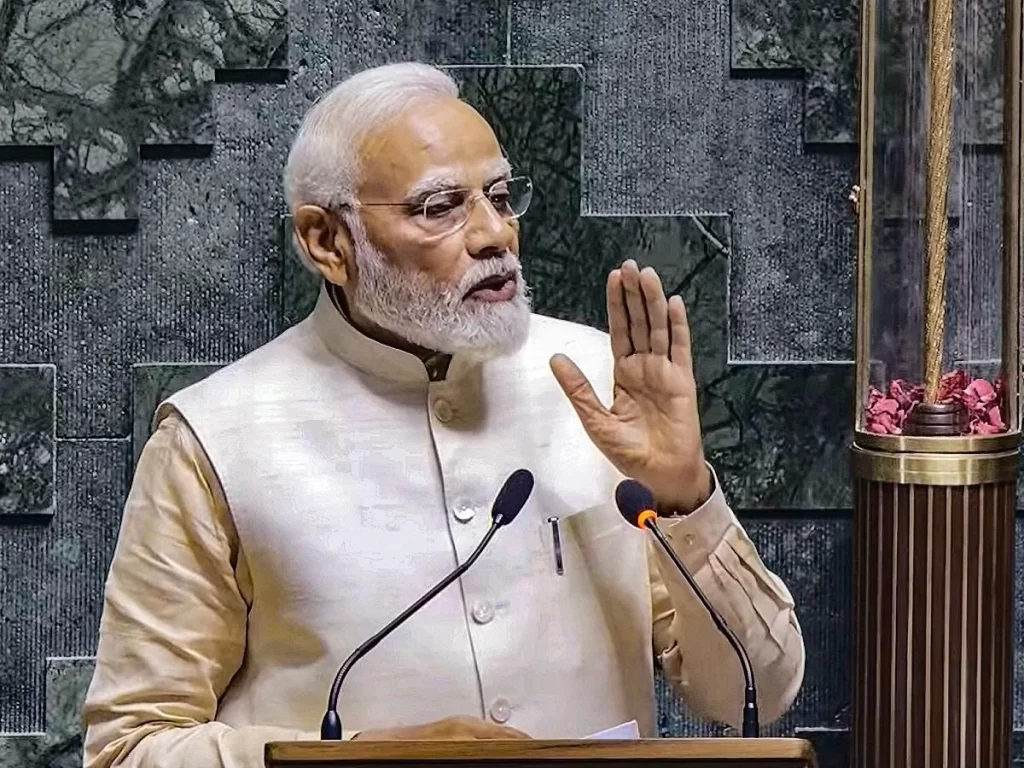
During a special Parliament session, Prime Minister Narendra Modi called for 50% of all government jobs to be held by women. He said that women’s voices should be heard at all levels of government, from villages to the national level. This is happening at the same time as India is having trouble getting more women into higher levels of government, even though there have been big achievements at the local level. Modi’s demand is part of continuous efforts to speed up the Nari Shakti Vandan Adhiniyam, which aims to change how decisions are made before the 2029 elections.
The Special Session Fire
Parliament doesn’t often take breaks for special meetings like this one, which lasted from April 16 to 18 and was only for making changes to women’s reservations and delimitation. In a speech to the Lok Sabha, PM Modi termed it a “historic occasion” for democracy and told MPs to put politics aside. He said that blocking such efforts will make Indian women angry and that it was important for Viksit Bharat, a developed nation where infrastructure alone isn’t enough and women’s input in policy is critical.
The meeting is about changing the 2023 Nari Shakti Vandan Adhiniyam, which pledges 33% of seats in Lok Sabha and state assemblies for women but was linked to the delimitation of the 2027 census. Some people want to use data from the 2011 census to raise the number of Lok Sabha members from 543 to about 816–850. About 273 of those seats would be set aside for women right away. Congress MPs and other opposition voices are fighting back and calling for the current seats to be used without “backdoor” delimitation.
Modi’s focus on getting 50% of people to vote is based on victories in the past. He talked about Panchayati Raj institutions, which have over 14.5 lakh women working for them—almost 46% of the 31 lakh elected representatives. In 21 states and two UTs, the number of women working for them reached 50%. “Systems become more sensitive when women are involved in decision-making,” he said, referring to greater results in health, water, and education.
Local Power’s Roots
In 1992, the 73rd and 74th Amendments made it mandatory for 33% of seats in Panchayati Raj Institutions (PRIs) and urban local councils to be reserved for women. This was the start of India’s grassroots experiment with women’s quotas. States like Bihar, Madhya Pradesh, Kerala, and Gujarat raised it to 50%, making a group of more than 1.4 million women leaders.
genuine studies indicate genuine effects. In reserved communities, women sarpanchs put drinking water, roads, and cleanliness first. These are things that males often don’t think about. One study indicated that when women are in charge, public funding goes more toward education and water, and these changes last for a long time as women gain experience. Modi regularly talks about how well the Jal Jeevan Mission did, and he gives credit to the women panchayat chiefs for getting to every household.
But the data paint a different story. While PRIs have the best female representatives in the world, national bodies are behind. Women only possess 74 seats in the 2024 Lok Sabha, which is 13.6% of the total. This is down from 78 seats in 2019. State assemblies have an average of 9-13% women MLAs, with Uttar Pradesh having the most at 47. No state has more than 20% women MLAs. The Rajya Sabha is 13% full. How many people voted? Women match or beat males, but they don’t get tickets or wins.
What stops them? The party is hesitant to run women because they think they won’t win, they have money problems, and they have family obligations. Many women who are elected still act as proxies for their husbands, even though there are quotas.
Modi’s Plan to Empower More Women
This push isn’t just one thing. Since 2014, Modi’s government has changed from “women’s development” to “women-led development,” which has affected people of all ages. Beti Bachao Beti Padhao helped more girls survive and brought down the number of boys to girls in places like Haryana. Ujjwala Yojana gave free gas connections to more than 10 crore women and made household chores easier. Jan Dhan plus Mudra opened more than 50 crore accounts, many of which were led by women, to support self-help groups and create Lakhpati Didis who earn ₹1 lakh or more a year.
In politics, the best law is Nari Shakti Vandan Adhiniyam, which was passed by everyone in 2023. Modi wants it to be vertical in SC/ST seats as well, which will help everyone. At the Nari Shakti Vandan Sammelan on April 13, he told women to lobby MPs and called it a “21st-century decision.”
India’s PRI model gets a lot of attention around the world since it has 46% local female representatives, which is more than most other countries. But higher up? India’s rate is lower than the international average of 25–26%. Rwanda is in first place with 61%, and the UK just hit 40%.
Obstacles on the Road Ahead
Pushing for 50% nationwide will be very hard. First, the 33% bill needs to be activated, which is frustrating because it is taking so long. Adding additional seats could make southern states angry because it would mean losing seats based on population, but Modi promises no cutbacks and more total seats. Using 2011 data for delimitation? Critics say it’s not fair without a new census.
Patriarchal ways of thinking are still around. Research points out “structural barriers”: male-dominated events refuse to give out tickets, money is hard to come by, and violence is a threat. Women leaders in PRIs say that male relatives get in the way. Winnability statistics shows that excuses are not true—women candidates win at the same rate as males.
Cultural customs in India keep women out of public life. This is even more true in rural regions; in cities, gains happen faster but aren’t always the same. Can quotas alone get rid of deep-seated biases? Or do they risk tokenism if they don’t get training and help? As the discussion goes on, these questions keep coming up.
The Lok Sabha has 13.6% women out of 543 members, the Rajya Sabha has about 13%, and the state assembly have an average of about 9% women out of over 4,100 MLAs. Uttar Pradesh has the most women MLAs with 47, while Chhattisgarh has the most women MLAs with 18%.
Wins in the Real World and Echoes Around the World
Local examples provide you ideas. In studies in Rajasthan and West Bengal, councils led by women did better on “feminine” issues like water, with investments going up by 14% to 24%. Next came the budgets for education and nutrition. Health measures also got better; there were fewer incidences of malnutrition where women made the choice.
Women sarpanchs in Maharashtra and Bihar installed lamps and built toilets—simple things that change villages. One leader in Gujarat made her drought-stricken neighborhood green by using water projects. These stories support Modi’s argument that being sensitive leads to better government.
Similar quotas work in other parts of the world. Nordic countries have 40–50% of their parliaments, which is in line with progressive ideas. The parity statute in Argentina helped women ministers. For India, striving for 50% might put us ahead, especially with a lot of young people and women who are good with technology joining the fight.
But balance is important. There is a lot of disagreement about quotas—do they hurt merit? No, evidence shows that women leaders catch up quickly, and sometimes even go beyond. Still, putting skill-building activities, like leadership seminars, alongside bets makes them stronger.
Voices from the Ground
Women leaders talked about their successes at the Vigyan Bhawan sammelan, such as better schools and cleaner water. One panchayat head said that her job helped the health of the village. Opposition leaders, including Bhagwant Mann from Punjab, support quotas but want them to be put into place right away. The Congress wants to combine caste census data.
Modi called on women in the Constituent Assembly to join the struggle for freedom: “Nari Shakti built India; now lead it.” Does it make sense? Yes, because millions of people watch moms and sisters step up in their own communities.
PM Modi Targets 50% Women in Governance: Historic Call from Parliament Session