
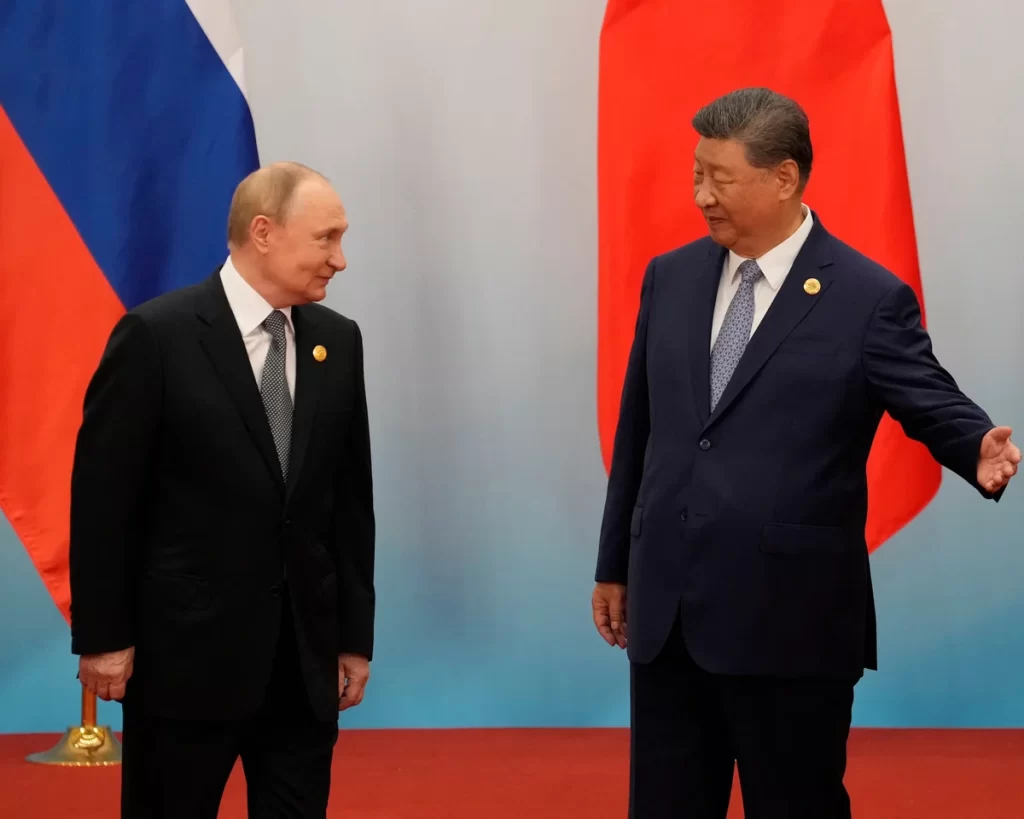
September 5, 2025: Russian President Vladimir Putin firmly defended India and China against Western criticism during the Shanghai Cooperation Organisation (SCO) summit held in Tianjin, China, in early September. His remarks came amid recent U.S. sanctions and tariff threats targeting India and concerns over China’s growing global influence.
Addressing global leaders, Putin criticized the use of coercive economic measures, emphasizing that tactics such as sanctions and tariffs are counterproductive in contemporary international relations. He specifically warned the United States against pressuring sovereign nations, stating, “You cannot talk to India or China in that way.” The statement underscores Moscow’s support for India and China in the face of mounting Western pressure.
The SCO summit, which convened leaders from member countries including India, China, and Russia, highlighted a growing alignment among major Asian powers. Putin’s remarks followed bilateral meetings with Indian Prime Minister Narendra Modi and Chinese President Xi Jinping, signaling a coordinated diplomatic stance among the three nations.
The timing of Putin’s comments is significant, coinciding with escalating trade tensions between the U.S. and India. In August 2025, the U.S. administration imposed tariffs on Indian goods, initially at 25 percent and later increasing to 50 percent, in response to India’s continued purchase of Russian oil. These measures have strained U.S.-India relations and prompted India to strengthen its strategic ties with Russia and China.
Former U.S. President Donald Trump expressed concern over the evolving alignment, remarking, “Looks like we’ve lost India and Russia to deepest, darkest, China.” This reflects the apprehension in Washington regarding the shifting geopolitical balance in Asia and the potential diminishing influence of the U.S. in the region.
Despite these external pressures, India, Russia, and China have emphasized the importance of deepening bilateral cooperation. At the summit, Prime Minister Modi referred to Russia as a “special and privileged partner,” while President Xi highlighted the value of friendship and cooperation between the world’s two most populous countries. These affirmations suggest a shared vision for a multipolar global order that challenges traditional Western-dominated power structures.
Experts note that Putin’s defense of India and China is part of a broader strategy to reinforce alliances among nations seeking greater autonomy in global affairs. By standing against Western economic coercion, Moscow, Beijing, and New Delhi are signaling that they intend to safeguard their sovereignty and strategic interests, while advocating for a more balanced international system.
The SCO summit has thus emerged as a platform for redefining geopolitical relationships in Asia. Putin’s remarks mark a clear message to Western powers: attempts to influence independent nations through sanctions and tariffs may no longer be effective. As India, Russia, and China strengthen their cooperation, the international community may witness a shift toward a multipolar world, reshaping global trade, security, and diplomacy.

