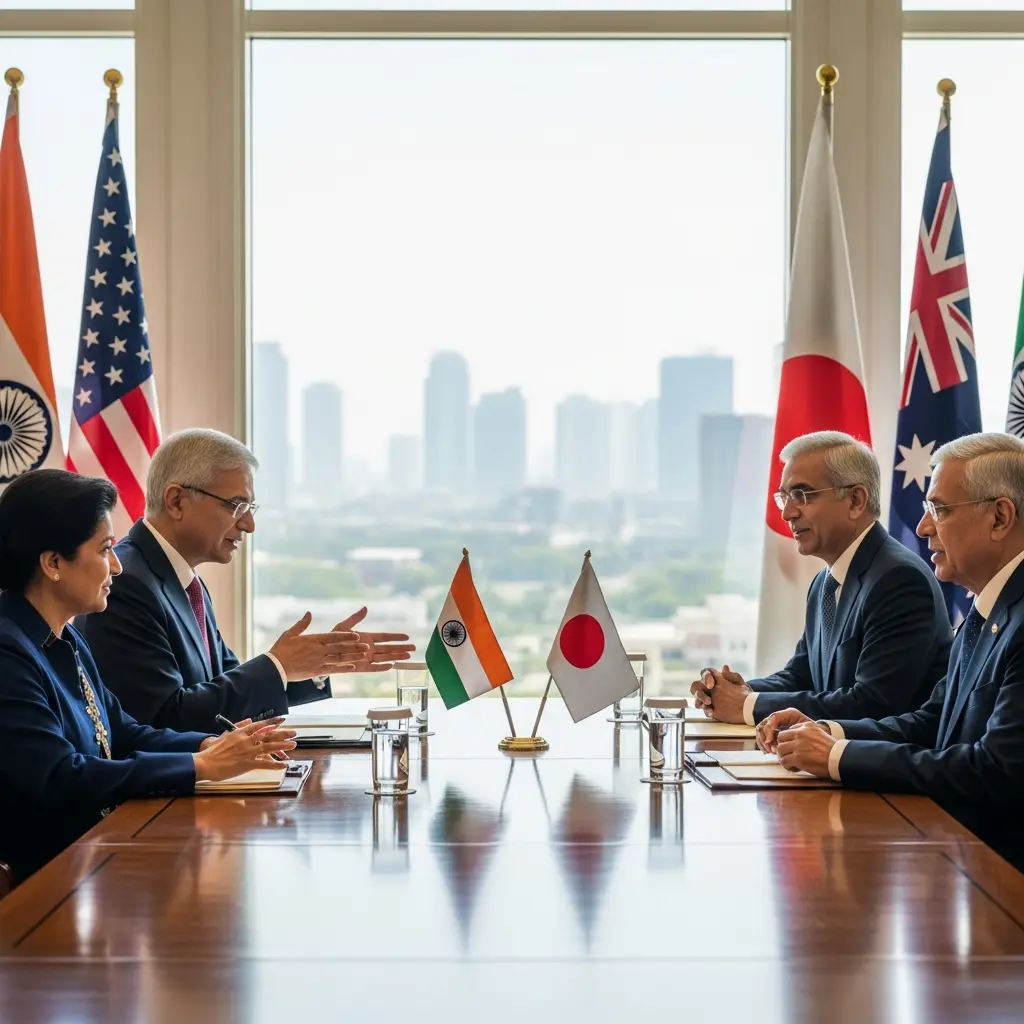
New Delhi | May 2026—There are diplomatic meetings, and then there are moments that quietly alter the world. The upcoming Quad Foreign Ministers’ Meeting in New Delhi, scheduled for late May 2026, leans closer to the latter.
India, the United States, Japan, and Australia — the four nations that form the Quadrilateral Security Dialogue — are set to sit across the table in the Indian capital in what is being described as far more than a routine check-in. With U.S. Secretary of State Marco Rubio making the trip alongside counterparts from Tokyo and Canberra to meet India’s External Affairs Minister S. Jaishankar, the meeting signals that the Indo-Pacific security partnership is alive, active, and eager to prove its relevance.
A Meeting That Carries More Weight Than It Looks
On paper, this is a foreign ministers’ summit. In practice, it is a course-correction exercise wrapped in diplomatic formality.
The Quad wrapped up its Indian chairmanship last year without hosting the Leaders’ Summit that was expected to crown it. That gap — roughly ten months between the July 2025 Washington engagement and this New Delhi gathering — isn’t just a scheduling quirk. For a grouping whose strategic value partly depends on being seen as cohesive, prolonged silence carries a real cost. Adversaries notice. Allies take note. The New Delhi meeting is, in many ways, the Quad showing up and saying: we’re still here, and we mean business.
That is also the first time since 2023 that the Quad Foreign Ministers have met on Indian soil, lending a certain symbolic weight to the proceedings.
Critical Minerals, Emerging Tech, and the China Factor
So what’s actually on the agenda? Diplomats rarely lead with the uncomfortable truth, but the subtext here isn’t hard to read: China.
The Quad nations are expected to deepen coordination on critical minerals and emerging technologies — two areas where dependence on Chinese-controlled supply chains has become a genuine strategic vulnerability. China currently controls an estimated 65 to 70 percent of global natural graphite production, a mineral essential to lithium-ion batteries and the clean energy transition. That level of concentration in a single, geopolitically complex nation keeps defense planners and economic strategists up at night across Washington, Tokyo, Canberra, and New Delhi alike.
The groundwork for this conversation was laid at the July 2025 Quad Foreign Ministers’ Meeting in Washington, which produced the Quad Critical Minerals Initiative — a coordinated effort to map and diversify supply chains across member nations and partner countries. The New Delhi summit is best understood as the next chapter: reviewing what’s been accomplished, identifying where gaps remain, and building toward a planned Quad Leaders’ Summit on Indian soil later this year.
Beyond minerals, artificial intelligence governance, cybersecurity, and clean energy cooperation are expected to feature prominently. These aren’t abstract policy discussions. They represent the Quad’s attempt to build a shared technological ecosystem that reduces member nations’ collective exposure to strategic chokepoints.
India’s Moment on the Global Stage Having this meeting is part of a broader, strategic diplomatic effort of India in 2026. New Delhi has been juggling multiple multilateral commitments simultaneously — including the BRICS Foreign Ministers’ Meeting and Prime Minister Narendra Modi’s five-nation tour earlier this month — in what the Ministry of External Affairs has described as an effort to “secure national interests” through expansive international engagement.
Hosting the Quad meeting fits neatly into India’s emerging identity as an indispensable middle power: a country that can simultaneously chair a BRICS summit and convene an Indo-Pacific security dialogue without appearing contradictory. That balancing act is itself a form of strategic messaging.
Regional Security and the Free, Open Indo-Pacific
The ministers are expected to reaffirm the Quad’s foundational vision of a free, open, and inclusive Indo-Pacific — language that has appeared in every Quad joint statement but carries fresh urgency given rising tensions in the South China Sea and ongoing concerns about maritime security in the broader region.
Freedom of navigation, respect for international law, and opposition to unilateral attempts to alter the regional status quo are likely to be central themes. These aren’t just talking points. They reflect the core anxiety that drew these four democracies together in the first place: the concern that the rules-based international order in the Indo-Pacific is under pressure, and that like-minded nations need to coordinate their response.
What Comes Next
The New Delhi meeting is designed to build momentum toward a full Quad Leaders’ Summit later in 2026. If the foreign ministers can leave the Indian capital with a meaningful joint statement and concrete deliverables on critical minerals, technology cooperation, and maritime security, they will have done their job.
The Quad has never been a formal military alliance. It doesn’t have a mutual defense clause or a standing command structure. What it does have — and what New Delhi will attempt to reinforce this week — is a shared sense of purpose among four democracies that believe the Indo-Pacific’s future should not be written by any single dominant power.
That idea, simple as it sounds, is what keeps bringing these four nations back to the table.
Quad Foreign Ministers Meet in New Delhi — What’s Really at Stake.