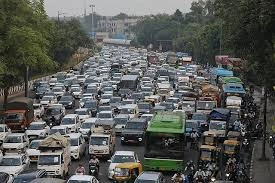
The peaceful morning at Rajghat, the quiet samadhi of Mahatma Gandhi on the banks of the Yamuna, has evolved into one of the busiest spots in New Delhi’s rush-hour narrative. The high-profile diplomatic function of floral tribute by Vietnamese President To Lam to Bapu during a state visit on the morning of May 6, 2026, set off a chain reaction of traffic restrictions in central and east Delhi. Even on a normal Wednesday, the event served to highlight the vulnerability of the Capital’s urban mobility.
Barricades, diversions and trapped commuters replaced the typical throb of arterial arteries in the city from ITO Chowk to Delhi Gate, from Shanti Van to the IP Flyover. The two-hour gap between 9:00 a.m. and 11:00 a.m. reserved for security and protocol once again prompted an uncomfortable question: How can a city as big and old as Delhi continue to allow the daily rhythm of millions of ordinary inhabitants to be dictated by VIP movement?
What happened on May 6 at Rajghat
At the core of the interruption was a wreath-laying ceremony at Mahatma Gandhi Smriti Sthal, part of Vietnamese President To Lam’s state visit to India. The visit, viewed as a diplomatic drive to boost India-Vietnam ties, commenced with a ceremonial welcome at Rashtrapati Bhavan and then proceeded to Rajghat at roughly 9:40 a.m. as per the schedule of the Ministry of External Affairs.
Security and protocol at such events are by design strong. Delhi Traffic Police had sent out a traffic advisory that special traffic arrangements will be in place from 9:00 a.m. to 11:00 a.m. around Rajghat Chowk, ITO Chowk, Delhi Gate Chowk, Guru Nanak Chowk and IP Flyover, with the clear expectation that vehicles would be diverted or stopped at important crossroads. The centre remained more or less packed. Traffic was barely thinned off at the fringes between Bahadur Shah Zafar Marg (ITO–Delhi Gate), Asaf Ali Road up to Netaji Subhash Marg, Shanti Van Chowk to Nishad Raj Marg and the stretch from Guru Nanak Chowk to Ranjeet Singh Flyover.
The Ripple Effect in Central and East Delhi
For a city already on the edge of gridlock, the impact of a tightly managed two-hour window at Rajghat might feel like a full-day disturbance. The worst hit were the passages that fed into the city’s central spine:
ITO-Delhi Gate (Bahadur Shah Zafar Marg): This was a main road for people going to offices and for government officials. It faced recurrent diversions and long waits. Public buses, auto-rickshaws and private vehicles were diverted, many times without any prior digital signage, leaving many passengers to improvise on the scene.
Shanti Van to IP Flyover This stretch connecting the historic Lutyens’ center with the eastern suburban belt, formed a bottleneck every time VIP convoys moved in or out of Rajghat.
Asaf Ali Road-Netaji Subhash Marg and Ring Road bypass routes: The major ring routes around Rajghat are also partially prohibited, diverting traffic to smaller lanes which are already over-stretched.
Commuters headed to the airport, train stations or far-flung offices in Noida or Faridabad were encouraged to depart ‘much earlier’, but that meant little more than buying into the expectation that traffic patterns would self-correct once the wreath-laying stopped. For years urban planners and transport specialists have been saying these kind of repeated interruptions are less due to the event itself than to the lack of a solid, real-time contingency plan.
Urban Mobility in Delhi A System under Stress
Delhi’s traffic woes are not new but they are coming to fore every time a VIP event coincides with peak hours The city has a large road network, but it is overburdened by personal vehicles, inefficient public transit systems and fragmented jurisdiction between many organizations. Congestion, poor last-mile connectivity and lax enforcement have been consistently identified as major difficulties in Delhi’s urban mobility studies, and these were again visible on May 6.
And the positioning is what makes Rajghat such a flashpoint. It is at the nexus of ritual importance and practical utility. In the morning, lakhs of people utilize the same streets to go to work, school and for medical visits, where international dignitaries are received. When a part of that space is essentially closed off for security, the city’s basic lack of redundancy becomes clear: there are no alternate routes to absorb the displaced traffic without generating new bottlenecks.
In this context, one can ask: are we still constructing urban transportation around vehicles, or around people?
The Cost of VIP Movements on Daily Life
What most frustrates Delhi residents about these situations is not the inconvenience, but the predictability of it. The national capital is used to seeing VIP convoys and state visits, and roads are often closed for security reasons. “Yet, alternate routing, traffic-signal coordination and real-time communication are typically behind the times, compared with the intricacy of the situation.”
The advice, issued May 6, accomplished what traffic advisories generally do, warning of disruption but providing no really dynamic response. Commuters were advised to steer clear of the affected areas, take alternate routes and obey the instructions of traffic authorities – all sound advice, but it still left many feeling their way through the uncertainty. In a city that’s racing ahead with digital public transport and smart corridors, it feels like a throwback to rely on static, text-based cautions.
The hidden expenses are obvious economically. Delayed workers, chaotic school runs, stalled deliveries, anxious logistics – it all adds up. In a quick economy, every stopped car is a small leak in the system. And when you have these leaks happening over and over again at the same junctions, the debate shifts from ‘how do we manage this event?’ to ‘how do we restructure the system so it doesn’t collapse every time diplomacy arrives city centre?’
Lessons from Previous Events and Global Models
The tension between ceremonial grounds and working streets is not unique to Delhi, of course. Similar issues have beset global capitals from London to Paris, Tokyo to Washington yet they tend to have better integrated, multi-modal networks and tighter time-band zoning for VIP movements.
Some international cities are planning designated ceremonial routes with separate routing for regular traffic, and digital dashboards are pushing live rerouting possibilities to smartphone maps, minimising guesswork. Delhi has tried similar approaches – Metro extension, rationalising bus routes and parking-management initiatives – but success has generally been incremental. The latest drive to put more electric buses on the road, improve the management of junctions and even consider congestion charge in certain areas has been praised but implementation has been spotty.
Is it possible to apply the same thinking to places like Rajghat? Could permanently delimited, fully indicated VIP corridors run alongside parallel routes optimised for general traffic? Or may ceremonial events be arranged outside peak hours if possible? These questions aren’t simply about convenience; they are about redefining the city’s goals in a period of rising vehicle density and digital data.
How can we do this better?
Several practical solutions can be taken to alleviate the repeated disruption produced by high-profile events at Rajghat.
Time-band ceremonial events: Move VIP movements out of the 9–11 a.m. and 5–8 p.m. windows, even by 30–60 minutes. The slightest change in schedule can have a huge impact on the city’s global rhythm.
Proactive digital redirection: Coordinate with key navigation applications and ride-hailing services to offer real detour recommendations as soon as a traffic advisory is posted, not just text alerts.
Strengthen last-mile connectivity: Improve feeder bus and auto-rickshaw lines near ITO, Delhi Gate and the Ring Road bypass so that the side lanes can carry more people efficiently even if the main arteries are clogged.
Integrated control rooms: Establish a single-window command with traffic police, Metro and bus operators sharing data in real time for coordinated traffic management during high-visibility events.
These concepts are not very novel, but they depend on collaboration and political will, not just technology.
What it means for the delhi daily commuter
For the typical Delhi dweller, the day that began with the excitement of a state visit concluded with more time spent in traffic, delayed meetings and a familiar sense of aggravation. The May 6 Rajghat event is a timely reminder that while high-profile diplomatic visits are boosting India’s stature on the world arena, the city’s infrastructure needs to keep pace too.
Of course, it is a bit ironic that even a memorial to Mahatma Gandhi, a symbol of simplicity and restraint, can bring a contemporary, tech-savvy metropolis to a standstill for a while. That begs another question: in our drive to develop big buildings and host world leaders, have we forgotten to design a city that runs efficiently for the people who live in it every day?
As Delhi grows, more state visits, high-stakes meetings and ceremonial occasions are inevitable in the years to come. The challenge is not to stop them, but to make sure that the city’s daily activity is not held hostage to the odd VIP convoy. Only then can the tale of urban mobility in Delhi change from one of disruption to one of resilience.
Rajghat Traffic Jam: Delhi’s Traffic Jam When Big Diplomacy Meets City Chaos