
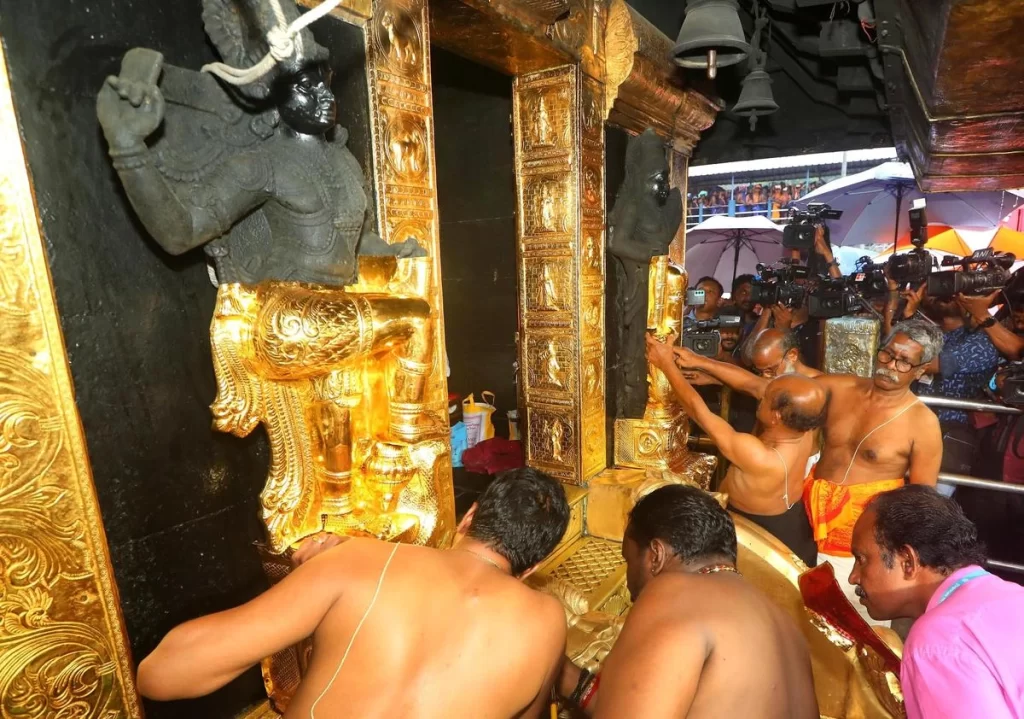
The Sabarimala temple gold misappropriation case has escalated after the Special Investigation Team (SIT) submitted its latest findings to the vigilance court, revealing that gold coverings from the temple’s Dwarapalaka idols and other sacred artefacts were removed without proper judicial approval. The revelations are expected to intensify political scrutiny on the ruling Communist Party of India (Marxist) (CPI(M)).
According to the SIT report, the gold-plated copper plates of the idols and temple door frames, initially removed for alleged repair work, have been found missing or unaccounted for, suggesting significant irregularities in the handling of temple assets. Investigators have widened the probe, questioning officials, former Devaswom Board leaders, and private jewellers involved in the plating process.
The controversy first emerged when the court noted that the Dwarapalaka idols’ gold coverings at the Sreekovil (sanctum sanctorum) were removed without informing the Kerala High Court, directly violating court directives and established temple protocols. Subsequent examinations revealed discrepancies in recorded weights before and after plating, raising suspicions of considerable gold loss.
Key Points from the SIT Report:
- Gold missing from Dwarapalaka idols, temple door frames, and multiple other sacred artefacts.
- Interrogations ongoing for officials and private parties linked to the plating process.
- Historical records indicate removal of gold-plated copper plates in 2019 without judicial permission.
- Political pressure mounts as opposition parties allege government mismanagement or complicity.
The revelations have sparked intense political debate in the Kerala Assembly, with opposition parties accusing the CPI(M)-led government of negligence or complicity in the irregularities. Legislative protests have resulted in the suspension of several opposition MLAs, further highlighting the tense political climate surrounding the case.
Legal experts note that the SIT findings could prompt additional judicial scrutiny and stricter oversight of temple assets, setting a precedent for greater accountability in managing religious property. Observers also suggest the investigation may expand to include broader financial and administrative aspects of temple operations, given the apparent scale of missing gold.
As the investigation continues, the case has captured national attention, reflecting the complex intersection of religious tradition, legal oversight, and political accountability in Kerala. The coming weeks are expected to see heightened scrutiny of temple administration and possible legal consequences for those found responsible for the irregularities.

