
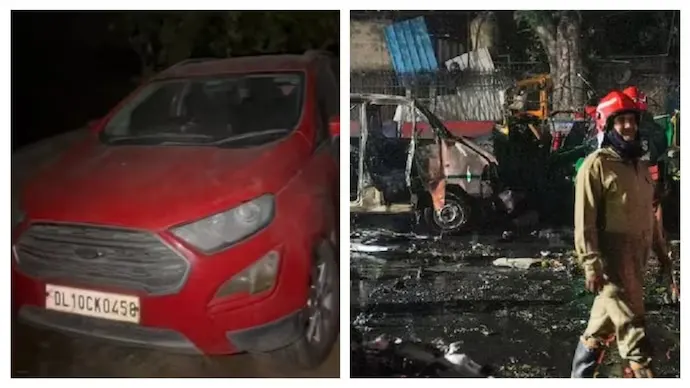
Security agencies have made a significant breakthrough in the investigation of the Red Fort blast case — a red Ford EcoSport has been traced to Khandawali village in Faridabad, Haryana, and a man linked to its abandonment has been detained. Meanwhile, authorities are intensifying efforts to locate a third vehicle suspected to be connected to the explosion, heightening concerns about an organised and pre-meditated attack.
The automobile in question, the red EcoSport, was discovered abandoned on Wednesday in Khandawali village. Investigators say it is linked to the primary suspect in the case, Dr Umar Un Nabi, who is under scrutiny for his alleged role in the blast. A relative of Dr Nabi, identified as one “Faheem”, has been taken into custody by the Faridabad police for questioning; he reportedly parked the vehicle and is believed to have logistical ties to the plot.
The investigation has now entered a critical phase as security agencies turn their attention to a third vehicle—a Maruti Brezza—which is suspected to have been used for reconnaissance or escape. Officials say multiple teams from the Delhi Police and other law-enforcement units across Delhi-NCR and adjoining states are combing through vehicle registration data, CCTV footage, and vehicle-movement trails to trace the Brezza.
Further investigations reveal that the terror module under probe may have prepared as many as 32 old vehicles for potential simultaneous attacks across different locations. Intelligence inputs suggest that the EcoSport and the exploded vehicle—a white Hyundai i20 which detonated near the Red Fort area—were part of a larger network of logistics and escape planning. With the blast taking place at a major national landmark and killing more than a dozen people, authorities are treating the incident as a terror attack and have declared a nationwide high alert.
In view of this, the Delhi Police have directed all second-hand car dealers in the capital and neighbouring states to verify recent vehicle sales and share data with investigators. The directive aims to prevent abuse of vehicle sales channels in terror planning.
The tracing of the red EcoSport is a major tactical win for the investigation, as it links the logistic chain of the blast to direct associates of Dr Umar Un Nabi. The detention of the man who parked the vehicle indicates that the sleeper-cells or support network for the attack may be broader than previously known. The hunt for the third vehicle—the Maruti Brezza—underscores the possibility of a sophisticated, multi-vehicle operation rather than a solitary act. The revelation of 32 vehicles being readied for attacks suggests that the blast near the Red Fort might have been only one component of a larger planned series of strikes.
Security implications are profound: the incident not only strikes at a national symbol—the Red Fort—but also exposes vulnerabilities in urban vehicle-tracking, inter-state coordination, and terror-modality through rented or purchased vehicles. The directive to second-hand dealers, while important, highlights how terror operators may exploit apparently innocuous channels such as used-car sales and anonymous registration addresses to mount high-impact attacks.
As the investigation advances, the tracing of the red Ford EcoSport and the ongoing search for the third vehicle mark key developments in the probe into the Red Fort blast. The incident has been officially treated as a terror attack, and the discovery of multiple vehicles linked to the operation raises fresh alarm about the scale and ambition of the network behind it. With authorities tightening sales-verification norms and conducting intensive intelligence operations, the coming days will be critical in determining whether other planned attacks were averted and in dismantling the broader terror infrastructure. The nation watches closely as security agencies pursue every lead to ensure that the perpetrators are brought to justice.

