
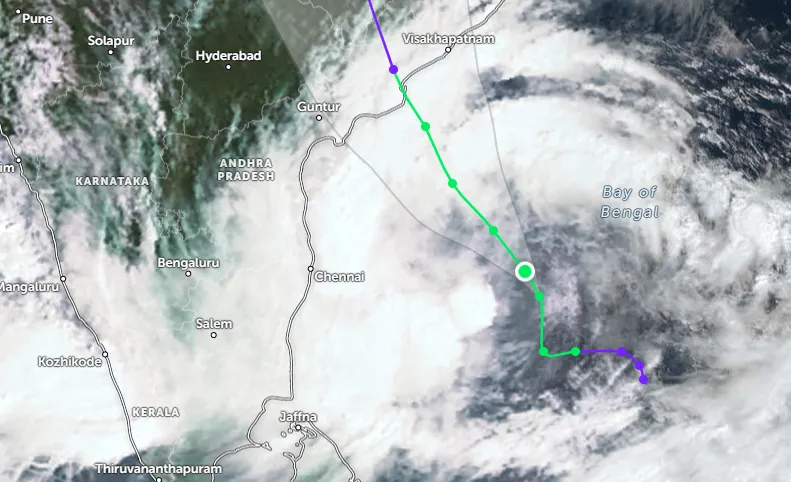
Severe Cyclonic Storm Montha made landfall along the eastern coast of India on the night of Tuesday, October 28, 2025, into the early hours of Wednesday, October 29. The storm crossed between Machilipatnam and Kalingapatnam, near Kakinada in Andhra Pradesh, with sustained wind speeds of up to 110 km/h. As of Wednesday morning, the system has weakened into a cyclonic storm and is expected to further reduce into a deep depression as it moves inland.
In its approach, Cyclone Montha had already triggered extensive precautionary measures. The India Meteorological Department (IMD) issued red alerts for several districts in Andhra Pradesh and neighbouring states, warning of extremely heavy rainfall and gusty winds. The landfall process began around 7:30 p.m. IST on Tuesday and lasted for about three to four hours, during which the storm centre moved inland between Machilipatnam and Kalingapatnam. The maximum sustained winds were recorded between 90 and 100 km/h, with gusts reaching up to 110 km/h.
Authorities had taken preventive measures well in advance, evacuating tens of thousands of residents from low-lying coastal zones. In Andhra Pradesh alone, more than 50,000 people were relocated to relief camps. Schools remained shut, transportation services were suspended or rerouted, and disaster response teams were positioned across vulnerable districts to respond swiftly to emergencies.
The cyclone caused considerable damage across coastal areas. Uprooted trees, snapped power lines, and waterlogged roads were reported in several districts. In a tragic incident, a woman in Makanapalem village of Mamidikuduru mandal lost her life when a tree fell on her house amid strong winds. Early assessments indicate widespread agricultural damage, with more than 38,000 hectares of crops and around 138,000 hectares of horticultural land affected across the state.
In neighbouring Odisha, the storm’s outer bands brought heavy rainfall and strong winds, disrupting daily life in at least 15 districts. Several low-lying areas experienced flooding and road blockages due to waterlogging, prompting local administrations to initiate rescue and restoration efforts. The IMD has forecast that Cyclone Montha will continue to lose strength as it moves inland, transforming from a severe cyclonic storm into a deep depression over the next 24 hours.
Cyclone Montha’s landfall highlights the recurring vulnerability of India’s eastern coastline to severe weather systems, particularly during the post-monsoon season. The rapid response by state authorities, including early evacuation and deployment of relief measures, reflects significant improvement in disaster management capabilities. District administrations near Kakinada demonstrated effective coordination, ensuring that residents were moved to safety ahead of the storm’s arrival.
Despite these efforts, the storm serves as a reminder of the persistent threat cyclones pose to India’s coastal regions. Rising sea-surface temperatures and shifting weather patterns associated with climate change are believed to contribute to the increasing intensity of tropical storms. Beyond immediate infrastructural damage, Cyclone Montha’s impact on agriculture underscores broader economic and environmental vulnerabilities that continue to challenge the resilience of coastal communities.

