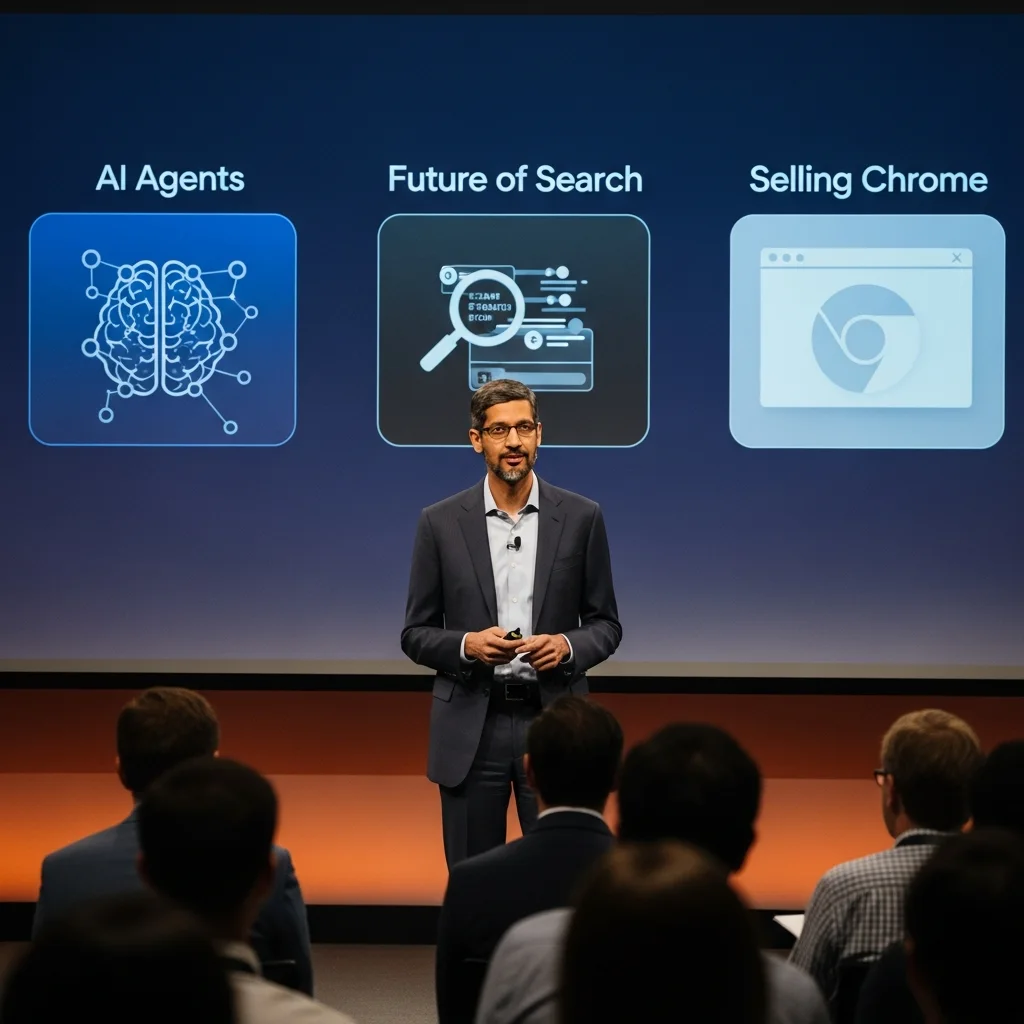
When I first used Google Search in the late 1990s, it seemed like magic. Just input a few words and you’ll get what you want.Fast, simple, and tidy.For more than twenty years, that basic formula didn’t vary much. You only need ten blue links and a search box.
The CEO who has been in command of that ship for years is suddenly redefining what search means in a big way. And to be honest? After seeing Sundar Pichai talk about Google’s intentions for the future, I’m not sure we’ll know what the internet will look like in five years.Some publishers and competitors are excited and scared about the shift that Pichai is leading. He is defending Google in the greatest antitrust case in decades, inventing new AI tools, and working in the most competitive tech scene ever.
Let me tell you what he really means when he talks about the future. It’s more extreme than most people assume.
Search isn’t just a way to find things anymore; it’s an AI assistant.At Google I/O 2025, Pichai made it very apparent that 2025 will be a big year for new search technology. But if you look more closely at what he means by “innovation,” you can see that he doesn’t mean making algorithms better or more useful. He wants to make a huge improvement to Google Search.
The new AI Mode from Google isn’t just a new feature; it’s the future of search.This is quite evident to Pichai. In an interview with Lex Fridman, he said that AI Mode is now on a separate tab, but Google will migrate it to the main site over time.
Think about what that means.Instead of typing a question and obtaining links, an AI will now search the web for you, piece together information, and give you answers.
To be honest, the first time I utilized AI Mode, it felt odd. I’d compose long, conversational questions that I wouldn’t type into a normal search engine. For example, “I’m going to Japan with my family, including my elderly parents, during cherry blossom season. What cities should we see, when should we go, and what accessibility issues should I think about?”In the past, you would have had to do ten different searches. AI Mode accomplished everything at once, receiving information from many sources and making a clear plan. It didn’t feel like looking for something; it felt more like talking to a travel agent who knows a lot.
The Traffic Controversy: Is Google Ruining the Internet?
This is when things start to get hard. Publishers, SEO professionals, and competitors all believe that AI Overviews and AI Mode are taking visitors away from websites.Some individuals have called it “theft.” The CEO of Cloudflare said that AI is destroying the web’s business model.
Pichai strongly disagrees with this story. He claims that Google is more concerned with getting people to visit the web than any other company.He says that Google has crawled 45% more web pages in the past two years.
He says that AI Overviews do make people more interested. Pichai noted that people who use AI Overviews search more often, ask longer inquiries, and Google sees more clicks on links in these summaries.
I’ve talked to a few small business owners about this, and it appears like the truth is somewhere in the middle. Some people are seeing their traffic drop, especially for simple questions that AI can answer right away.Others are noticing that even though their total traffic is down, the people who do visit are more interested. They click through when they need more information than what AI summaries can give them.
Pichai remarked that this is like the transfer from desktop to mobile: it will be hard at first, but in the end it will make the pie bigger. He thinks that AI could change how things are done, but in the end, it helps consumers get valuable information more easily.
But you might think that if you’re Google or a website publisher.
The Rise of AI Agents: Your Digital Butler Is Coming
If you think AI-powered search is cool, wait till you hear what Pichai wants AI agents to do. This is when things get really interesting and maybe even change your life.Pichai added that AI agents might be like credit card companies in that they might help with transactions and make things like scheduling and managing money easier.Take a second to think about that similarity. Credit cards changed the way company works, not just how easy it is to pay. AI bots could do the same thing for practically everything we do online.
Google’s first try at making this dream come true is Project Mariner. Pichai revealed at Google I/O 2025 that Project Mariner can now accomplish more than one thing at a time and has a “teach and repeat” function that lets you show it how to do something once and then it learns how to do similar things in the future.I got to try out Project Mariner early, and it’s really amazing.I taught it how to book a specific kind of hotel room with specified attributes. A week later, I asked it to book a similar place to stay in a different city. It did a wonderful job of doing everything on its own, like going to booking sites, looking at options, and filling out forms.We’re not talking about bots that answer questions.We’re talking about AI that truly helps you with things like making appointments, keeping track of your schedule, dealing with customer service problems, buying products, and learning about hard topics.Pichai said this is a transformation in platforms that is bigger than the internet itself. He believes that the dropping cost of computers and the potential for AI to rise will lead to the establishment of new businesses and types of products.
The Two Webs: Human and Agentic
I think the idea of two parallel webs that Pichai came up with is interesting and a touch disturbing.
Pichai remarked that he thinks there will be two different webs: the agentic web and the traditional or human web. AI agents will be in charge of executing tasks for people on the agentic web.Shopping is one thing he does. Some people enjoy coming to stores, touching items, and having that experience. People like to shop online, click buttons, and get their packages. They both do.Pichai sees the same thing happening with the web: a human web for when we want to look around and a robotic web for when we want AI agents to perform things quickly and well.
The agentic web would need new regulations, new ways of doing business, and new ways of developing trust and trading value. It’s not just a change in technology; it’s a completely new way of thinking about how the internet works.
I’m still trying to figure out what this means for the future. Should websites have two separate experiences, one for people and one for AI agents?How do businesses make money when visitors don’t go to their websites directly? Pichai knows the answers to these questions, but he hasn’t given them all yet.
Project Astra: The AI Helper for Everyone
Pichai is quite excited about Project Astra, which is Google’s concept for an AI helper that can see and understand everything around you. This is in addition to search engines and web agents.
Pichai said that people can see the future of AI and Search with Project Astra, which is DeepMind’s multimodal AI system that can scan live video from a camera or computer screen and answer questions about what the AI sees in real time.Gemini Live has already used this technology, and it is already available for Android users and will soon be available for iOS users as well. People are using it to get ready for job interviews, train for marathons, and even learn how to cook by pointing their camera at food and getting advice right away.
I tried to use Project Astra to help my kid with their math homework. We didn’t have to explain things to the AI; we just showed it the problem and it helped us figure out the answer step by step, modifying its explanation based on what my son understood or had difficulties with.Google intends to put this in AR smart glasses in the future. Imagine walking through a place you’ve never visited before with glasses that can read signs in real time, point out landmarks, and suggest places to dine based on what you like.
Deep Research: AI That Can Think for Hours
Pichai is quite proud of Gemini Deep Research. Most AI doesn’t take as long to generate big research reports as Deep Research does. People used to accomplish this by hand with Google Search.Pichai noted that this makes Search relevant in a lot more circumstances, including ones where you don’t get an answer immediately away but may have to wait a while to get one.
I used Deep Research to find out how new regulations will affect small businesses like mine. I asked it a basic question and went to get coffee. When I got back, I had a 20-page report with references, analysis, alternative outcomes, and ideas for what to do next.
This isn’t just research that goes faster; it’s research that I wouldn’t have been able to accomplish on my own since I didn’t have the time or knowledge.That’s what Pichai is talking about. AI isn’t just helping things go faster; it’s also making things that weren’t possible before.
The Chrome Saga: Google’s Line in the Sand
Now let’s talk about the main issue: the Department of Justice’s antitrust case and the plan to make Chrome sell.
The DOJ argued that Google has illegally retained a search monopoly by controlling Chrome, which is responsible for about 40% of Google’s US search traffic.At first, they wanted Google to sell Chrome as part of the answer.Pichai fought this hard. During his comments, Pichai claimed that the government’s intention to have Google sell Chrome and share data with competitors would make individuals less eager to invest in new technology.
He told the federal judge that the proposal to remove Chrome from Google is “so far-reaching” that it means Google is “de facto divesting” its search engine. He says that Chrome is more than just a browser; it’s a key aspect of Google’s ecosystem, which includes security, AI features, and search.
When asked directly if Google could work without Chrome, Pichai made it clear that Google doesn’t want to sell it.He stated, “I don’t think we’re in that situation,” which suggests that the company isn’t even thinking about when it would have to sell its browser.
What is good news for Google? In September 2025, Judge Amit Mehta made his decision and decided not to make Chrome sell. He instructed Google to cease negotiating deals with companies like Apple and Samsung that only let them use their search engines as their default ones. Instead, he told Google to share some search data with its competitors.Before the decision, Perplexity AI had even offered $34.5 billion for Chrome, but Mehta’s decision meant that Chrome stayed with Google.Pichai has a huge win, but the company still has to deal with a lot of restrictions and appeals that might take years to settle.
The Market: Is It Not a Monopoly Anymore?
Pichai’s best argument against antitrust concerns is that the AI market is quite competitive right now.OpenAI has ChatGPT, Microsoft has Copilot, Meta has its AI products, Anthropic has Claude, and Perplexity—everyone is striving to go ahead.
Pichai took a direct jab at Microsoft in an interview with The Verge, saying he would love to compare Microsoft’s models against Google’s models side by side any day, any time.This indicates that Microsoft uses OpenAI’s technology a lot instead of building its own.
I think the competition is serious and hard. I use several AI technologies for different projects. ChatGPT for creative work, Gemini for searches, and Claude for in-depth research.The market is not closed at all.
Pichai argued that worries about an AI monopoly were not true.He added that AI is a bigger platform revolution than the internet and that new businesses would start up.
The Business Model Question: Will this actually produce money?
A lot of people are scared that all the money invested on AI would be wasted. Google is spending billions on AI research, development, and infrastructure. Is there a profit?Pichai is convinced there is. He told CNN not long ago that he doesn’t think there is an AI bubble. He claimed that consumers paying for AI tools is a sign that the technology is useful.AI Overviews now have more than 1.5 billion users and are available in 200 countries and territories. Pichai claimed that this is one of the best launches in Search in the last ten years.
AI Overviews are making more than 10% more of the kinds of searches that show them in Google’s biggest markets, such the US and India. That’s real growth in how many people use it, not just talk.
Pichai added that when it comes to AI Mode advertising, which is a significant problem for making money, they’re starting with the organic experience.He also remarked that the need for people to respect business information has not altered. He believes that AI will help determine the ideal way to put ads in, possibly by coming up with a new approach to present business information.
What This Means for Jobs in the Future
People at Google I/O 2025 asked Pichai how AI will change jobs. He said he sees a group of powerful technologies that will make life easier for individuals and give them more time to do more creative and fulfilling work.
I found his comparison of programming languages very interesting.He said that no one wants to write code in assembly language anymore, and that in ten years, people will feel the same way about the programming languages that are used now. AI won’t put programmers out of work; instead, it will make them work at higher levels of abstraction.
I see this in my own work. I spend less time doing the same research and collecting data over and over again and more time coming up with new ideas and plans. People who know how to use AI well will take our jobs, not AI itself.Pichai’s Hope for the Open Web
Even if people are scared that AI will take over the internet, Pichai is still hopeful about the future of the web. “I’ve cared about the Web for a long time,” he said. “I don’t think it belongs to anyone. That makes it valuable.”
He thinks that websites will get better for users, with better design, easier navigation, and maybe even AI helping to make things better.The transactional and task-oriented things will be handled by the agentic web in the meantime.
I desire to believe this good point of view. The internet has done a lot to make the world a fairer place. But I’m just as scared about a future when AI does everything, most people don’t go to websites, and the rich ecosystem of independent producers and publishers has a hard time remaining alive.
Pichai’s answer is to have faith in the market, fresh ideas, and the fact that we’ll find new methods to make things work.He stated that fears about the web’s destruction were unjustified because it is growing and Google helps consumers access trustworthy information in a time when there is too much information.
The Timeline: This Is Happening Right Now
What I find most interesting about Pichai’s vision is how much of it is already here or will be by 2025.
1.5 billion people can watch AI Overviews live. Millions of people are getting AI Mode. Testing what Project Mariner can do. You can acquire Gemini Deep Research. Gemini Live includes some of the same characteristics as Project Astra.This isn’t a story from a science fiction book. This isn’t going to happen until ten years. Right now, we’re in the middle of the transformation, and most people don’t realize how big of a deal it is.
What I Think: Excitement and Worry
I have conflicting feelings after reading Pichai’s interviews, presentations, and intentions for the future.
On the one hand, the technology is quite interesting.This is the future we were promised in science fiction: an AI that can undertake difficult research, plan trips, keep track of my schedule, and answer questions by looking at what I see.
But I’m worried about how much power is in one place. Pichai thinks that competition and the open web are wonderful things, but Google is making itself the middleman for how billions of people obtain their news. That company has a lot of power.
The antitrust case is still relevant, even if Google keeps Chrome.Competitors might be able to take advantage of the rules around exclusive partnerships and the necessity to share some search data. But will it be enough to stop one company from telling individuals how to utilize information?
The Bottom Line: The Internet Is Changing
No matter what you think of Pichai’s actions, one thing is clear: Google is the one who is reshaping the internet.
It’s evident from Pichai’s interview that the company is spending more money into AI to revolutionize how consumers look for things and talk to each other. This indicates that the next ten years will be substantially different.We’re moving from a world where we look for information to one where AI does things for us. From a web of links to a web of agents. From typing out queries to talking to people. From clicking on results to getting answers that are put together.
It’s clear that this future is already here; the question isn’t if it will come.The question is if it will be made in a way that preserves the internet free and democratic while simultaneously taking advantage of AI.
Pichai seems confident that Google can do it. I’ve been watching the internet change for 30 years, and I’m hopeful but cautious. In the next few years, we’ll find out if his positive vision comes true or if things get worse.
There is one thing we can be sure of: the Google Search we used to know is going away. What happens next will affect how the next generation learns, makes decisions, and lives their lives. I hope that Google and its rivals take that responsibility seriously.