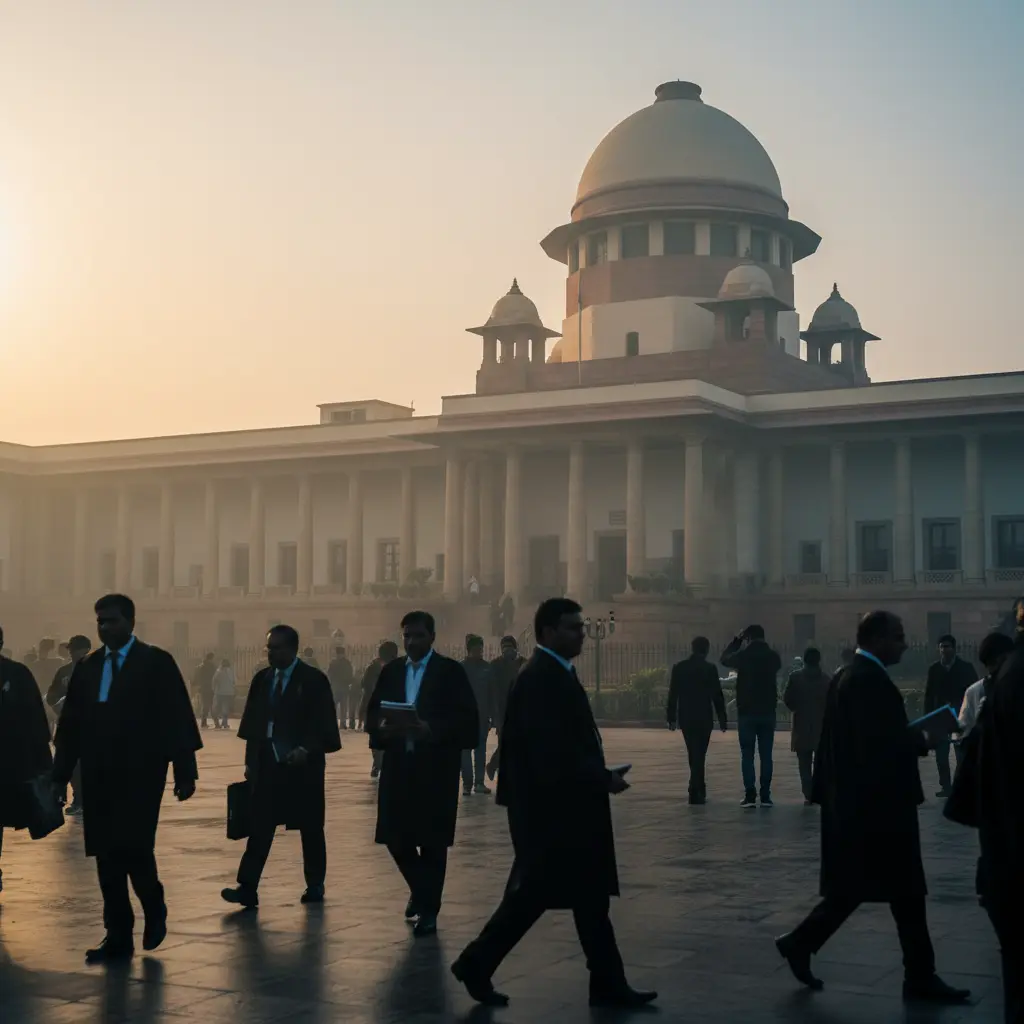
India’s judiciary is in one of the busiest phases in recent history, with the Supreme Court taking up a wide range of cases touching upon governance, civil liberties and limits of executive power. Legal experts say 2026 looks set to be a consequential year for constitutional law in the country, from challenges to new laws to disputes over electoral processes, and political leaders across the spectrum continue to weigh in as key judgments loom.
Scrutiny of Election Commissioner Appointments One of the issues closely watched by the court is the law on the appointment of India’s Chief Election Commissioner and other Election Commissioners. Petitioners, including the Association for Democratic Reforms, argue that the 2023 law excludes the Chief Justice of India from the selection committee in a manner that conflicts with an earlier Supreme Court ruling requiring a panel made up of the Prime Minister, the Chief Justice, and the Leader of the Opposition. The case strikes at a sensitive question in Indian governance: how much independence election oversight bodies should have from the executive branch, and whether Parliament can effectively override a constitutional bench’s directions through ordinary legislation.
Free Speech and the New Criminal Code
Another major thread running through this year’s docket involves India’s newer criminal statutes. A provision in the Bharatiya Nyaya Sanhita, the law that replaced the colonial-era Indian Penal Code, is facing a constitutional challenge on the grounds that it effectively reintroduces sedition-style restrictions on speech under a different name. Critics of the provision argue it criminalizes broadly worded conduct — from “exciting” secessionist sentiment to actions that supposedly endanger the country’s unity — in language vague enough to chill legitimate dissent and journalism. The bench hearing the matter has issued formal notice and tagged it alongside a related pending challenge, signaling the court intends to examine the provision closely rather than dispose of it quickly.
Online Gaming, Land Disputes and Laws on Religious Conversion The court’s calendar for this year also includes a challenge to the 2025 law banning real-money online gaming, with a gaming company arguing that Parliament exceeded its constitutional authority by imposing a blanket prohibition and not a regulated framework. Separately, the court continues to hear consolidated petitions challenging anti-conversion laws passed by several states, including Uttar Pradesh, Madhya Pradesh, Gujarat, Uttarakhand, and Haryana. Civil society groups involved in that litigation say the case has taken on new urgency as some states move to make their laws even more stringent.
Land and property rights remain another flashpoint. In one closely followed case, the court stayed a High Court-ordered eviction affecting thousands of alleged encroachments on railway land, citing concerns about the scale of displacement — a reminder of how constitutional questions in India often intersect directly with the daily lives of ordinary citizens rather than staying confined to abstract legal debate.
Technological Advances and Judicial Responsibility in the Court Room The judiciary too has been introspective. The Supreme Court in a recent warning stated that lawyers using AI-generated fake legal precedents in their arguments is professional misconduct and any judgment based on such fabricated citations would be void. This is the first indication of how Indian courts are dealing with the increasing use of generative AI tools in legal practice. The court also asked for public comment on draft rules that would govern the use of artificial intelligence in the judicial system itself, part of a broader effort to modernize court processes while guarding against its attendant risks.
A Pressurised Court An Attentive Public The number of cases that reach India’s highest court gives a sense of how big a role it plays in the governance of the country. The Supreme Court disposed of close to 75,000 cases last year giving about 1,400 judgments and still has a backlog of more than 90,000 pending cases. Constitutional bench hearings are now livestreamed, giving ordinary citizens direct access to arguments that once played out only within courtroom walls — a shift that legal experts say has heightened public engagement with, and scrutiny of, the judiciary’s work.
Political leaders, meanwhile, continue to debate legislative reforms on several fronts connected to these cases, from electoral process changes to speech regulations to the pace of land-related evictions. As is often the case in a democracy with a written constitution and an assertive judiciary, many of these disputes over policy are ultimately expected to be resolved, or at least reshaped, by court rulings rather than parliamentary votes alone.
What to Watch in the Coming Weeks
Legal observers expect several of these matters to see significant movement in the near term, though the Supreme Court’s docket is famously difficult to predict given the volume of cases competing for bench time. Whatever the outcomes, each of these cases carries implications well beyond the parties directly involved — touching on how elections are overseen, what speech is protected, how religious freedom is balanced against state regulation, and how technology is reshaping the practice of law itself.
For a country of India’s size and diversity, these aren’t just legal technicalities. In many ways, they are continuing conversations about what the Constitution means in practice, conversations that will keep courts, legislators and the public engaged for months to come.