
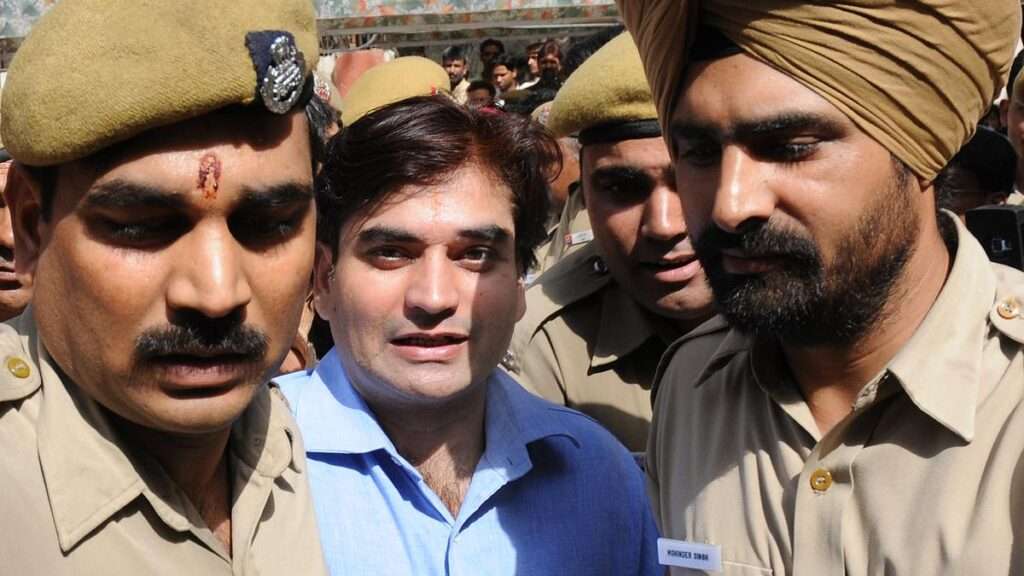
Sept. 8,2025: The Supreme Court on Monday refused to extend the interim bail of Vikas Yadav, who is serving a 25-year jail term in the 2002 Nitish Katara murder case. The court said there were no compelling reasons to justify continuation of the relief earlier granted and directed that Yadav return to custody.
Yadav, the son of former Member of Parliament D.P. Yadav, had been released on interim bail earlier this year citing personal grounds. His counsel sought further extension, arguing that his circumstances warranted additional time outside prison. The prosecution opposed the plea, stating that the gravity of the offence and the long history of the case left no room for leniency. After hearing both sides, the bench dismissed the application and made it clear that punishment in such cases must be enforced strictly.
Nitish Katara, a 25-year-old business executive, was abducted and murdered in February 2002. Investigators proved that Vikas Yadav and his cousin Vishal Yadav carried out the killing because of Katara’s relationship with Bharti Yadav, the sister of the convicts. The crime was described as an “honour killing” and sparked nationwide outrage at the time. The trial court convicted Vikas and Vishal Yadav, sentencing them to 25 years of rigorous imprisonment without remission. In 2014, the Delhi High Court upheld the conviction, and the Supreme Court later confirmed the verdict, noting that the case reflected a serious assault on individual freedom and the right to choose a partner.
During Monday’s hearing, the Supreme Court observed that honour killings cannot be treated with indulgence as they undermine personal liberty and the constitutional right to life. The judges remarked that granting repeated extensions of bail in such cases would send a wrong signal and weaken the deterrent value of punishment. The decision is in line with the consistent approach of the courts over the years, which have treated the Katara case as one of exceptional importance for society.
Members of Nitish Katara’s family welcomed the judgment and said the order had strengthened their long fight for justice. They described the verdict as a reminder that the struggle was not just for one individual but for many others who face violence in the name of family honour. The prosecution also expressed satisfaction with the outcome, pointing out that the refusal to extend bail preserves the integrity of the earlier judgments delivered by the trial court, the High Court, and the Supreme Court itself.
More than two decades after the murder, the Katara case continues to hold significance as one of the most widely cited examples of honour killing in India. With its latest order, the Supreme Court has reaffirmed the need for strict enforcement of sentences in crimes that strike at the foundation of personal liberty and social justice.

