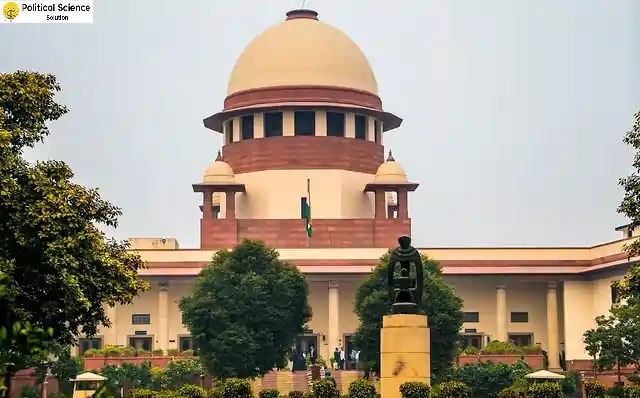
July 31,2025 — The Supreme Court of India on Wednesday advised the Parliament to reassess provisions of the Tenth Schedule of the Constitution, particularly the clause that gives the Speaker of the Legislative Assembly or Lok Sabha the authority to decide on disqualification petitions linked to political defection.
A bench headed by Chief Justice D.Y. Chandrachud made the observation during hearings on a series of disqualification matters pending across various state assemblies. The court expressed concern over the impartiality of the Speaker, given that the position is typically held by a member of a political party, often the ruling one.
“There exists a structural conflict when the Speaker, affiliated with a political party, is empowered to adjudicate cases that may impact the majority in the House,” the bench noted.
The court proposed that Parliament explore alternatives such as assigning disqualification powers to an independent authority or constitutional body, potentially the Election Commission, to ensure unbiased decision-making.
Introduced through the 52nd Amendment in 1985, the Anti-Defection Law was designed to maintain political stability by discouraging elected representatives from switching parties. However, over the years, this provision has drawn criticism due to allegations of delays and partisanship in decisions made by Speakers.
Recent incidents in states like Maharashtra, Karnataka, and Goa have underscored concerns about the Speaker’s role in politically sensitive disqualification proceedings. In many of these cases, verdicts were delayed, often resulting in prolonged legal and political uncertainty.
Legal analysts have consistently flagged this issue. Previous reports by the Law Commission of India and the National Commission to Review the Working of the Constitution have recommended revising the current model to ensure neutrality and efficiency.
The Supreme Court’s comments have sparked renewed political debate. While several opposition leaders welcomed the suggestion as a step toward restoring institutional integrity, reactions from the ruling coalition remained guarded. Sources indicate that Parliament may soon discuss the matter through relevant committees or legislative forums.
Legal experts say the recommendation, though not binding, adds momentum to the demand for systemic reform in handling defection cases.
The apex court clarified that its remarks are advisory in nature and aimed at improving the credibility of democratic institutions, particularly in situations where governments may be at risk due to internal defections.