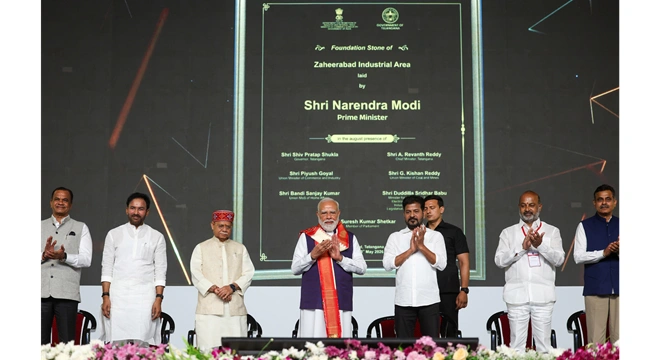
Warangal, Telangana — In the heart of cotton fields and the handloom legacy of Telangana, India’s first fully operational PM MITRA textile park was inaugurated this week in a lively event. This Warangal park is a giant leap ahead for Prime Minister Narendra Modi’s ambitious PM MITRA (Mega Integrated Textile Region and Apparel) program. It’s not just another industrial project, it is a daring bet to revive India’s textile tradition, while creating thousands of employment in a state yearning for economic movement. And as the world’s want for sustainable materials grows, this park makes India – and Telangana in particular – an important player. But can it deliver on its promise of increased textile exports and sustained employment in a competitive world?
Top state authorities and industry leaders attended the inauguration which represents the culmination of years of planning and the beginning of what might be a textile revolution. Warangal, a hub for traditional weaves like Pochampally ikat, is now looking at modern manufacturing. As investors flood in, the park promises to integrate farmers, weavers and industries into a smooth supply chain. It’s a crucial campaign for a country where textiles employ more than 45 million people and account for 2% of GDP.
PM MITRA – A Glimpse from Vision to Reality
The PM MITRA plan was launched in 2021 with an outlay of Rs 4,445 crore to set up seven mega parks across the country. These are not your usual industrial zones. They are “plug-and-play” ecosystems aimed at cutting costs, speeding production and attracting large companies. Telangana’s aggressive land acquisition and infrastructure push led to Warangal’s park, stretched over 1,100 acres, becoming the first operational one.
Why is it important now? India’s textile exports exceeded $44 billion last fiscal but have fallen behind rivals like Bangladesh and Vietnam. The park hopes to address this gap with a common infrastructure of modern testing labs, effluent treatment plants and worker housing. The confidence is reflected in the interest displayed by early movers like Reliance Industries and Aditya Birla.
Key characteristics at a glance:
1,100 acres with space for 50+ apartments.
Focus on man-made fibers, cotton mixes and technological textiles.
Integration of green energy example solar energy.
Skill centres tied up with local ITIs for speedy workforce training.
Experts say the arrangement might cut production costs by 20-30% making Indian fabrics competitive on markets from New York to Tokyo.
Textile Roots of Warangal Deep
Take a step back and the story of Warangal is almost poetic. This city 150 km from Hyderabad has been weaving cloths for hundreds of years. Patronised here by the Kakatiya monarchs, silk and cotton today get premium rates for their sarees with GI tags. But, like most rural economies, it suffered after liberalization. Mills closed, employment disappeared, youth moved to cities.
The PM MITRA park brings back that spirit with a modern touch. Telangana spent Rs 350 crore upfront on land and necessities, earning praise from the Centre. Chief Minister A Revanth Reddy dubbed it a “new chapter for weavers dreams”. Local farmers cultivating cotton on the adjacent black soil are the biggest beneficiaries. The park has backward integration with ginning facilities adjacent to spinning mills, thus eliminating transit issues.
Honestly speaking, Telangana’s textile sector provides jobs to 5 lakh people, while unemployment is at 7% across the state. In five years, this park alone will provide 15,000 direct jobs and 50,000 indirect jobs. Women, who dominate handlooms, may get a major uplift — think clusters where rural craftspeople feed into hi-tech garment lines. “My daughters may not choose for Gulf jobs now,” said a weaver from Kazipet.
Jobs Ahead: Winners and Waiters?
The primary sell of the park is jobs. Imagine spinning units spinning yarns, weaving floors humming with mechanized looms, blocks of garment sewing for export companies. The first phases would be on cotton and MMF (man-made fibre) with intentions to get into home textiles and garments, he said.
But it’s not all smooth sailing. Unions are concerned about skill shortages, with many people knowing handlooms, not high-speed machines. The state assures of providing training under the Samruddhi plan in association with NIIT and others But then problems arise. Will salaries converge to urban levels? Entry-level jobs Rs 15,000-20,000 a month, good for Warangal, but tough against Hyderabad’s draw
These textile parks are repeating the success stories of Tirupur (knitwear center) or Surat (synthetic fabrics) across the globe. India looks to take $1 trillion share of global garment market by 2030. For Telangana, it’s personal — state lags behind Gujarat, other neighbors in manufacturing. And with its young population, this may counter that.
Question to ponder: Can mega parks like Warangal’s help tiny players without eating them in a country where 70% of textiles are from unorganized sectors?
Export Dreams and Supply Chain Wizardry
The true prize is textile exports. India’s stake in global trade is 4%, PM MITRA targets 10% by end decade. The park is anticipated to generate $1 billion in exports for Warangal, focusing on value-added products including sustainable denim and medical textiles. Its proximity to the Nhava Sheva port is a help, and rail lines to Chennai are being upgraded.
Sustainability is built in. The park must be zero liquid discharge and use recycled water with the looming carbon border fees of the EU. Cotton producers are being nudged towards organic cultivation, in line with India’s desire for greater farm wages. For brands like H&M and Zara, finding ethical suppliers might be a real problem.
Obstacles in front? Raw material prices increased by 15% last year owing to worldwide disruptions. Synthetics are dominated by China, hence India requires policy power — like the ongoing PLI plan extensions. But Warangal’s edge is labour: plentiful, English-speaking and cheap.
Sustainability & Tech: The New Edge
No more dye houses that pollute. This park is green tech-first, with solar panels for 50% power, rainwater collection and AI-powered quality inspections. Drones scan the fields to prevent pests and connect farms directly to factories. It’s digital agriculture meets textiles, a tribute to Telangana’s digital image.
This has to be upgraded in India’s textile tale. After COVID, consumers want traceability — apps like “farm to fashion” may use blockchain to track Warangal yarns. The park has an R&D centre that will experiment with regenerated polyester from plastic trash as per the Swachh Bharat mission.
Local effect? Cleaner Kakatiya river, less health problems from chemical discharge. Farmers might shift to high-yield Bt cotton cultivars, increasing their yields by 30%. Good for the environment AND the economy.
The Loom: Skills, Land, and Rivalry as Barriers
No project is flawless. Land acquisition displaced a few farmers but at the market rates. The Telangana park’s water shortage means it has to use treated sewage – clever, but unproven at scale. Power rates need subsidies to match the cheap electricity of Bangladesh.
Skill development is essential. 10, 000 youth to be trained in CAD designing, robotics and retailing. ITi Warangal has scaled significantly but difficult to scale fast. Hostels for women are useful, but without childcare mothers risk being left behind.
The competition is tough. Vietnam’s FTAs offer it an edge; India’s FTAs with the UAE and Australia are a plus, but more is needed. Still, Warangal’s integrated methodology – from fiber to fashion – results in shorter lead times, a significant draw for fast-fashion giants.
Other Parks in the Pipeline A National Roll Out
Warangal is the first but six other PM MITRA parks are going up Amaravati (AP), Gwalior (MP), Dharwad (Karnataka), Navsari (Gujarat), Khurpia (UP) and Manapparai (Tamil Nadu). Each was adapted – Gujarat to synthetics, UP to cotton. Total investment? Rs 25,000 crore-plus, 35 lakh employment across India.
Telangana win sets the pace. States vie for anchor tenants, offering advantages such as stamp duty rebates. The problem for India is scale: fragmented clusters won’t stand up to the heavyweights of Asia.
Looking Forward: Threads of Hope
Warangal’s PM MITRA park is not bricks and machinery. It is a lifeline for a dying trade in a high-tech world. It means jobs for the jobless, exports for a trade-hungry economy and sustainability for a warming world. Good early signals Rs 5,000 crore MoUs inked, first units to break ground next month
Sure, there are challenges — from training shortfalls to global headwinds. But if Warangal does deliver, it might ignite a textile boom in India. What if this is the dawn of a new golden age when the looms of Telangana would clothe the world? For now, the gates of the park are open and the real weaving begins.
Telangana’s game-changer – India’s first PM MITRA textile park opens in Warangal, eyes on jobs & exports