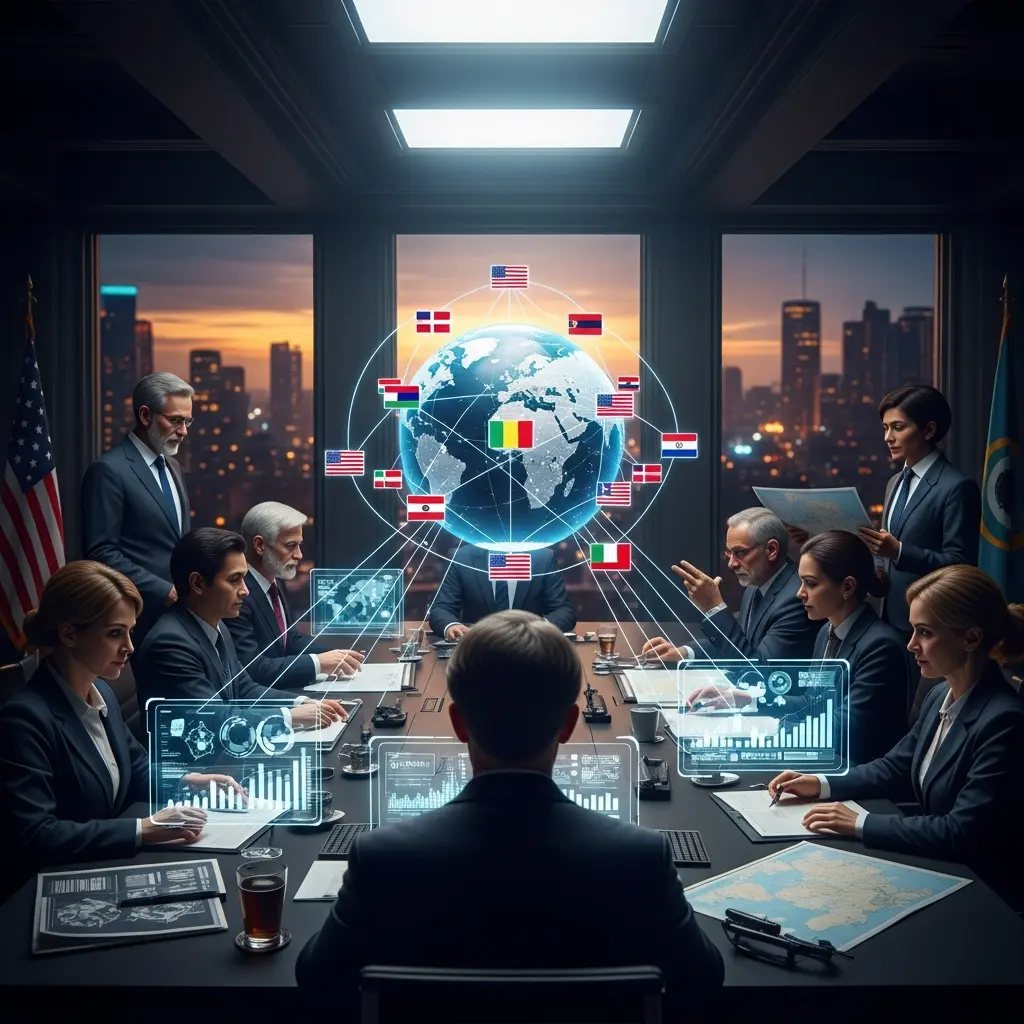
There’s an old saying in diplomacy: nations don’t have permanent friends, only permanent interests. It sounds cynical. But right now, watching how the world’s major powers are quietly repositioning themselves on the global stage, it reads less like cynicism and more like a live forecast.
Something significant is happening in international relations — not the dramatic, headline-grabbing kind, but the slower, more consequential kind. Alliances that looked rock-solid a decade ago are being quietly stress-tested. Countries that once shared a lane are drifting. And new partnerships, forged not by ideology but by strategic necessity, are emerging in their place.
When the Old Maps Stop Working
The post-Cold War world ran on a fairly simple map. The United States and its Western allies anchored one corner. Russia and China occupied complicated, often overlapping corners of their own. Developing nations navigated the space in between, often leaning toward whoever offered the better deal — or the most pressure.
That map hasn’t been torn up. But it’s been folded, creased, and redrawn enough that navigating by it has become genuinely difficult. The war in Ukraine exposed fault lines in transatlantic unity that optimists preferred not to dwell on. Tensions over Taiwan reminded everyone that the Pacific is not a calm lake. And a series of economic shocks — supply chain collapses, energy crises, food insecurity — forced governments everywhere to ask a hard question they’d been avoiding: can we actually rely on the partners we’ve always assumed would show up?
For many, the honest answer was: not entirely. And that realization has been the quiet engine driving the current global diplomacy reset.
The New Logic of Partnership
What’s striking about the current alliances shift is how much it’s being driven by economics rather than ideology. During the Cold War, you picked your side based largely on political values — or at least, that was the official story. Today, the conversation in most foreign ministries sounds a lot more like a procurement meeting.
Who controls the semiconductors? Who has the rare earth minerals we need? If one corridor is cut off, where do we get our energy? These are the questions shaping international strategy in 2026 and leading countries to partnerships that would have seemed unthinkable not so long ago. India is not only deepening its ties with both the United States and Gulf states, but doing so in a balancing act that would have seemed paradoxical in a more ideologically strained era. Gulf states, once seen simply as energy providers, are reinventing themselves as investment hubs, mediators and players with real strategic weight. Countries across Southeast Asia are hedging carefully, building relationships with a number of great powers rather than fully joining one orbit or another. Even in Europe, the push to wean off Russian energy and Chinese manufacturing has led to a more assertive, self-sufficient approach than the cozy interdependence of recent decades.
This isn’t chaos. It’s a new kind of order — messier and more multipolar than what came before, but arguably more honest about how national interest actually works.
Defense, Deterrence, and the Rise of Hard Power There is a quieter but undeniable uptick in defense preparedness across regions, in concert with the economic recalibration. Countries that spent decades cutting defense budgets are now reversing course. Regional defense pacts are being dusted off, expanded, or built from scratch. The thinking is simple: in a world where the geopolitical rules feel less fixed, sitting vulnerably on the sidelines is a risk few governments are ready to take.
This isn’t necessarily a march toward conflict. In many cases, it’s the opposite — an attempt to build enough credible deterrence that conflict becomes less likely. But it does signal a broader shift in how nations are calculating their security needs. The assumption that economic interdependence alone would keep the peace has taken some serious blows in recent years, and policymakers have noticed.
Trade Relations in a Fragmented World
Perhaps nowhere is the realignment more visible — and more consequential — than in trade relations. The era of truly open, borderless global trade is not dead, but it is under significant strain. The phrase “friend-shoring” — routing supply chains through politically aligned or trusted partners — has gone from an academic concept to active government policy in a surprisingly short time.
This shift will reshape global trade patterns in ways that are still hard to fully model. Some regions stand to gain significantly — countries that can offer stable governance, skilled labor, and geographic convenience are suddenly very attractive to corporations looking to diversify away from single-country dependencies. Others risk being sidelined if they don’t find a way to plug into the new networks being constructed.
For businesses operating globally, the implications are profound. Supply chain decisions that were once made almost purely on cost are now being made with a geopolitical checklist in hand. Where is this component manufactured? What happens to our operations if relations between these two countries deteriorate? These questions have moved from the risk department to the boardroom.
No Clean Endings, Only Ongoing Adjustments
It would be tidy to conclude that all of this repositioning will settle into a new stable order soon. The honest reality is that we’re likely in a prolonged period of adjustment — one where the rules are being renegotiated, alliances are fluid, and the outcomes of individual decisions by major powers will compound in unpredictable ways.
What seems clear is that the countries and institutions that will navigate this era best are those that approach it with flexibility rather than rigidity. Clinging to the old map when the territory has changed is rarely a winning strategy. And in a world where the chessboard is actively resetting, the players who understand the new geometry — and move early — tend to find themselves with far more options than those who wait for clarity that may never fully arrive.
The alliances of tomorrow are being quietly built today. And the decisions being made in foreign ministries, boardrooms, and summits right now will shape the world that the next generation inherits. That’s worth paying close attention to — even when the headlines are about something else.
The Chessboard Resets: Why the World’s Major Powers Are Rethinking Who They Stand With.