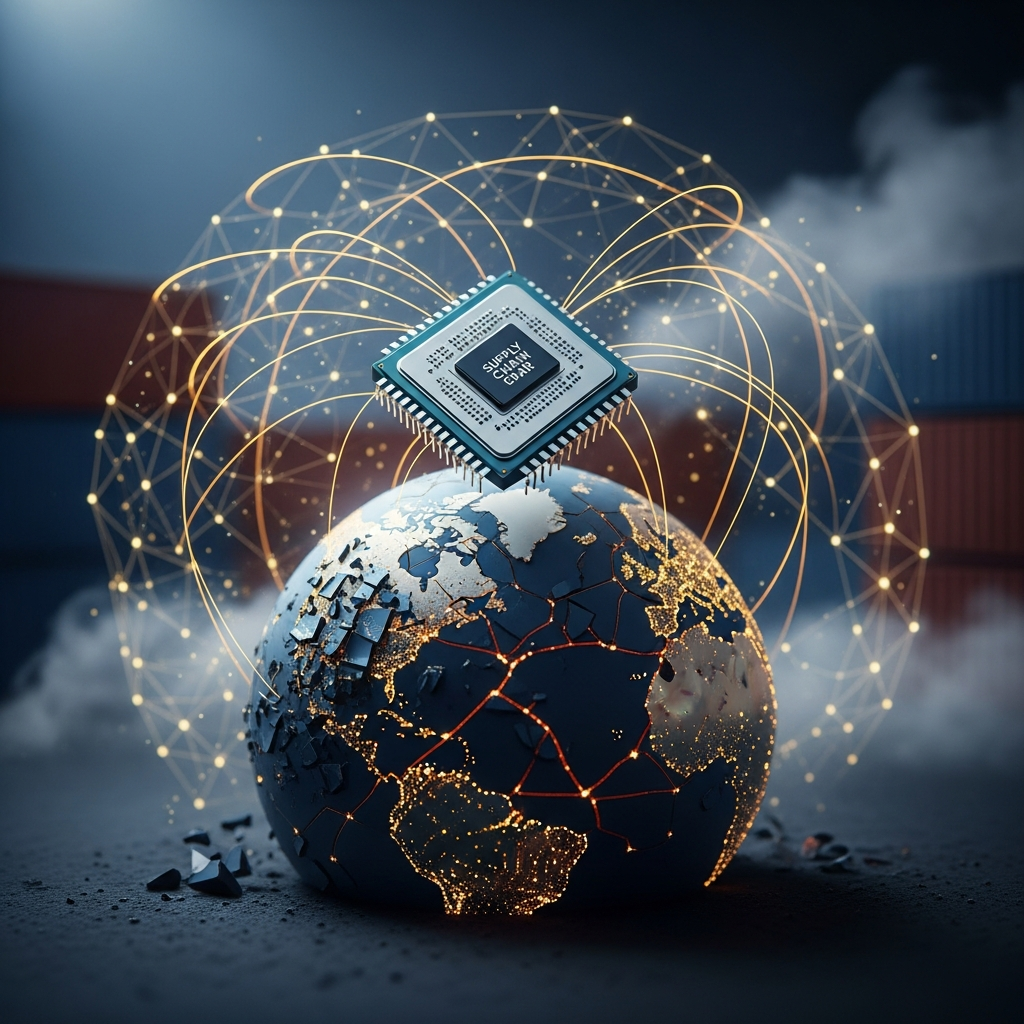
There’s a particular kind of anxiety that has settled over boardrooms and factory floors across the global technology sector in recent years. It doesn’t come from a failed product launch or a missed earnings quarter. It comes from something far more fundamental: the fear that the parts you need to build the things the world depends on might simply not arrive.
That fear has a name now. Supply chain risk. By 2026, it had solidified its status as a key influence, fundamentally altering the way tech companies approach their strategies, investments, and long-term projections.
When the World Realised How Fragile Everything Was
The semiconductor supply crisis that erupted in the early 2020s was, for many executives, a genuine wake-up call. Suddenly, the invisible threads holding global manufacturing together became very visible indeed. Carmakers couldn’t finish vehicles. Consumer electronics sat incomplete on factory floors. Hospital equipment faced delays. All because a handful of fabrication plants — most of them concentrated in Taiwan and South Korea — couldn’t keep pace with a surge in demand that coincided with pandemic disruptions, shipping bottlenecks, and a sharp escalation in US-China trade tensions.
The tech industry risk that materialised wasn’t theoretical. It was measured in billions of dollars in lost revenue, in product shortages, in quarterly earnings calls full of uncomfortable explanations to shareholders. Companies that had spent decades optimising their supply chains for efficiency — squeezing out every dollar of slack, running lean inventories, single-sourcing components from the cheapest reliable supplier — found that all that efficiency had come at a hidden cost: fragility.
The lesson was painful. But it was also clarifying.
The Geography of Chips Is Changing
At the heart of the current anxiety is semiconductor supply. Semiconductors — the microscopic chips that power everything from your smartphone to fighter jets to the servers running artificial intelligence — remain among the most geographically concentrated products in human history. The most advanced chips in the world are largely produced by a single company, TSMC, in Taiwan. That’s not a criticism of TSMC, which is a marvel of engineering and industrial organisation. It’s simply a statement of geopolitical reality: an enormous share of the world’s technological capability runs through a relatively small island in one of the most contested stretches of ocean on Earth.
Governments and corporations have spent the past several years trying to change that equation. The United States passed the CHIPS and Science Act, pumping tens of billions into domestic semiconductor fabrication. The European Union launched its own Chips Act. Japan lured TSMC to build a facility in Kumamoto. India has announced semiconductor incentive programmes. South Korea is doubling down on its existing strengths. The message from every major economy has been the same: we cannot afford to be this dependent on this few places for something this critical to global manufacturing and national security.
Diversification Is Harder Than It Sounds
Here’s what the policy announcements don’t always convey: building semiconductor fabrication capacity is extraordinarily difficult, expensive, and slow. A leading-edge chip fab costs upward of $20 billion to construct and takes years to become operational. The workforce required — materials scientists, process engineers, equipment specialists — takes decades to develop. You can’t simply decide to build a domestic semiconductor industry and have one ready in three years. The supply chain tech ecosystem that surrounds chip manufacturing involves thousands of specialised suppliers, many of them concentrated in their own geographic clusters.
This is why, despite all the investment and all the political will, the diversification of global chip production is moving at a pace that makes tech industry executives nervous. The geopolitical tensions that create the urgency aren’t waiting for the new fabs to come online.
Businesses are, of course, wrestling with risk in a number of ways. One common approach is to build up inventory, essentially a financial buffer against disruptions. Rather than putting all their eggs in one basket, they’re diversifying their suppliers, especially for critical components. Furthermore, they’re taking a close look at their supply chains, probing several tiers deep to uncover vulnerabilities that might otherwise remain hidden.
Finally, they’re putting money into design flexibility, creating products that can use chips from different manufacturers.
The Reshaping of Global Manufacturing
What’s emerging from all this anxiety and adaptation is a fundamental restructuring of where and how technology gets made. Global manufacturing in the tech sector is becoming more regionalised. The era of pure globalisation — where you built each component wherever it was cheapest and assembled wherever labour costs were lowest — is giving way to something more complex and more politically shaped.
This shift carries real costs. Redundant supply chains and multiple manufacturing locations are less efficient than concentrated ones. Prices for some technology products will be higher than they would have been in a world of unfettered globalisation. Companies are essentially paying a resilience premium — buying insurance against disruption by accepting somewhat higher operating costs.
But it also carries something else: the possibility of more durable innovation ecosystems in more places. New semiconductor clusters emerging in the United States, Europe, Japan, and India will eventually produce their own engineering talent, their own research ecosystems, their own startup cultures. The diversification that began as a defensive response to supply chain tech vulnerability may, over time, create new centres of technological gravity.
A Sector Learning to Live With Uncertainty
The global technology sector has always been comfortable with disruption when that disruption came from within — a new product category, a platform shift, a breakthrough in materials science. What it is still learning to navigate is disruption from without: geopolitical fractures, trade wars, climate events, pandemic shocks.
Supply chain resilience has moved from being an operational concern — something for logistics managers — to a strategic imperative that sits in the CEO’s office and in government ministries. The companies that will thrive in this environment are the ones treating that imperative seriously, investing not just in the next product cycle but in the underlying architecture of how their products come to exist at all.
The chip on the world’s shoulder isn’t going away. But the world, slowly and expensively, is learning to carry it better.
The Chip on the World’s Shoulder: How Supply Chain Fear Is Reshaping the Tech Industry.