
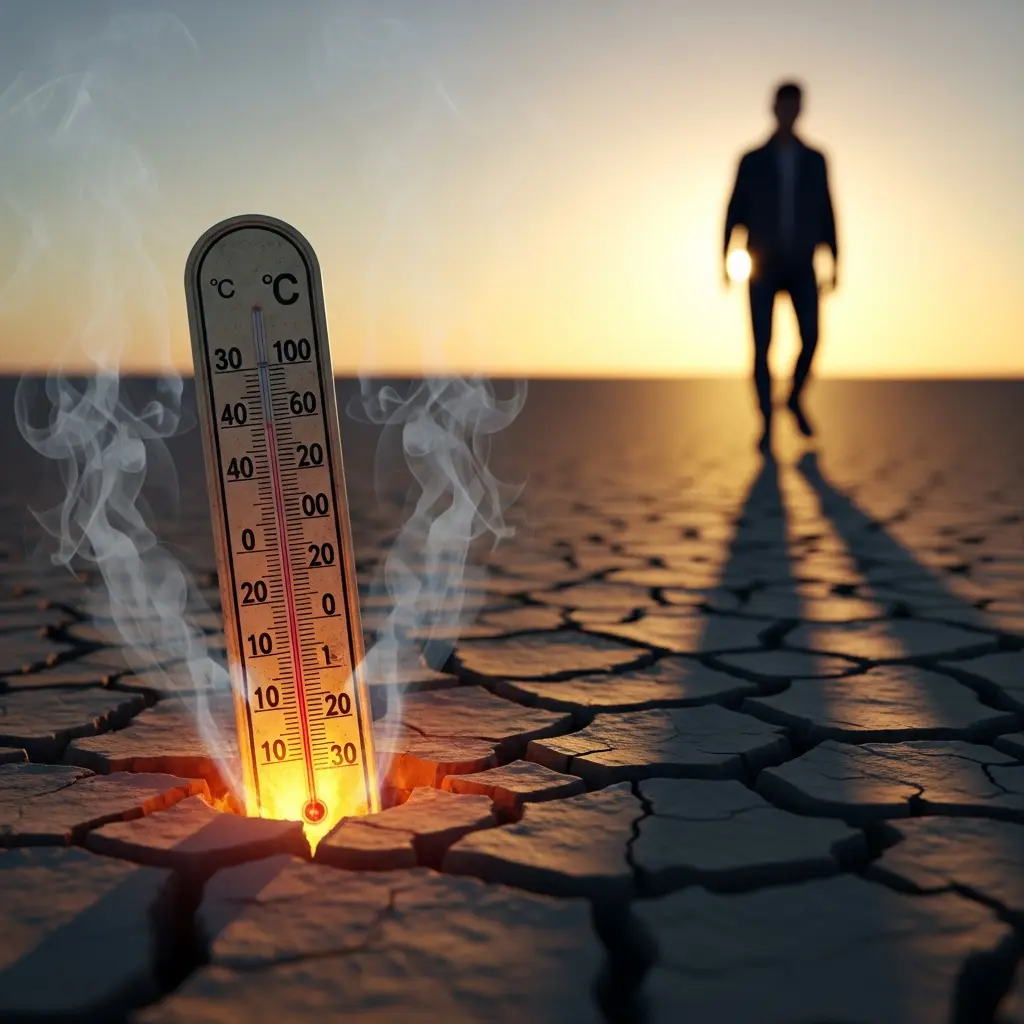
Records are not just being broken. They are being shattered. A planet-wide heatwave is forcing a reckoning with the slow, stubborn failure of climate action.
omewhere between the record temperatures scorching Southern Europe, the unprecedented wildfire seasons tearing through North America and Australia, and the flood-wrecked monsoons battering South Asia, a quiet consensus has hardened among climate scientists: we are no longer talking about a future problem. The global heatwave gripping the planet in 2026 is not an anomaly. It is an announcement. The climate emergency has arrived, and it looks exactly like what the data predicted — only faster, and hotter, than most people were willing to believe.
1.6°C above pre-industrial average — 2025 global mean temp
12 months of consecutive record-breaking heat globally
3.5B+ people exposed to extreme heat events in 2026
This is not just hot weather
There is a temptation to treat heatwaves as seasonal inconveniences — uncomfortable, certainly, but temporary. That framing is becoming harder to sustain. What climate scientists are documenting now is a structural shift in the planet’s thermal baseline. The extreme heat events of 2026 are not peaks on an otherwise normal curve. They are the new norm, compressing what used to be once-in-a-century events into cycles that repeat every few years. For hundreds of millions of people in tropical and subtropical regions, the outdoors is becoming genuinely dangerous for significant portions of the year.
The human cost is already staggering and largely undercounted. Heat-related deaths rarely make headlines the way earthquakes or floods do. They accumulate quietly — elderly people in apartments without air conditioning, agricultural workers in fields with no shade, urban residents in cities built from concrete and asphalt that trap heat long after the sun goes down. Public health researchers estimate that heat is already the deadliest form of extreme weather on Earth, and the current global heatwave is accelerating that toll at a rate that existing health infrastructure is struggling to absorb.
“We have spent decades debating the science. The science is no longer the question. The question now is whether our institutions can move as fast as the crisis demands — and so far, the answer is not encouraging.”
Why the climate emergency declaration matters
The language of climate emergency has moved from activist circles into the vocabulary of mainstream governance, and for good reason. An emergency framework changes the calculus of response. It authorizes faster decision-making, bypasses the glacial pace of normal legislative processes, and — critically — shifts the burden of proof. Instead of asking why we should act urgently, it asks why we should not.
Several nations and dozens of cities have already issued formal climate emergency declarations, but the gap between declaration and meaningful action remains vast. The declarations have not, in most cases, been followed by the kind of structural changes — in energy systems, in land use, in industrial policy — that would actually alter the trajectory of global warming. Words without policy teeth are just words, and the planet’s temperature does not respond to rhetoric.
Climate scientists warn that without urgent structural cuts to greenhouse gas emissions, average global temperatures could breach the 2°C threshold before 2040 — a level associated with catastrophic, largely irreversible changes to ecosystems and human habitability in large parts of the world.
Global warming solutions: what actually works
The conversation around global warming solutions has matured considerably in recent years. There is now a clear, evidence-backed hierarchy of interventions: deep, rapid decarbonization of energy systems is the irreplaceable core; everything else — carbon capture, adaptation measures, geoengineering proposals — is at best supplementary. Renewable energy deployment has scaled faster than most projections imagined. Solar and wind are now the cheapest sources of new electricity generation in most of the world. The economics have shifted decisively. What has not shifted sufficiently is the political will to phase out fossil fuels at the speed the physics demands.
At the same time, climate adaptation — designing cities, agriculture, and public health systems to cope with the heat that is already locked in — has moved from a secondary concern to an urgent parallel priority. Cooling centers, urban tree canopies, heat-resilient crop varieties, early warning systems: these are not concessions to defeat. They are the pragmatic acknowledgment that even the most aggressive mitigation scenario does not stop the warming that is already baked into the system. We must both fight the fire and build firebreaks at the same time.
The moment for half-measures has passed
What makes the current global heatwave different from previous climate inflection points is not just its severity. It is the accumulation of credibility that comes with being right, repeatedly, over decades. Climate scientists have been making these predictions since the 1980s. The models have been accurate. The tipping points they warned about are being crossed. And yet the response from the world’s largest economies remains stubbornly incremental — calibrated to political cycles rather than to the pace of atmospheric change.
The climate emergency is not coming. It is here, measured in heatstroke deaths and failed harvests and coastal cities spending billions on flood barriers that buy time rather than security. The question that matters now is not whether this is real — it is — but whether the institutions built in a more stable climate era can reimagine themselves fast enough to meet it. The Earth is not waiting for the answer.

