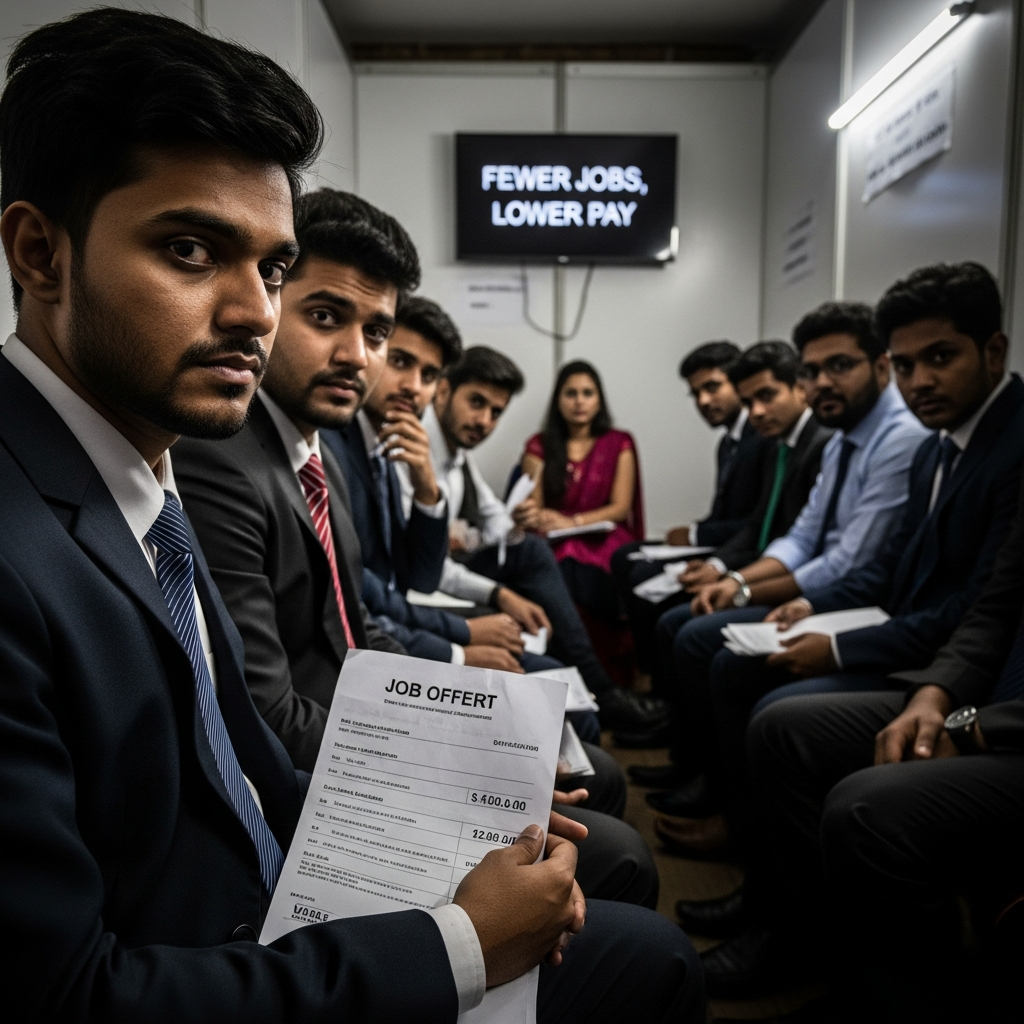
Across India’s campuses and recruitment portals, a quieter kind of crisis is unfolding — one measured not in layoffs but in lowered expectations, accepted compromises, and the slow recalibration of what a first job is supposed to look like.
alk into any campus placement cell at an Indian college this season and the mood is hard to read. There is relief — jobs are being offered, offers are being signed, parents are being called with good news. But underneath that relief, if you listen carefully, there is something else: a faint but persistent undercurrent of disappointment. The packages being discussed are lower than what the batch above received. The companies visiting are different — more cautious, more conditional, more transactional in their expectations. The fresher salary numbers that dominated the headlines a few years ago — those eye-catching figures from the boom years of tech hiring — now feel like artefacts from a different era. For this generation of graduates entering the job market India, the welcome mat is still out. It just looks a little different from what they were promised.
The shift in hiring dynamics is real, measurable, and rooted in a set of forces that neither graduates nor employers fully control. The post-pandemic years produced an extraordinary surge in hiring across sectors — technology especially — as companies scrambled to build capacity, expand teams, and capture the digital acceleration that the lockdowns had catalysed. Salaries rose sharply. Freshers in engineering and data science were offered packages that would have seemed implausible five years earlier. The expectations set during that period were genuinely distorted, and the correction that has followed — while painful for those on the receiving end — was, in retrospect, almost inevitable.
₹3.5L
Avg. starting salary for non-tech freshers in 2026
40%
Graduates reporting offers below expectations
2–3×
Rise in applicants per opening vs. 2022 levels
Employers, when pressed, are candid about the calculation they are making. Economic caution is the phrase most commonly used — a shorthand for the fact that many companies, particularly in technology and startups, are operating under investor pressure to demonstrate profitability rather than growth at all costs. The free-spending years of venture-fuelled expansion are over. Hiring managers now face headcount approvals that require justification, and the easiest lever to pull when justifying a new hire is cost. In this environment, fresher salary offers are often the first thing compressed, on the calculation that a candidate with no prior experience has less negotiating leverage than one with a few years behind them. It is not a flattering logic, but it is a real one.
“The market is not punishing this generation for being untalented. It is asking them to absorb the cost of a recalibration they had no part in creating.”
The skill mismatch argument — the one employers lean on most heavily when defending lower offers — deserves some honest scrutiny. There is truth in it: the economy is evolving rapidly, and the gap between what many undergraduate programmes teach and what the workplace now demands has genuinely widened. Artificial intelligence tools are reshaping roles that freshers were traditionally hired to fill, from entry-level coding tasks to basic data processing and content creation. Employers who are hiring for roles adjacent to these shifts are looking for fluency with new tools that many curricula have not yet caught up with. Candidates who walk in knowing how to work with AI-assisted development environments, or who can demonstrate applied skills rather than just theoretical knowledge, are finding themselves in a meaningfully different position from peers who cannot.
What Employers Say They Actually Want
Across surveys of Indian hiring managers in 2025–26, the most consistently cited gaps are not technical in the traditional sense. Communication skills, problem-solving under ambiguity, adaptability, and comfort with AI productivity tools rank above specialised technical knowledge for most non-engineering roles. For tech roles, hands-on project experience — even from personal or open-source work — consistently outweighs academic credentials in shortlisting decisions.
But blaming graduates for a structural mismatch that took years to develop — while simultaneously compressing their salaries — is a convenient framing that lets both employers and policymakers off the hook. The employment trends visible in India’s current hiring cycle are not primarily a story of unprepared candidates. They are a story about what happens when a generation plans its futures around a set of market conditions that the market then abruptly revises. The expectations were not unreasonable given the signals that were being sent. The frustration now being felt on campuses across the country is not entitlement — it is the rational response of people who did what they were told and are discovering that the rules changed mid-game.
There is, tucked inside all of this, a more hopeful reading — if one is willing to look for it. The Indian economy, for all its current caution, is not contracting. Sectors like manufacturing, logistics, green energy, and healthcare are hiring in ways that do not always make headlines but are creating genuine, durable employment at scale. The graduates entering the job market today are doing so in an economy that is, by most projections, on a long-term upward trajectory. The first pay cheque may be smaller than the dream. But for most of them, it will not be the last — and the ones who use this moment to build skills, demonstrate adaptability, and resist the temptation to wait for the perfect offer will, in all likelihood, be fine. Markets correct. Careers are long. This particular chapter, difficult as it feels, is not the whole story.
The First Pay Cheque Dream: India’s New Graduates are Settling for Less, And What It Really Means.